What AI search visibility is
AI search visibility is how often your business shows up in the answers AI assistants write when people ask a question you would want to be the answer to. Showing up means one of three things. The assistant names you. It links to your website as a source. Or it recommends you ahead of the others it mentions. The assistants in question are ChatGPT, Google's AI Overviews and AI Mode, Gemini, Claude and Perplexity.
Picture a store that sells aquarium plants. A customer wonders which plants are easy for a beginner, opens an assistant and asks. The assistant writes a short answer listing five plants and mentions two stores, with a link to each. If the store is one of those two, it has visibility for that question. If it is not, then for that person at that moment it did not exist, however good its plants are. Now multiply that by every question a customer asks before buying. Your visibility is the share of those chances you actually capture.
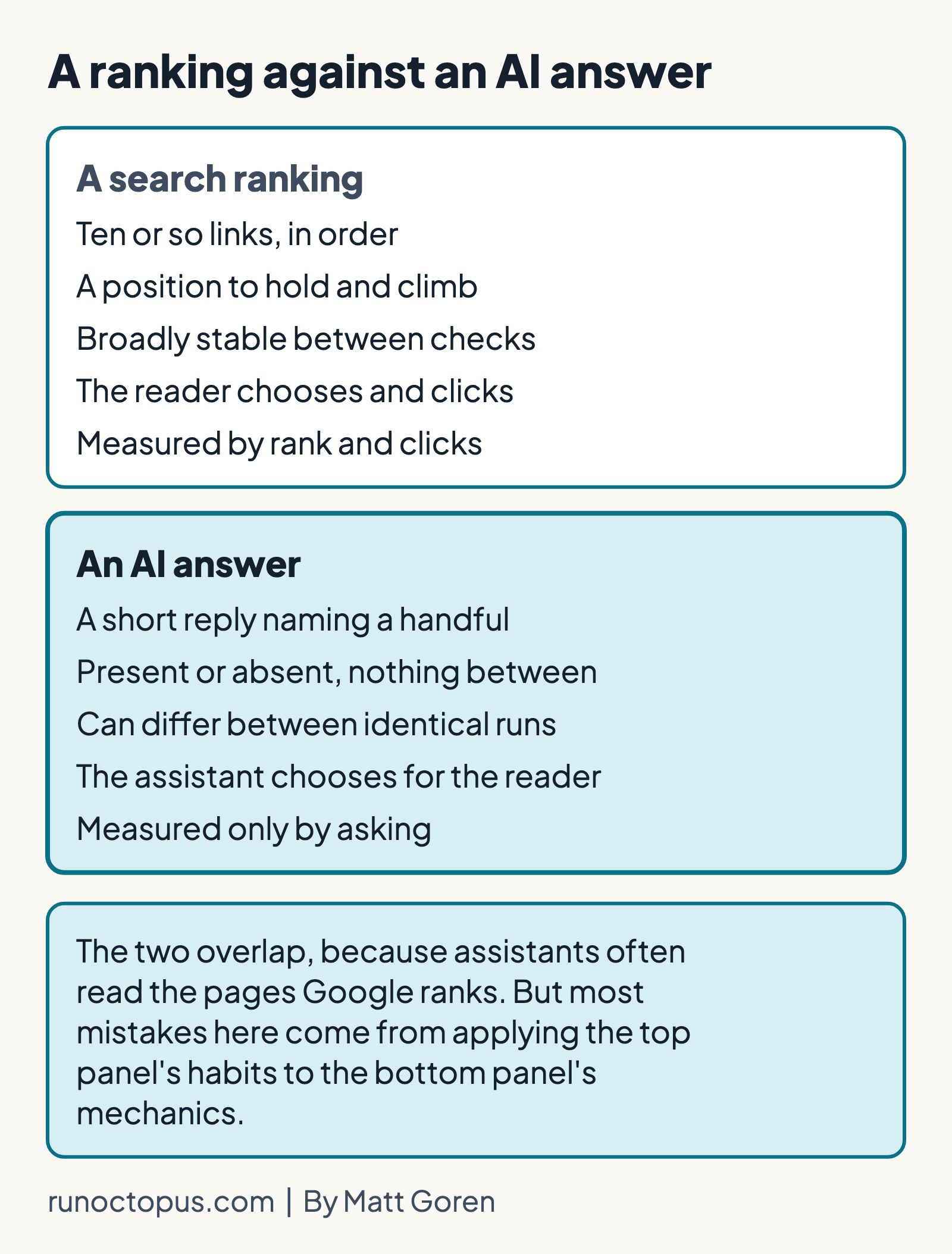
It is worth separating from two things it gets confused with. It is not ranking, because an assistant reads a handful of results and writes from them, so being eleventh is the same as being nowhere. And it is not traffic, because most people who read an AI answer do not click a citation. They take the name and act on it later, which arrives in your analytics as a direct visit or a branded search with nothing connecting it back. Nothing shows up in a dashboard to tell you about it, so it is a thing you have to go and measure on purpose.
AI visibility, LLM visibility, AI brand visibility: one idea, several names
The same idea gets sold under several labels. AI visibility is the general term. LLM visibility says the same thing from the technology side: an LLM, or large language model, is the kind of AI behind ChatGPT, Claude and Gemini, so LLM visibility means being named in the answers those models write. AI brand visibility and brand visibility in AI search put the brand at the center and usually stretch the idea to include how you are described once you are named. AI visibility optimization is the work of raising it. Every one of these asks the same question: are you in the answer?
The work has its own acronyms. GEO, generative engine optimization, is work aimed at being included in the answers generative models write. AEO, answer engine optimization, is the same aim stated for any system that gives direct answers. Our comparison of GEO, AEO and ordinary SEO sets out how much they really differ, which is less than the separate names suggest.
One more wrinkle catches people out. The same question asked of two different assistants can produce entirely different sets of brands, because they retrieve from different places and weigh what they find differently. So there is no single answer to whether you are visible in AI search. There are several answers, one per engine, and they can disagree sharply. A business can be a fixture in one and absent from another for months.
You are trying to be in the pages an assistant reads, and quotable once it reads them. Those are two separate jobs with two different timescales, and the rest of this page is about both.
Present or absent, not ranked
For any single answer, your name is either in it or it is not. There is no eleventh place, no gradual climb and no position to defend. That one property breaks most of the habits people carry over from ranking.
Under ranking, effort shows up early. Moving from twentieth to twelfth is real and reportable even though it brings almost no clicks. Here there is no partial credit for a single answer. You do a quarter of work and you are still absent, right up until you are not. That is harder to fund and harder to stay with, and it is the main reason programs in this area get abandoned two months in.
The partial credit that does exist is in frequency. Across many askings of many questions, your name appears some share of the time, and that share can move. It is the only continuous number available, and it is what any sensible measurement watches.
Use this image on your site
You may share this image with a credit link back to this page. Copy and paste the lines below.
<a href="https://www.runoctopus.com/ai-visibility/ai-search-visibility"><img src="https://www.runoctopus.com/img/diagrams/search-ranking-vs-ai-answer.png" alt="A ranking against an AI answer" width="800" height="1054"></a>
<p>Image: RunOctopus</p>
The answer is also short. A search page has room for ten results. An assistant often names three or four businesses. Being third in a list of ten is fine. Being sixth in a list of three is impossible, because there is no sixth place. And readers tend to treat the reply as an informed opinion rather than a set of links to weigh, so a name in the answer carries weight, and a missing name gives the reader no reason to look further.
None of this means search has stopped mattering. Google is still where a large number of buyers begin, and the pages that rank well are often the same pages assistants draw on. Search is changing, and a business needs to be findable in both places. The two overlap but they are not identical. A page can rank well and never be cited. A business can be named in assistant answers because of a forum thread or a review site, even when its own website ranks poorly.
Why the same question gives different answers
Anybody who tests this properly finds within an hour that asking twice can produce different names. The process is not deterministic. Two runs of an identical question can gather overlapping but different material and pick differently from it. That is a property of the system, not a fault in your test.
So a single reading is a sample, not a measurement. A business that asks once, sees a competitor named, and reorganizes a quarter around it has built a plan on one draw. Improvement works the same way. You are not switching yourself on. You are raising how often you come up. A question that names you three times in ten is telling you something quite different from one that names you never.
What it is not
It is not brand awareness. Being named is a mechanical outcome of being reachable, quotable and deep on a subject. A famous brand with a thin page on a subject regularly loses to an obscure specialist with a thorough one.
It is not a single score. A percentage is a summary of whichever questions somebody chose. Change the questions and it changes without anything about you changing. It is useful watched over time against a fixed set, and meaningless as a verdict. Our page on the AI visibility score covers what one number can and cannot carry.
It is not permanent. Answers vary between runs and assistants change over time. Visibility is a pattern you keep up, not a position you win once.
It is not a substitute for being good. Assistants describe what the world says about you. If the underlying business, reviews and information are weak, no amount of effort fixes that in the answer.
What actually happens when someone asks
The mechanism matters because it tells you which of your problems is real. Four steps, and each one is a place you can be filtered out.
The assistant decides whether to search. Timeless questions get answered from what the model already absorbed in training. Current, commercial or specific questions trigger a live search. Almost anything involving buying triggers one, which is good news, because it means the answer comes from pages rather than from whatever the model happened to learn about your industry two years ago.
It writes its own search query. Rarely the words the person typed. Somebody asking what to get their sister who has just started running produces searches like best running gifts and beginner runner gear. The page that gets pulled in answers the machine's query, not the human's question. This is the step almost nobody optimizes for.
It reads the top results. The first handful. Not page two. ChatGPT's search draws on Bing, Perplexity runs its own index and leans hard on live results, and Google AI Overviews sit directly on top of Google's own ranking. Either way, the same kind of ranking system that has always decided what is at the top still decides it.
It writes an answer and names sources. Pages containing a clear, self-contained, quotable claim get quoted. Brands that appear only as a logo, a widget that loads with JavaScript, or a vague claim in the middle of a paragraph tend not to.
Two separate failure points, then. Failing to be retrieved is an authority problem. Being retrieved and not quoted is a writing problem. They need different fixes, and most advice on this subject only addresses the second, which is why so much of it produces nothing for sites that have the first.
That mechanical fact reorganizes everything else. AI search visibility is not a way around search authority. It is search authority, read by a different reader one step removed. A page nothing links to and nothing ranks for does not get retrieved, so it does not get read, so it cannot be cited.
What decides who gets named
Nobody outside the AI companies knows the full recipe, and anyone who claims to is guessing. But the broad pattern is observable. Assistants name businesses they find stated plainly in sources they trust, and both halves of that sentence matter.
Sources they trust lean toward places you do not own. Community platforms such as Reddit, YouTube, Quora and forums turn up constantly in cited sources, because a thread where nine people argue about which product actually worked is exactly the kind of evidence an assistant wants, and those threads sit on domains with enormous authority. Established publishers come next. Specialist independent sites follow. A brand's own marketing pages come last, and are often skipped when a better source exists. Our guide to how LLMs choose their sources goes through this tier by tier.
Stated plainly means quotable. The brands that get named consistently tend to have a specific, checkable thing that is true about them. The brands that do not tend to describe themselves in the same words as everyone else in their category.
That tilts the field in a way many owners find surprising. A large brand with a big advertising budget does not automatically win. When we asked several assistants for local recommendations in two towns, local businesses filled most of the answers and the national chains mostly sat in the paid ads shown beside them. Our write-up of that field test has the category-by-category results. The common thread was outside voices, such as reviews, local guides and forums, describing a business for the exact job somebody asked about.
It follows that visibility is not a trick or a setting. It is mostly the by-product of being easy to describe accurately, in many places, in the words buyers use. Consistency matters for the same reason. If your site says you serve three counties, a directory says one and a social profile says none, the assistant will hedge, and a hedge rarely ends in a recommendation.
The authority half, which is slow
If your pages do not surface in the searches an assistant runs, nothing else on this page matters. This is the uncomfortable half because it does not respond to effort in the short term.
What decides whether you surface is the same thing that has always decided it: whether other sites reference you, how long your domain has existed, and whether you have real depth on the subject rather than one page about it. Topical authority is the useful concept here, and it is built by covering a subject thoroughly enough that a search engine treats you as a source on it rather than a page about it.
For a young site this is the binding constraint, and pretending otherwise wastes months. A domain that is a few months old with almost nothing linking to it will not appear in competitive retrieved results however good its pages are. That is not a judgment on the writing. It is how the system works, and the honest response is to build depth while borrowing reach from places that already have it.
The practical version: pick a narrow subject you can truly own, build a real topic cluster around it rather than scattering single pages across a broad category, and accept that this compounds over quarters rather than weeks. The mistake worth naming is publishing width instead of depth. Twenty pages on twenty loosely related subjects looks like a content program and behaves like twenty orphans. Five pages that fully answer one narrow question, cross-referencing each other, do considerably better.
Your own site still has a specific job even when most citations come from elsewhere. It is the corroboration: when an assistant meets your name in a thread and looks for supporting detail, your pages are what it finds. It is where the checkable facts about you live, in language plain enough to quote. And it is what compounds. Mentions elsewhere fade as threads age, while pages that answer real questions keep working.
The quotable half, which is fast
This half responds quickly, costs little, and is where most sites have easy ground.
Lead with the claim. An assistant writing a three-sentence answer is looking for a sentence it can lift. Put the answer in the first line of a section and support it afterward. A page that spends three paragraphs warming up gets skipped in favor of one that answers immediately.
Be specific enough to be checkable. Compare two versions of the same fact. "We pride ourselves on fast shipping" gives an assistant nothing. "Orders placed before 2pm ship the same day, and we refund the delivery cost on anything that misses its window" is a claim it can repeat and attribute. Specificity is what makes a sentence quotable.
Answer the question the page is named for. A page titled how to choose a filter for a 20 gallon tank should answer that in its first paragraph, not in section four after a history of aquarium filtration.
Say who you are for. Buyers ask for fit, such as the best option for a small budget or for an older home, so assistants look for fit. Pages that list products or services without saying who they suit leave the assistant nothing to match.
Structure so extraction is easy. Clear headings that describe what follows, short paragraphs, lists where a list is truly the shape of the answer, and FAQ markup on the questions. None of this is exotic. It is the same structure that makes a page readable by a person in a hurry.
A useful test before publishing anything: read your own page and try to find the one sentence an assistant would quote. If you cannot find it in ten seconds, neither will the machine, and the page will lose to one where the claim is sitting in plain view. The test works because it catches the most common problem in commercial writing, which is a page that circles a subject at length without ever committing to a statement somebody could disagree with.
Borrowing authority you do not have yet
Since the most-cited sources are other people's platforms, the fastest route for a business without much authority is to be genuinely present there. A comment in a relevant thread carries the platform's authority, not yours, which makes it the one route where being new costs you nothing. It is also the route most likely to go badly, so it is worth being precise.
Answer the question, and mention the product only when it is the answer. Communities are very good at spotting an account that exists to promote something. The pattern that works is a real person who knows the subject, answers things for free, and says what they make when it is directly relevant. The pattern that fails is an account that only ever posts links.
Be in threads that already rank. The threads an assistant cites are the ones that surface in search for category questions, and those already exist. Finding the ones that come up for your category and being useful in them is far more direct than starting new ones.
Know the downside. Moderators can and do ban a product's web address across a whole community, and that is hard to reverse. This is a slow, honest-participation channel or it is nothing.
The sensible plan for a young business is to borrow authority while building its own, not to pick one.
What does not work, and why it keeps getting recommended
A lot of AI visibility advice is technically true and practically useless, because it addresses a step that was never your bottleneck.
Adding schema to a page nothing retrieves. Schema markup helps a machine understand a page it has already fetched. It does nothing to get the page fetched. Worth having, not a strategy.
Writing more pages on a subject nobody asks about. Publishing volume feels like progress and produces nothing when the demand is not there. Measure the questions before writing the answers.
Repeating your brand name in your own copy. Assistants are not counting how often you say your own name. They are looking for a claim worth repeating.
Chasing broad questions you cannot reach. If a question is broad enough that Wikipedia, YouTube and a few enormous publishers own the retrieved set, adding a page to that pile changes nothing. Specific questions have thin competition, and that is where a smaller business can actually appear.
Writing in a supposed machine dialect. Pages padded with keyword lists or stiff question-and-answer filler read worse for people and give the assistant nothing more to quote.
Before doing anything on a list like this, ask which of the two failure points it fixes. If it does not help you get retrieved, and it does not make you more quotable once retrieved, it is not AI visibility work.
The check that takes ten minutes and blocks everything
Before either half matters, the AI crawlers have to be able to read your site, and a surprising share of sites block them without anyone having decided to.
The ones worth allowing are GPTBot and OAI-SearchBot for OpenAI, ClaudeBot for Anthropic, PerplexityBot for Perplexity, and Google-Extended for Google's AI surfaces. Blocking any of them removes you from that engine's answers entirely, however good your content is.
Three things cause it in practice. A robots.txt file that disallows unfamiliar agents by default, which is a common inherited setting. A content delivery network with bot protection turned up high enough to challenge them. And a site that builds its content with JavaScript, since several of these crawlers read the raw HTML and find an empty page. The robots.txt guide for AI crawlers walks the check crawler by crawler.
This belongs first because its outcome is binary and its fix is instant. A site can be fully open to Google and closed to the answer engines, which produces total absence with no other symptom. Everything else on this page is a matter of degree. This one is a gate.
Being named is not the finish line
Once you appear, the next question is what the assistant says about you. It helps to think of visibility as a ladder with three rungs, because the rungs are worth different amounts.
Known. The assistant has enough information to say what your business is, where it operates and what it does. Test it by asking about your business by name. If the answer is vague or wrong, the higher rungs are out of reach for now.
Included. When a buyer asks a general question with no name in it, you appear in the answer. This is the rung most people mean by visibility, and the hardest to reach, because you are competing with every other business the assistant could have named.
Chosen. You are named first, or the assistant says outright that you fit the situation described. This is where visibility starts to look like sales.
Inside an answer, you can show up as a bare name in a list, as a description of what you do and who you serve, or in a comparison that sets you beside others and draws a distinction. A comparison is where choices are made. Being on the favorable side of one is worth more than a dozen bare mentions, and being on the unfavorable side is worth knowing about at once.
So copy every sentence that mentions you into one document and read them together. Five checks cover most of what matters:
- Is it accurate? Wrong facts are the most fixable problem, because they usually trace to one outdated page or listing.
- Is it specific? "A reputable provider" says nothing. "A family-run firm that handles older homes" says something. Vague wording usually means the assistant has little to go on.
- Whose words are they? If the phrase sounds like your marketing copy, the assistant is leaning on your site. If it sounds like a customer, it is leaning on reviews. The voice tells you where your reputation is being built.
- What are you compared with? Words like cheaper, larger or more traditional put you on a scale. Ask whether that is the position you want.
- What is missing? The thing you are proudest of may not appear anywhere. Either you have not said it clearly, or nobody else has.
Take an imagined example. A buyer asks where to get a mattress that suits a bad back, and the answer says "Hartley Beds is a long-established local retailer with a wide range, though some reviewers mention higher prices." It is accurate, but barely specific, nothing in it speaks to bad backs, and the only contrast drawn is price, in the voice of reviewers. Everything the store knows about back support, from its fitting service to its trial period, is missing. The actions follow straight from that one sentence: a plain page on choosing a mattress for back pain, the fitting service described the same way on every listing, and an honest answer on the site to the price point reviewers raise.
When the wording is unfavorable, ask first whether it is true. If it is, it is a business matter before it is a visibility matter. If it is untrue or dated, find the source, often a single old review or listing that keeps getting repeated, and correct what you control or publish a clear, current page that gives the assistant a better source. Never scrub real reviews or write fake ones. Assistants lean on the same sources your buyers do. Watching this wording over time, across several assistants, is the job of AI brand monitoring.
How to measure it
Because the traffic signal is unreliable, you have to measure the thing directly, and the discipline matters more than the tooling.
Ask buyer questions, not brand questions. Asking an assistant about your brand tells you what it knows about you. Asking what to buy tells you whether you exist at the moment of decision. Only the second is visibility.
Use the same set every time. Write around twenty questions in a buyer's words and freeze them. Changing the wording restarts your history, so write them carefully once and keep the original somewhere separate. The questions are the hard part, and only you can write them, because only you know what your buyers ask before they choose.
Ask each question more than once, and find your noise floor. Run the whole set twice in one afternoon and see how much it moves on its own. Any change smaller than that gap carries no information, and most people are surprised how large it is.
Check at least two engines. They disagree constantly and the disagreement is informative. Present in Perplexity and absent from ChatGPT points at a different problem from absent everywhere.
Record who else gets named. An absolute number means little on its own. Being named in four answers out of twenty is good or bad depending on what everyone else in your category managed. Counting every brand across every answer turns a pass or fail into a map of your category, and it reframes the work: you are not raising a number, you are trying to join a short list that already exists. A question where the same incumbent is named every time is a hard fight. A question where the names change from run to run is one where nothing has settled and a good page can still change the outcome. You will rarely displace the default name in a category, but becoming the second or third name is where most of the available ground is.
Read the answers, not only the tally. Being named dismissively and being recommended both count as present, and only one of them is worth anything. Once a month, read the full text of a handful of answers.
Track three groups of questions separately. Questions that name you directly move first, coming back accurate rather than empty or garbled. Specific long-tail questions that match pages you rewrote move next, because fewer sources address them. The broad category question with the most obvious phrasing moves last, if at all. A single average across all three hides which of your changes mattered.
You can run all of this by hand in a logged-out browser window. Our guide to running an AI visibility check shows how to do it properly the first time, and the comparison of AI visibility tools covers what the paid trackers automate once a manual check stops scaling. Whatever you use, take the first reading before you change anything. It is the step most often skipped and the only one that cannot be rebuilt later.
How long any of it takes
Different engines move on different timescales, and knowing which is which prevents a lot of premature despair.
Perplexity is the fastest. It retrieves live and leans heavily on current results, so a new page or a new mention can show up in its answers within days of being indexed. If you want early evidence that something is working, look here first.
ChatGPT is slower. Retrieval-driven change tends to appear over roughly ten to fourteen weeks. Anything that lives in what the model itself absorbed only changes when the model does, which is not on your schedule.
Google AI Overviews move with Google. They sit on top of ordinary rankings, so they shift when your rankings shift, which for a young site is measured in months. Our guide on how to rank in AI Overviews covers that surface on its own.
There is a second lag underneath the first. Before an engine can retrieve your page, a search index has to have crawled and stored it, and for a young site that alone can take weeks. So the sequence is publish, wait to be indexed, wait to rank well enough to be in the handful an assistant reads, and only then appear in an answer. Three waits stacked on top of each other. Track the earlier stages too, because indexing moving is the first honest sign that anything is happening.
The reasonable expectation is a shift over one to two quarters of consistent work rather than a step change. That is worth saying plainly at the start, because the most common way this work gets abandoned is somebody checking after three weeks, seeing nothing, and concluding it does not work. Decide before you begin what result would count. Being named more often across questions your buyers actually ask is the outcome. Traffic is not what this produces, and a program judged on traffic will look like a failure even when it is working.
Who this pays off for, and who should skip it
Not every business should spend a quarter on this, and it is worth knowing which side of the line you are on.
It pays off when the buying decision involves a recommendation. If people ask other people what to buy, they now ask assistants too. Anything considered, comparative or unfamiliar sits squarely here: a first aquarium, a contractor for a job you have never hired for, software for a task you have never done.
It pays off for specialists. Depth on one subject is the deciding factor, so a business that truly knows one narrow thing is better placed than a larger one covering everything moderately. Local and specialist businesses often do well, because the questions are specific and the sources about them are close at hand.
It pays off when you can say something only you can say. If your pages contain nothing that could not appear on a competitor's site, no amount of technical work opens the quoting step.
It pays off less when the purchase is habitual or price-driven. Nobody asks an assistant which brand of trash bags to buy. If your category is bought on reflex or on the lowest number, the recommendation moment barely exists. The same goes if you need attributable traffic this quarter. Those are fair reasons to spend the money elsewhere.
A realistic order to work in
The order matters more than the list, because doing these out of sequence wastes the most time.
Week one: the crawler check, then the questions. Confirm GPTBot, OAI-SearchBot, ClaudeBot, PerplexityBot and Google-Extended can read you. Then write the twenty buyer questions. They become your measurement set and your content plan at the same time.
Week two: take the baseline. Put every question to two or three assistants, more than once, and record every brand named. Without a baseline you cannot tell later whether anything moved, and a baseline rebuilt from memory produces a number nobody trusts.
Weeks three to eight: fix quotability on the pages you already have. For every question where a competitor is named and you are not, look at what the assistant read, and whether you have a page that answers the question in its first paragraph. Usually the page exists and buries the answer, or says nothing specific.
Weeks three to twelve, in parallel: build somewhere you can be found. Depth on a narrow subject on your own site, and honest presence in the threads and videos that already get cited for your category. Both are slow, which is exactly why they start early rather than after the fast work is done.
Week twelve: re-run the identical question set. Same wording, same engines. Compare against the baseline. Expect movement in Perplexity first and less in ChatGPT, because that is the shape of it.
AI search visibility is how often you are named in the answers assistants write, measured by asking, not by watching traffic. It rests on two jobs with two clocks. Being quotable is fast and most sites have room there. Being retrievable is slow and is usually the real constraint. Work out which one is stopping you before spending a quarter on the other.