Get your brokerage and every agent in it named by ChatGPT and Google AI.
In 6 of 6 AI answers to "which brokerage should a new agent join?" in three Florida towns, one brokerage was named first. See the answers
When someone asks AI which agent or broker to call, let it be you. Buyers, sellers and agents now ask ChatGPT and Google's AI, and each answer names two or three. RunOctopus writes and publishes the pages on your website that those answers are built from, and every month shows you, with dated screenshots, who the AI named.
Run my free scanAdams, Cameron & Co. is a brokerage whose recruiting site we write. One run, one day, names as printed.
Nobody picks a brokerage, a listing agent or a property manager on a whim. They ask around first. For years "asking around" meant friends, Zillow reviews and ten blue links on Google. Now a lot of it starts with one typed question: "Who's the best listing agent in Ormond Beach for a waterfront home?"
The AI reads what it can find, then answers in a paragraph. It names two or three businesses, says why, and the person calls one of them. If your name isn't in that paragraph, you weren't in the running. Many brokerages have never checked whether they are.
This page explains how those answers get made for real estate, what we saw when we checked real ones, and exactly what RunOctopus does about it.
It helps to know what happens in the few seconds between the question and the answer, because every part of our work aims at one of these steps.
The AI doesn't know your brokerage. It searches, the way you would, then reads the pages it finds: your site, review sites, local news, Reddit threads, comparison pages others wrote. It then writes an answer from what those pages say, and it leans hardest on the pages that answer the exact question asked.
That last part is the opening. A national franchise has a famous name, but it rarely has a page that answers "best brokerage for new agents in DeLand who want non-competing managers." A local brokerage can have that page. When we tested this in Richmond, Virginia and DeLand, Florida in October 2026, the AI answers for local services named zero national chains in coffee, pizza and AC repair. The chains showed up in the paid ads beside the answer instead. One day, two cities, so we say it as an observation, not a law. But it matches everything we see in real estate.
So the job is not "be bigger." It's: be the business with the clearest, most specific, most vouched-for answer to each question your buyers ask.
When we read hundreds of AI answers about local businesses, the same five things kept showing up in the businesses that got named. None of them is "spend more on ads." All of them are things a brokerage can put on its own website.
The pages AI picks answer one exact question, in the first lines, with facts only you can give.
A page titled for the town, the home type and the worry. "Selling a waterfront home in Ormond Beach" beats "Our listings" every time.
The AI quotes the sentence that answers the question. If the answer is in paragraph six, it quotes someone else's paragraph one.
How your managers work, how many agents you train a year, which neighborhoods you sold in. Specific beats polished.
Reviews, local press, comparison pages and forum threads that mention you. The AI trusts what others say more than what you say.
The same name, address, logo and phone everywhere, so the AI is sure all those mentions are the same business.
A market page from 2023 tells the AI you stopped paying attention. Dated, refreshed pages read as alive.
Signal 4 is the one people underestimate. In Google's own answer about DeLand, the sources it showed included a third-party comparison site, not just the brokerages' homepages. That's why our work doesn't stop at your site: we also make sure the pages others write about your market have something true and specific about you to repeat.
Three kinds of people ask AI about residential real estate, and each one is a different customer for you. A brokerage that only writes for buyers misses the sellers who list and the agents it wants to recruit.
Sample These are the kinds of questions we build pages for. On your account, every question comes from your own Search Console, your own towns and what people in your market really ask, and you see the list before we check it.
Three people ask three different questions. Write for all three, not just buyers.
"Which agent in Port Orange knows 55+ communities and can show homes on weekends?"
"Is it worth using a buyer's agent for new construction in Deltona?"
"Who sells the most waterfront homes in Ormond Beach, and what do they charge?"
"How long do homes take to sell in DeLand right now, and which brokerage sells fastest?"
"Best real estate agency to work for in DeLand for a brand-new agent who needs training"
"Which Volusia County brokerage has managers who don't compete with their own agents?"
Notice how long these are. That's normal for AI. People type to it the way they'd talk to a friend who knows the market, with the town, the type of home and the thing they're worried about all in one sentence. The short, famous searches ("realtor near me") are owned by the portals and the franchises. The long ones are wide open, and they're the ones where someone is ready to call.
These are untouched phone screenshots of Google, taken October 20, 2026, for the question "best real estate agency to work for in DeLand" (DeLand, Florida). One question, one day: AI answers change, so we re-check monthly. Adams, Cameron & Co. is a 300-agent brokerage in Volusia and Flagler counties. Its recruiting site, floridarealtorcareers.com, is one we write and publish for.
Google's own AI named a brokerage we write for "the top choice overall," ahead of a national franchise.
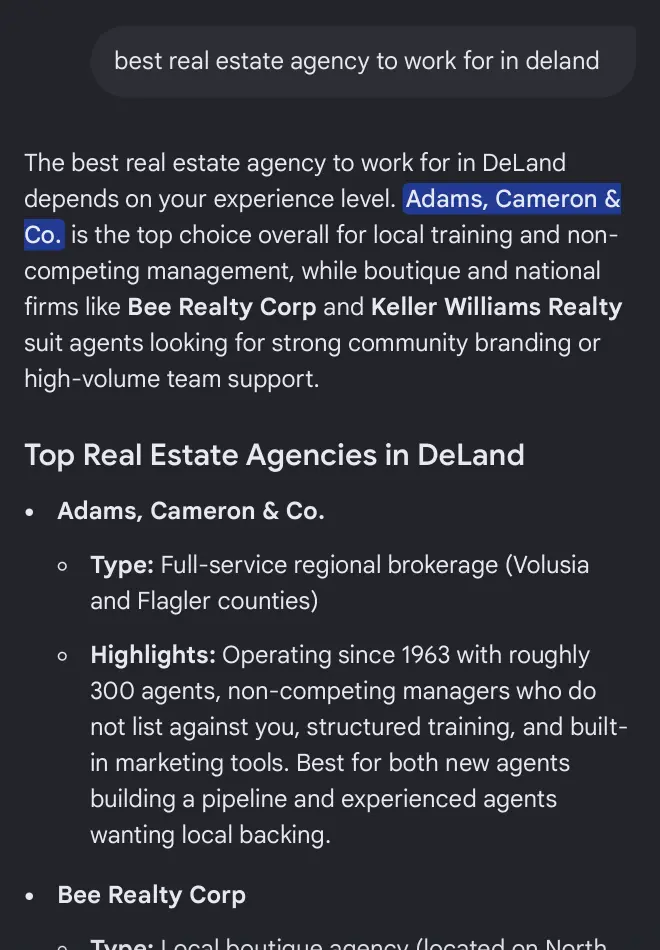
Named first and called "the top choice overall," with the reasons pulled from its own pages: training, and managers who don't list against their agents.
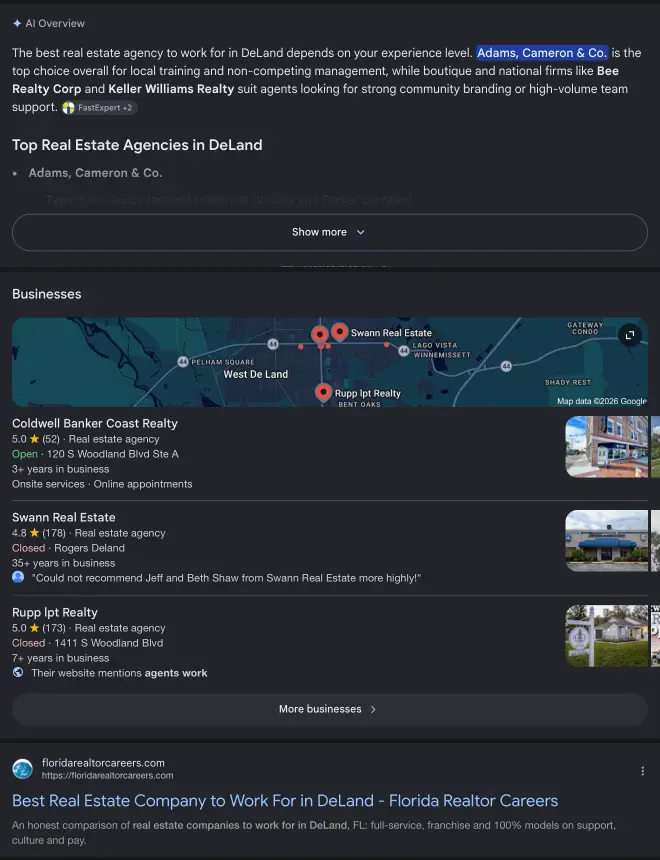
The same answer in the regular Google results, and the recruiting site is the first ordinary result under the map.
The recruiting site had nine pages when we started. Here is what 16 weeks of Google's own Search Console data shows, with the misses left in.
What this does and doesn't prove. It proves a brokerage's own pages can become the source Google's AI quotes, in a town where national franchises compete. It doesn't promise your result: one brokerage, one market, and AI answers change week to week. That's why we check them every month and show you the dated screenshot, good or bad.
On October 22, 2026 we asked both AIs the same nine questions in DeLand, Ormond Beach and Port Orange, Florida: one from a first-time buyer, one from a seller, one from a new agent choosing a brokerage. Here is what came back, with the misses left in.
AI quotes the pages we wrote for agents. Buyer and seller answers still name individual agents.
| Question | Who led | Adams Cameron |
|---|---|---|
| New agent: which brokerage trains best? | A brokerage, named first by both AIs in all three towns | Named first, 6 of 6 |
| Seller: who is the best listing agent? | Individual agents and small local teams | An agent named in 3 of 6 |
| Buyer: which agency for a first home? | Individual agents and small local teams | Named in 2 of 6 |
First name in each answer. Logged-out ChatGPT and signed-in Google AI Mode, October 22, 2026, one run each.
What this means for you. The questions agents ask before they switch brokerages are the ones where pages we wrote are being quoted. Buyer and seller questions were answered with individual agents and small teams, which tells us what to write for those next: pages that make each agent and each town easy for an AI to tell apart. The AIs also did not lead with a national brand for most buyer and seller questions, though a franchise team led one of them.
You don't write anything and you don't approve anything. Our AI agent, Ollie, does the research and the writing, our team checks it, and it goes live on your site. Here's the order it happens in.
You write nothing. We find the questions, write and publish the pages, then check every month.
We read your Search Console, your towns, your reviews and your competitors' pages, and list the questions your buyers, sellers and recruits ask.
We ask ChatGPT and Google's AI those questions and save dated screenshots, so you see exactly who gets named now.
One page per question: the neighborhood, the home type, the worry. Specific facts about how you work, never filler.
Each page goes live with its FAQ, links to your related pages and a correct Google listing, then we load it to confirm.
We re-run the same questions and show you who's named now, next to the screenshot from before.
Your name, logo and listings in Google cleaned up, so the AI reads the right business.
Of the three kinds of questions, recruiting is usually the least crowded. Buyers' questions compete with Zillow and the national portals. Agents' questions ("best brokerage to work for in DeLand", "which brokerage has the best training in Volusia County") mostly compete with a few franchise career pages that say the same thing in every city. A local brokerage that explains its training, splits, culture and managers in plain detail has very little competition for those answers. That's exactly what happened in DeLand.
An owner asking "who should manage my vacation rental in New Smyrna Beach" wants fees, how guests are screened, and what happens when the AC breaks at midnight. A business asking about office space wants square footage ranges, lease terms and parking. Those answers rarely exist on property managers' and commercial brokers' sites, which is why the AI so often falls back to directories. Each one is a page we can write.
Here is the shape of a page we'd write for a brokerage. The details change for every town and question, but the parts don't.
The title is the question. Written the way a person would type it, with the town in it. Not "Join Our Team" but "Best brokerage in DeLand for new agents who want training."
The answer comes first. Two or three sentences that answer the question straight, so the AI has a clean line to quote. The rest of the page backs it up.
Then the proof. Facts a reader can check: how many agents, what the training covers, which neighborhoods, what managers do and don't do. A short table if the question compares options.
Then the questions that come next. A real FAQ, written from the follow-up questions people ask. Google reads these, and so does every AI that reads Google.
Then the paths. Links to the next pages that reader needs: the town page, the commission page, the "how to switch brokerages" page. That's how one good page lifts the ones around it.
Brokers have been burned by agencies that take a quarter to show anything. So here is the first week, and what you can see each day. You do not write or approve anything along the way.
Google usually takes a few weeks to show new pages, as the chart above shows, so the first week is about getting the right pages live and your starting answers saved. The monthly re-check is where you see whether the AI's answer has moved.
Real estate owners have been burned by marketing that takes six months to "start working." So here is exactly what happens in the first four weeks, and what you'll be able to see each week.
The first pages go live in week one. Google usually takes a few weeks to show them, as the chart above shows, so the first month is about getting the right pages up and the right questions checked. The monthly re-check is where you see whether the AI's answer has moved.
Everything we publish is recorded in your RunOctopus account: each page, the day it went live, and the questions it was written for. You can open it any time. You'll never have to ask what we did.
A brokerage is two businesses at once: the company, and the agents who carry its name. We can work on both, under one plan. And the second half is also a recruiting pitch: an agent deciding where to hang a license wants to join the brokerage the AI names, and wants a page of their own the AI can name too.
You probably do, and for many brokerages it still works. The difference is what you are buying. A portal lead is a person on someone else's site who was shown several agents at once. Your name shows up there because you paid for the slot, and the portal keeps the relationship.
An AI answer is different. It names two or three businesses with a reason, and the person then goes to that business's own website or phone. Nobody sells that slot. It goes to the businesses whose pages and outside mentions answer the question best, and that is the one place a local brokerage can still beat the national names.
We are not asking you to cancel anything. We are asking whether you also want to be the name in the answer.
| Portal lead | Named in AI answer | |
|---|---|---|
| Who owns the page | The portal | You |
| How you get the slot | You pay per lead or per zip | Your pages answer the question best |
| Who else is shown | Several agents at once | Two or three businesses, with reasons |
| Stops when you stop paying? | Yes | The pages stay on your site |
We do not promise a result, because AI answers change and no one controls them. What we can do is show you the math you will run in your head anyway. Put in what one closed sale earns your office.
Sample The numbers below are an example. Use your own average commission to your side of one sale.
Then compare that to what you spend on leads today and what an agency costs. If one extra sale a year does not cover it, this is not for you, and we will say so on the call. We do not claim a number of sales, because we have no honest way to know yours in advance.
Ask any provider what it checks. Ours is the same question set every month, in ChatGPT and Google AI, with dated screenshots of who was named. You see the answer, not a score.
They do not need one. Each agent gets pages under your brokerage for their towns and home types, so the AI can tell them apart, and you see every agent's pages in one login.
You write nothing and approve nothing. Anything we publish is on your site and recorded in your account, so you can read it any time.
Searching has changed before and people still need an answer. AI answers are built from pages like the ones we write, so useful pages on your own site keep their value whichever engine reads them.
Pages describe homes, towns, prices and what you do, never who should live where. You can read every page before and after it goes live.
Then the guarantee above applies, and you keep every page. The monthly check also tells us early which questions are not moving, so we change the pages instead of waiting.
Each kind of real estate business gets asked different questions. Pick yours for the questions, mistakes and plan that fit it.
Most brokerages already pay for something. Here's what each one does about AI answers, in plain terms.
| Option | What it does | AI answers |
|---|---|---|
| Portal ads (Zillow, Realtor.com) | Buys leads on someone else's site | Not your site, so not your name in the answer |
| Franchise marketing | Promotes the national brand | Helps the brand, rarely your office or town |
| A website builder or IDX site | Shows listings | Listings change daily, so there is nothing for the AI to quote about you |
| An SEO agency | Reports, some posts, monthly calls | Sometimes, often not checked |
| RunOctopus | Writes, publishes and checks a page per question, every week | Checked monthly, screenshots shown |
Yes. Google now puts an AI answer above the regular results for many real estate searches, and ChatGPT answers questions like which brokerage to join or which agent to call. The businesses named in that answer get the first call.
It can. In one check in DeLand, Florida on October 20, 2026, Google's AI named Adams, Cameron & Co. the top choice overall to work for, ahead of Keller Williams. The AI tends to name the business that independent sources and detailed pages vouch for, not the biggest brand.
No. We research the questions, write the pages in your voice, publish them and check them live. You can read everything, but nothing waits on you.
On the Florida recruiting site, most weekly batches had shown up in Google within four to six weeks. Clicks came later and were uneven: half of all clicks came from 20 pages.
Yes. A brokerage can cover its own site and also give each agent pages for the neighborhoods and homes they sell, under one plan.
It's built on the same work: useful pages that answer real searches. The difference is what we aim at and check. We aim at the long questions people type into ChatGPT and Google's AI, and every month we look at what those AIs actually say about you.
Listings come and go too fast to build on. We write pages about the agents, the towns and the kinds of homes they sell, which stay useful long after a listing closes.
Both. The brokerage gets pages for its towns, its recruiting and its sellers. Each agent can also get pages for the neighborhoods and homes they sell, under one plan and one login.
An IDX site shows listings, which change daily and read the same on every competitor's site. We write pages about your towns, how you work and the questions people ask, which stay useful and give the AI something specific to quote.
A ranking, a number of leads, or a place in any one AI answer. AI answers change week to week. We promise to put the right pages on your site, to check the answers every month and show you the screenshots, and to refund you if your Google appearances are not up after 90 days.
Access to your website and Google Search Console, the towns you cover, and anything that makes you different. We look up the rest ourselves.
One more honest note on size: on the Florida recruiting site, a typical page earns well under one click a month at first, and half of all clicks came from 20 pages. The work is to build the pages that answer real questions well, and to check each month which ones the AI now trusts.
The pieces behind this page, in plain words.
Every number from the proof section, with the misses left in.
AI Search for a Local BusinessHow AI picks a local business, step by step.
What AI Search Visibility MeansThe idea behind being named in an answer.
RunOctopus Compared with an SEO AgencySide by side, in plain terms.
The Answer-Engine PlaybookPart of the Search Playbook, our library of guides.
The Search PlaybookAll the guides, in one place.

We research the questions, write and publish the pages, check every one, and show you each month who the AI named. If your Google numbers are not up at 90 days, you get your money back and keep every page.
Click Here to Start with the Free Scan →How the 90-day promise works: we compare how often your site is shown in Google in the 90 days after your first page goes live against the 90 days before. It covers how often Google shows your site, not a particular ranking or a spot in a particular AI answer, because nobody can promise those. The price you start at is the price you keep, even when it goes up for new customers.
Type your website. The free scan shows what AI can and can't read, and which pages you're missing.
Run my free scan