If you read nothing else
- 727 pages added to a recruiting site, June 25 to September 22, 2026.
- 530 of them (73%) have appeared in Google. 307 (42%) have had at least one week at position 10 or better.
- 241 clicks to those pages in 16 weeks. That is small, and this page says so before you do.
- Half of all clicks came from 20 pages. 419 of the 530 pages that appeared have earned no clicks at all.
- On a clean phone check on October 13, the site showed on three of the four broad recruiting searches we set as the goal (positions 6, 2 and 1), against none on June 26. Search Console shows almost nobody types those exact sentences. The win is real, and it is small.
1. The result, in sixty words
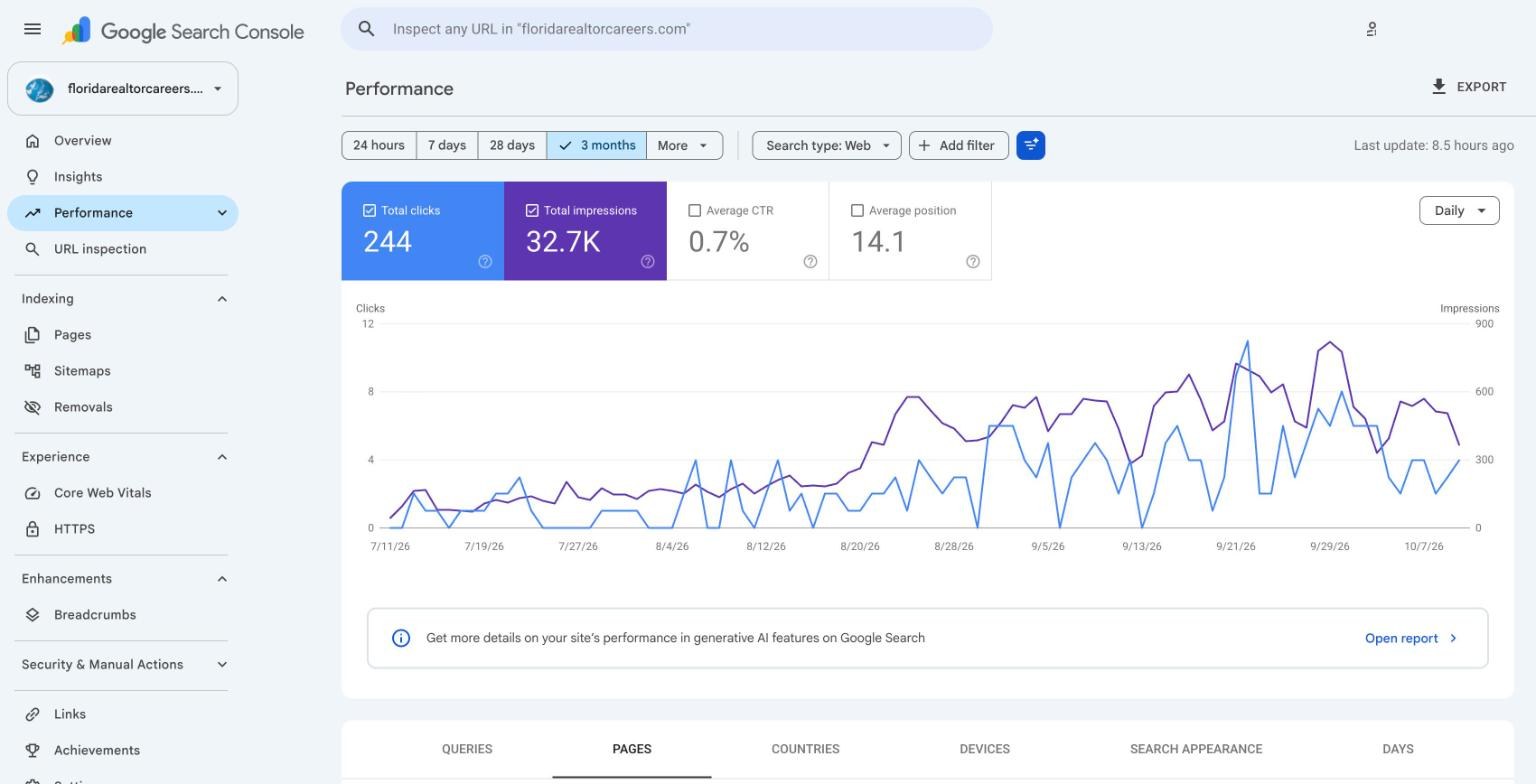
Between June 17 and October 10, 2026, floridarealtorcareers.com went from no measured search presence to 250 clicks and about 35,000 impressions across more than 1,100 searches. Monthly clicks rose from 2 in June to 130 in September. On a clean phone check on October 13 it appeared for three of the four broad "which brokerage should I join" searches it was built to win, though almost nobody types those exact sentences.
2. June 26
On June 26, 2026, the day before the first fourteen pages went live, we asked four questions a licensed agent weighing a move might type:
- best real estate brokerage to join in Volusia County
- how to become a real estate agent in Daytona Beach
- best real estate company to work for in Daytona Beach
- best brokerage for experienced agents in Volusia and Flagler
The brokerage's careers site appeared in none of them. For the third question, the brokerage itself was named, but only because two review sites, Zippia and Glassdoor, said so. The pages that were supposed to recruit for it were nowhere on the page.
The winners were directories (FastExpert, Yelp, Redfin, HomeLight, RateMyAgent), a licensing school, and one direct rival, a national franchise office in the same city.
That list is the starting line. One caveat belongs next to it: that check was a single run of one tool on one day. We could not reproduce it, and section 10 explains why later checks disagreed with it.
Everything below is measured against it.
3. Who this is, and the question this page answers
The client is a real estate brokerage founded in 1963 that works Volusia and Flagler counties on Florida's east coast, with around three hundred agents.
The site is floridarealtorcareers.com, a separate domain from the brokerage's main site. It existed before we arrived. It was a handful of pages when we started: nine, uploaded on May 19.
The goal was recruiting: get licensed and experienced agents to find the brokerage while they were deciding where to work. Clicks are a stand-in for that. Whether any of the people arriving applied is not something we measure, and section 11 says what that means for how much weight the numbers deserve.
The question: can a young recruiting site, with no authority of its own, earn a real place in Google and in AI answers for a hard, competitive subject, and how long does it take?
3b. The field this sits in
How the subject works. A Florida real estate licence is a time-limited permission, and holding one is a continuing obligation: it has to be renewed on a fixed cycle, kept active, and attached to a sponsoring broker to be used at all. A great many of the questions agents search are about exactly those obligations: transferring to a new broker, what it costs to keep a licence active, what happens to pending deals when you leave. Each of those is a question with a precise, checkable answer, which is what makes the subject a good fit for pages that answer one question completely.
A hypothesis worth testing. The renewal page was shown a great deal and earned no clicks, then moved from the 50s to position 17 in the week of September 21. A renewal deadline falls at the end of September. A page about renewing would plausibly gain visibility as a deadline nears. We have not tested that. It is a hypothesis, and we will look at the same weeks around the next deadline.
How people look for a brokerage. A licensed agent deciding where to work searches in whole questions, and starts with the rules and the money before it ever reaches a brokerage's name: can I transfer, what happens to my listings, what does it cost. A careers page that only says "join us" meets the reader after those questions have been answered somewhere else.
The competition, as seen in public. Three kinds of site took the searches we set out to win: directories and review sites. Licensing schools. And other brokerages. By September 10, two brokerages had appeared that were not in the June baseline. One publishes county-by-county comparison content. Another has a careers page that now ranks for the experienced-agent search. We are describing what is visible to anyone, and not naming them.
What an outcome is worth. The value of a recruited agent to a brokerage is a number the client knows and we do not. Without it, nothing on this page can be turned into a return, and we say so.
4. What we were up against
A case study that only shows the finish line hides how steep the start was. These are the conditions we began with.
The site was new, and standing on its own
The careers site had been a handful of pages for weeks. It had no history of being read, linked to or cited. It sat on its own domain, so none of the brokerage's 63 years of reputation, four chamber memberships and association standing passed to it automatically. It had a single link from the main site in an archived copy from January, and that link now points to a page on the main site instead.
There was no traffic baseline
Search Console's history for this property begins on June 17, 2026. Its comparison view reads "previous period: 0" for every metric. That zero means the property was not being measured, not that traffic was zero. We cannot say "from zero". We can say what happened from the first day of measurement, and we can say what the four searches looked like the day before the work went live.
The searches that matter most are the ones heavy sites own
A recruiter-style search like "best brokerage to join in Volusia County" is answered by directories with many thousands of links and by franchise offices with national brands. The subject is also what search engines treat as higher stakes: licensing, money and a person's career. Pages on it are held to a higher bar for accuracy.
The platform could not be changed from outside
The site is a static site on the client's own hosting account. We could add pages. We could not change how the site was served or what was injected into it. That matters later, when a tracking tag turns out not to have been loading.
The field moved while we worked
By September 10, two competitors had appeared that were not in the June baseline: a brokerage publishing county-by-county comparison content, and another brokerage's careers page ranking for the experienced-agent search. Both used an approach that looked a lot like ours.
What we had going for us
The brokerage was a real, long-standing business with a real local reputation that third parties wrote about. That is why Zippia and Glassdoor named it. Recruiting questions were poorly served: for one of the searches, the AI answer itself noted it "may not capture all options for agents seeking a brokerage to join". There was room.
5. What was shipped
Counts by kind and date only.
- May 19: nine original pages, uploaded by the client.
- June 25 to September 22: 727 pages added by us.
- Largest days: September 22 (158 pages), July 10 (152), July 21 (97), August 6 (86), July 3 (82).
- Work began June 25. Search Console data begins June 17, eight days earlier, so there is a small period before any work.
Pages we published, day by day
Pages were questions licensed agents ask: transferring a license, what a rule requires, what a fee covers, how a commission is treated when you leave. Every legal statement was checked against the primary source before the page went live. Two planned pages were dropped before writing because the rule they described had been repealed.
We are not describing the order the work was done in, how topics were chosen, or how pages were produced. That is the part we keep.
6. Sixteen weeks, in five turning points
June 27: the first pages go live. Fourteen pages. Nothing happens for days, which is normal. Impressions are in the single digits.
Early July: the first pages appear fast. About four in ten of the first two weekly batches showed in Google within seven days of going live. These early pages appeared the quickest of any batch.
Late July to early August: a slower start, a better finish. Batches added from July 20 onward were slower to appear. Only 1% of the July 20 batch showed in its first week. But by week four, 78% had appeared and by week six, 93%. The earliest batches plateaued lower.
August 20 onward: the chart bends. Daily impressions roughly double within two weeks of late August. Clicks follow in September.
September 10: a controlled test, and a miss. Section 12.
How fast pages first showed up in Google
7. Results by month, from the first day of data
| Month | Clicks | Impressions | Days in the data |
|---|---|---|---|
| June (from the 17th) | 2 | 403 | 14 |
| July | 21 | 3,279 | 31 |
| August | 56 | 8,649 | 31 |
| September | 130 | 16,765 | 30 |
| October (to the 10th) | 40 | 4,784 | 10 |
Search Console, Web search type, pulled October 13. Impressions measure how many times a page was shown, not how many people saw it. We quote clicks.
Latest two equal windows:
- 28 days to September 12: 81 clicks, 477 pages in search, 306 pages at position 10 or better.
- 28 days to October 10: 124 clicks, 503 pages in search, 385 pages at position 10 or better.
Clicks rose 53%. Pages at position 10 or better rose from 306 to 385. Pages at position 3 or better fell from 45 to 40, which is worth saying because it is the other way from the headline.
8. Where the clicks come from
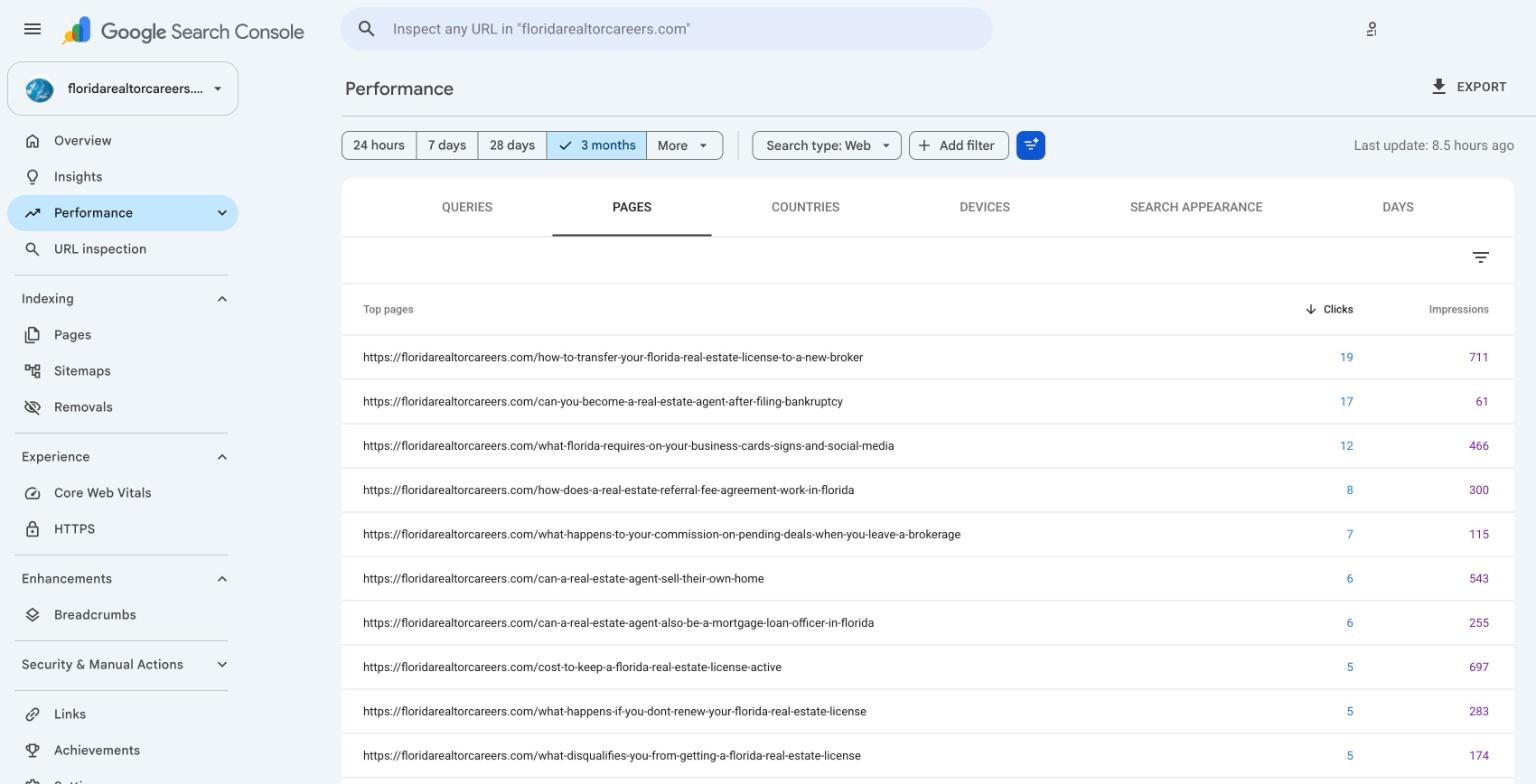
241 clicks reached our pages. They are very uneven.
- The top page earned 19 clicks (8%).
- The top 10 pages earned 90 clicks (37%).
- The top 20 pages earned 123 clicks (51%).
- The top 50 pages earned 180 clicks (75%).
- 111 of the 530 pages that appeared have earned at least one click. 419 have earned none.
Half of all clicks came from 20 pages
A small number of pages carry the result. That is normal for a content site, and it is also the reason a single-number headline would mislead. A reader should hold both facts: most pages did appear, and most appearances did not turn into visits.
One surprise
The page that earned the highest share of clicks per appearance had only 61 impressions and earned 17 clicks, a 28% rate. It answers a question about becoming an agent after a bankruptcy. It is the opposite of a high-traffic page. Five or six of our most-clicked pages are answers to narrow, awkward questions that few people ask and that few sites answer.
One mystery
The page about renewing a Florida real estate license has been shown 1,078 times and earned no clicks. Its average position is 40 or worse. We do not know yet whether that is a wording problem, a competition problem or simply a position problem, and it is the first thing we are watching.
8b. Who arrives, on what, and when
Three cuts of the same 250 clicks, from Search Console, June 17 to October 10.
- Phones carried the result. 137 clicks came from phones and 111 from desktops. The gap in position is wider than the gap in clicks: the site averaged position 8.2 on phones and 19.5 on desktops. Google showed the site much higher to people on phones. That is one window, and the average is weighted by impressions.
- It is a local story. 243 of 250 clicks came from the United States. The rest were scattered in single digits across countries that produced impressions and no clicks.
- Weekdays beat weekends, with a Sunday dip. Tuesday and Wednesday earned the most clicks (47 and 44). Sunday earned 19. Impressions per day were highest early in the week (about 330 on Monday and Tuesday) and lowest on Saturday (226).
- People search in whole questions. Of the impressions on searches Google lets us see, 82% came from searches of four words or more, and 31% from searches of seven or more. Only 18% were one to three words. Of 1,184 visible searches, 314 (27%) began with a question word.
None of this is advice. It describes who found a young recruiting site and how they phrased the search.
8c. The four searches almost nobody types
The four searches in section 2 were our choice. They read like what a licensed agent would type. Search Console says otherwise. Across the whole period, none of the four exact sentences appears in the data with any real volume. The nearest visible searches are looser and rarer (for example "best real estate agent Volusia County", with a handful of impressions).
That changes what "winning" them means. A page can sit at position 1 for a sentence nobody types and bring nothing. It is why the case for this site rests on 530 pages answering narrow questions that people actually ask, not on the four headline searches. We kept the four as our scoreboard because they are the questions a recruiter would hope a candidate asks. We did not find that candidates ask them in those words.
9. Six searches, followed week by week
Averages hide the paths. Here are six searches from the first week each appeared.
- "florida realtors careers": first appeared June 17 at position 10, reached position 4 on July 1, and has sat between 7 and 16 since. This is the one search that is about the site's own name.
- "real estate career path fl": began at position 53, reached 20 on July 14, and has since drifted to the high 40s and 50s.
- "florida real estate license renewal": began at 78, reached 36 on September 3, and is at 44 in October.
- "the unlicensed practice of real estate is": appeared September 15 at position 9, reached 7.4 on September 23, and sits at 10.
- "career change from nursing to real estate": appeared August 6 at position 22 and has held between 19 and 24 all autumn.
- "realtor license": appeared September 30 at position 14 and moved to 20 within a week.
Six searches, week by week
Most of the broad head searches sit on page two to six. The clicks come mostly from long, specific searches that Google does not show us in Search Console, which is why only 3 of 250 clicks can be tied to a named search.
9d. Why it behaved this way
Numbers without reasons are trivia. These are the main things the data shows, with the most likely explanations and an honest note on which ones we have and have not checked. Where we have not isolated a cause, it is a hypothesis.
Why a page can sit at position seven for fourteen weeks and earn no clicks
What we saw: the page about active versus inactive licences held positions 6.8 to 9 for fourteen weeks, with 382 impressions and no clicks. Common explanations: a result above it answers the question in full (a box, a summary or an AI overview), so people never need to click. The wording of the result looks like a definition they already know. Or the search is one people read and leave. What we have checked: only that the position is real. What we have not: what sits above it. That is the next look.
Why a young site appears late, then all at once
What we saw: the July 20 batch showed 1% in the first week and 93% by week six, while the earliest batches showed 40% in week one and plateaued near 75%. Common explanations: a search engine decides how often to revisit a new site and how much to trust it. Early on it visits rarely and trusts little. As the site grows, visits become more frequent and more of its pages are tried. What we have not isolated: why the earliest batches plateaued lower. Candidate reasons are that the first topics were broader and so contested, or that later pages benefited from a site that was better known by then. Both are hypotheses.
Why impressions are not visits
An impression means a result was shown on a page of results. It does not mean anyone saw it, scrolled to it or read it. Most searches stop at the first few results, so a page at position 30 can collect hundreds of impressions that no person looked at. This is why we quote clicks, and why a rising impression count on its own is not a result.
Why a page's average position hides its real path
An average blends every search a page appeared for. A page can sit at position 1 for one narrow question and position 60 for a broad one and show an average of 30 that is true of neither. The weekly paths in section 9 are closer to what actually happened.
Why phones and desktops differ so much
What we saw: average position 8.2 on phones and 19.5 on desktops. Common explanations: search engines rank for the phone version of a page first, and the results shown on a phone can differ from a desktop's, with different features above them. Pages that are quick and readable on a phone are not penalised there. What we have not checked: the same searches side by side on both devices. That is a short, cheap check.
Why a plain search and an AI assistant disagreed about the same site
A plain search returns a ranked list of pages and shows whether one of them is yours. An assistant composes a short answer from a handful of sources and decides which to name. A site can be absent from the first and named in the second, because the assistant weighs different things: how specifically a page answers the question, how checkable it is, and who else mentions it. It is also why neither check alone is the whole story.
Why a careful change to a description did not move the click rate
What we saw: six descriptions changed, click rate from 0.48% to 0.60%, against a prediction of about 3.4%. Common explanations: the description is only one of several things a person weighs, such as the title, the position, the other results and whether the answer is already shown. The prediction used a control whose own early rate was inflated by small numbers and fell by about half. And the six pages moved up the page, which would change who sees them. What it does not show: that descriptions never matter. It shows that this one change, on these six pages, was not enough.
Why half the clicks come from a few pages
Searches follow a long tail. A small number of questions are asked far more often, or have an answer that is a clearer match, and those pages absorb most visits while the rest collect an occasional one. This is common to content sites. It is why the number of pages is a poor measure of results.
What best explains what we saw
Ranked by how much each would change the conclusion if proven:
- What sits above the pages that rank and earn nothing. If answers are shown above them, position is the wrong target for those searches.
- How much of the result is the main site's reputation reaching this young site. If a lot, the pages are doing less of the work than the totals suggest.
- Whether phone results really are better or whether it is a quirk of which searches we appear for on each device.
- Whether the later, faster-completing batches reflect a better-known site or better pages.
Terms used here are defined in the glossary, and the broader method is in the Search Playbook.
9b. Eight pages, up close
Five pages that did best and three that did worst, from the week each one went live.
The five
How to transfer a Florida real estate license to a new broker (added July 3). First appeared July 5 and was in the top 10 by the week of July 6. It has sat between positions 5 and 9 for fourteen weeks and earned 19 clicks on 742 impressions. It is 815 words and has never been in the top three. The steadiest page on the site, and the only one in our controlled test that we left alone.
Can you become a real estate agent after filing bankruptcy (added August 6). It did not appear for 25 days, then arrived at position 2.1 in the week of August 31 and has stayed between 1.5 and 2.3. It earned 17 clicks from only 61 impressions. At 1,642 words it is the longest of the five. It is a question few people type, which is the reason the page is at the top.
What Florida requires on business cards, signs and social media (added August 11). First appeared September 3 and entered the top 10 the same week. It holds 5 to 7 and has earned 12 clicks on 466 impressions. At 1,993 words it is the longest page in this group.
How does a real estate referral fee agreement work in Florida (added July 21). It took 25 days to appear and has moved from position 9.6 to about 5 to 6 over eight weeks, earning 8 clicks on 300 impressions. A steady slow climb, not a jump.
What happens to your commission on pending deals when you leave a brokerage (added July 24). It appeared within two weeks at position 5, reached 2.0 in one week, and has since drifted from 3 to about 6 over nine weeks. Seven clicks on 115 impressions. This one is the only page that has been falling while still earning.
The three
How to renew your Florida real estate license (added July 10). It has been shown 1,078 times and earned no clicks. For eleven weeks it sat at positions 50 to 85. In the week of September 21 it jumped to 17.2. We do not know why. The jump is recent enough that clicks may still come.
Active versus inactive license in Florida (added July 3). It entered the top 10 in its first week and has stayed between positions 6.8 and 9 for fourteen weeks, with 382 impressions and no clicks. A page at position 7 for three months with a zero click rate is not a ranking problem. Something above it is answering the question first. We have not yet looked at what.
What E&O insurance costs for Florida real estate agents (added July 3). It climbed from position 28 to under 9 in two weeks, then stayed at 8 to 10 for ten weeks. Three hundred and nine impressions, no clicks. Same pattern as the page above, and the second reason to look at the results page itself.
What the eight have in common
They are not what the numbers would predict. The page with the most impressions earned none. The page with the fewest earned the highest rate. Length did not separate them: the best two are 1,642 and 1,993 words, the third is 815, and the worst three are 1,280, 1,286 and 1,330. Position did not either: three pages that sit at 6 to 9 for months have earned zero clicks.
We are not drawing a rule. These are eight pages, and the honest summary is that a page's position told us less than we expected about whether anyone would click it.
9c. The brokerage's own nine pages, for comparison
The client uploaded nine pages on May 19 before we began. They are the closest thing we have to a control: same site, same domain, same period, not part of our work.
- Nine original pages: 6 clicks on 992 impressions, a 0.6% click rate. 4 of the 9 were never shown at all in this period.
- Our 727 pages: 241 clicks on 33,101 impressions, a 0.73% click rate.
The click rates are close. What differs is reach: 33 times more impressions, spread across 530 pages. Our pages did not click better. They simply appeared more.
The original pages that are shown are the home page (590 impressions, 2 clicks) and the about page (243 impressions, 1 click). Neither is the kind of page a stranger would search for.
10. What AI answers did
We tested the site in the AI assistants a prospect might use. Questions were fixed in advance in two sets of four, so a later re-run asks exactly the same things.
Set A, joining a brokerage: best real estate brokerage to join in Volusia County · how to become a real estate agent in Daytona Beach · best real estate company to work for in Daytona Beach · best brokerage for experienced agents in Volusia and Flagler
Set B, license questions: what counts as unlicensed real estate activity in Florida · how to transfer your Florida real estate license to a new broker · cost to keep a Florida real estate license active · what happens to my Florida real estate license if my broker dies or leaves
Result of the run on October 12, three samples per question:
- ChatGPT named the careers site on 7 of 8 questions and linked to it on 7 of 8.
- Gemini answered on 4 of 8 questions and linked to the site on all four it answered. The other four returned errors.
- Claude named it on 0 of 8. That run had no web search switched on, so Claude answered from what it already knew.
- Perplexity did not run (a missing key). It is not counted either way.
The earlier checks disagreed, and that is part of the story
On June 26 and again on September 10 a web-search tool said 0 of 4. On October 13 three other instruments disagreed with that and with each other:
- A clean Google check (phone, Daytona Beach location, no sign-in) put the site at position 6, 2 and 1 on three of the four searches, and not in the top 20 on the fourth.
- A signed-in Google check on a desktop showed the site on all four. That account is in Volusia County and has visited the site, so this one is personalised and we do not lean on it.
- The AI assistants said 7 of 8 in ChatGPT.
We do not know which of these the September tool should have matched. The honest position is that checking whether a young site is visible is itself uncertain, and a single tool on a single day is a snapshot.
One Google check, with the query visible
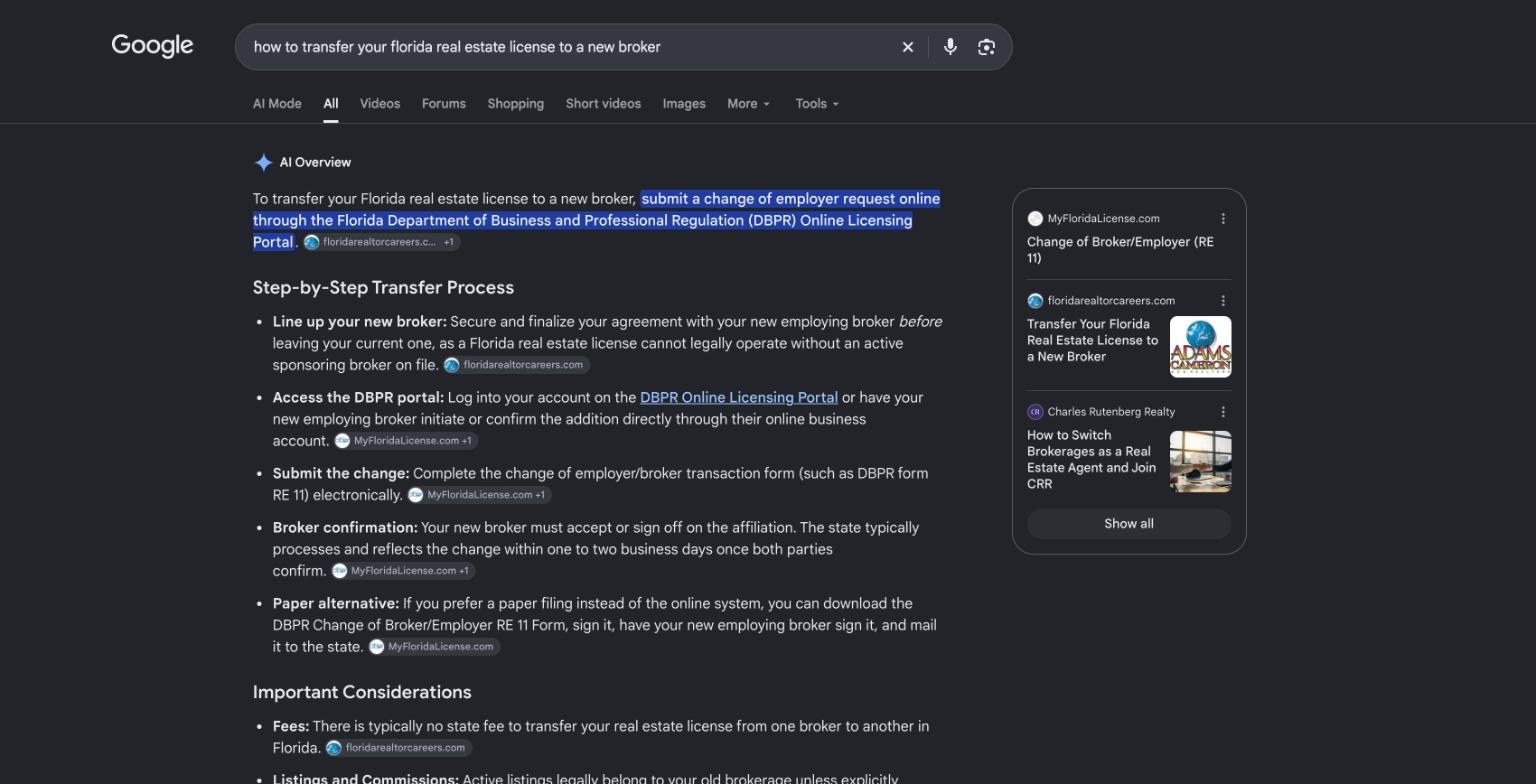
On October 13 we searched Google for how to transfer your florida real estate license to a new broker on a desktop browser. Google's AI Overview cited floridarealtorcareers.com in its lead sentence and in two of its steps, and listed the page as a source card beside the state's licensing portal.
Two checks that did not show the client
- Another Google phrasing about becoming an agent after a bankruptcy did not show the page on the first screen, even though it is the page with the most clicks per appearance.
- The Gemini app, asked a licence-transfer question in plain words, returned a full answer with no sources shown and did not name the site.
Limits: every one of these is a single check, or three samples on a day. Answers vary run to run and by who is asking. We re-run the same questions on a schedule and will report the trend. Today's result is a snapshot.
The long-tail check, October 13
The sets above are broad. People rarely type the broad version, so we ran a second set built from the site's real Search Console searches and the topics it publishes on.
Where the site is cited:
| Question | ChatGPT | Claude | Google AI Mode |
|---|---|---|---|
| career change from nursing to real estate in Volusia County Florida | linked | cited | |
| best real estate company to work for in Daytona Beach Florida | cited | ||
| real estate broker in New Smyrna Beach to join as an agent | linked |
The pattern: the careers site is picked for a specific person in a specific place, a nurse in Volusia, a broker in a named town, which is what it was built for.
How these were chosen: from the site's real searches. The table shows the questions where it is cited, so read it as a list of where it appears, not a random sample of everything a customer might ask. One sample each, October 13. ChatGPT logged out, Claude through its API, and Google AI Mode in the owner's signed-in browser, which may favor sites it has visited. On the nursing and Daytona Beach questions the brokerage itself is also named.
For how assistants choose which businesses to name, see how AI assistants pick businesses and what generative engine optimization is.
11. What we cannot tell you
We do not know whether any of these visits became a recruit. Clicks are the nearest thing we can measure from the outside. Whether a reader applied is a number the client holds, not us. Until that number exists, "clicks" and "recruiting" are different words.
We cannot split brand from non-brand cleanly. Google hides most rare searches. Of 250 clicks, only 3 can be matched to a named search. The visible searches are not the brand name. The honest statement is: almost everything we can see is not people typing the brokerage's name, and we can see very little of it.
The count is small. 250 clicks in 16 weeks is a small number. The claim of this page is about breadth and speed of appearing, not about volume of traffic.
One analytics tag was not loading for the first months because of how the site was set up on the client's side. We found it on October 7 and corrected the pages that omitted a required closing tag. The tag now loads. It matters here only because it is why the client's own analytics cannot confirm any of these numbers for the period before.
11b. People, time and small mishaps
Who did what. One person at the client approved and answered. One person on our side wrote and signed every page. Nothing was published without the client having agreed to the plan. Individual pages were not sent for approval one by one.
Mishaps, told plainly.
- We missed our own re-measure date. The plan was to re-run the four-search check at six to eight weeks. We ran it at eleven.
Who is responsible when a sentence is wrong. The pages carry a single author's name, and that person is accountable for them. A legal or regulatory statement that turns out to be wrong is corrected, dated and logged on this page's corrections log, not quietly edited. Corrections log: none yet as of the date above.
12. The test that did not work
On September 10 we changed one thing: the search descriptions on six pages that were being shown a lot and clicked on very little. We left the page titles untouched so that a change in ranking could not explain a result. A seventh page at the same position, left unchanged, was the control.
The reasoning behind it was simple. The six descriptions either answered the question outright, so nobody needed to click, or ended on a vague promise. The control named concrete specifics. If specifics were the difference, the six should climb toward the control's click rate.
The prediction, written down before the result: the six would approach the control's 3.4% click-through rate, which would be about 66 clicks against a site total of 110.
The result, 30 days later (September 11 to October 10):
| Before (28 days) | After (30 days) | |
|---|---|---|
| Six changed pages: clicks | 7 | 9 |
| Six changed pages: impressions | 1,473 | 1,501 |
| Six changed pages: click rate | 0.48% | 0.60% |
| Six changed pages: average position | 13.5 | 8.2 |
| Control page: click rate | 1.77% | 1.94% |
It did not work. The click rate moved from 0.48% to 0.60% on six pages that now sat five places higher on average. Nine clicks instead of seven. We predicted something about ten times larger. The changed descriptions did not close the gap.
Two things we learned that we did not expect:
- The control's own rate fell by about half from the 3.4% we used as the target to 1.8 to 1.9% in the next windows. The target was partly luck. A small page's early click rate can look better than it is.
- Position improved on its own. The six pages rose from 13.5 to 8.2 while we touched only descriptions. Ranking was rising anyway, which is exactly the kind of drift a test like this is supposed to hold constant and cannot fully.
We are not drawing a rule from this. We are reporting that a single, careful change did not do what we expected, and that it cost almost nothing to find out.
13. What did not work, or did not move
- Two of the four searches we set as the goal were not clearly won. On the clean phone check, the site was at position 6 for "best real estate brokerage to join in Volusia County" and absent from the top 20 for "how to become a real estate agent in Daytona Beach", behind two social networks and a training site.
- The September 10 check said 0 of 4 and was probably wrong. It used a different tool. A clean check a month later found three of four, and Search Console already had one page at position 1.0 for a close variant. We should have cross-checked the instrument before we reported it.
- The searches we won are ones almost nobody types. Search Console shows near-zero impressions for the exact sentences. The pages rank, and the searches are ours, not the market's.
- Two competitors arrived with a very similar approach and began to rank on those same searches.
- 197 of our 727 pages have never appeared in Google. 158 of them are the September 22 batch, which is under three weeks old and is not a miss yet. About 39 older pages are a real miss.
- Pages at position 3 or better fell from 45 to 40 in the latest window, even as clicks rose.
- The page with the most impressions earned nothing. See section 8.
- A tracking tag was missing for months. Section 11.
- The one link from the main site pointing here is gone, and that was not in our control. We have asked the client to restore it.
14. Threats to the claims
A careful reader should hold these against everything above.
- Seasonality. We have 16 weeks. Real estate and licensing questions have seasons, and we cannot yet compare to the same weeks last year because no measured year exists.
- Search Console's own limits. It lags about two days. It hides rare searches. It counts a page "shown" even when nobody scrolled to it.
- Google changes. An update in the period would move everything, and we cannot isolate one.
- We are the ones reporting. We are not neutral. The data is the client's Search Console and anyone with access can check it.
- Survivorship. The pages we feature are the ones that did well. The tables include the rest.
- One site. This is one client in one place and one subject. It does not show what would happen elsewhere.
15. What we are not claiming
- That our pages caused every click. Some of the site's early traffic may have come from the brokerage's own mentions and the main site.
- That the result would repeat on another site.
- That 727 pages is the right number for anything.
- That rankings are stable. They move week to week.
- That any visit became a recruit.
- That AI assistants will keep naming the site. They changed their answer between our June and October checks, and may again.
15c. Myths this case tested
- "More pages means more traffic." 727 pages produced 241 clicks, half from 20 of them. Page count was a poor predictor of anything we could measure.
- "A good position means clicks." Three pages held positions 6 to 9 for months and earned none.
- "Fix the description and the click rate follows." Not on these six pages, not in thirty days.
- "A site must rank for the head search to count." It did not. The pages that worked were narrow questions.
- "AI answers will make search results irrelevant." On this site, the Google result and the AI answer both mattered, and they did not agree.
- "New sites cannot get anywhere in four months." This one appeared in Google within weeks and held positions at the top of page one for narrow questions. On a clean check it also showed for three of the four broad ones, though almost nobody types those. Both are true.
15d. What we got wrong
- We expected the six-description test to approach the control's click rate. It did not, and the control's own rate halved.
- We reported "0 of 4" at week eleven from one tool and did not cross-check it. A clean check a month later said three of four. We cannot tell whether the pages moved or the first check was wrong.
- We chose four searches that sound like what a recruit would type, and almost nobody types those sentences. We measured ourselves against a test we wrote.
- We read the control's 3.4% as a stable target. It was partly small-number luck.
- We expected position to be the signal for which pages would be clicked. It was not.
- We did not run the re-measure on time.
15b. What we believe, and what this case did to it
This section is opinion. It is labelled as opinion so it can be held to later. None of it is a method.
Answers, not lists
People did not stop searching. They started asking. A licensed agent weighing a move does not type "brokerage". They ask what happens to my pending deals if I leave. A list of ten links is how the old question was answered. A paragraph that names two or three sources is how the new one is. A recruiting site that wants to be in that paragraph has to be the place that actually knows the answer, in the place where the question is asked.
Be the answer, not the ad
You cannot buy your way into a paragraph an assistant writes. Ads rent attention for as long as you pay. An answer earns trust and keeps earning it. The careers site is a small, young page set with no budget behind it, and the pages that did best were the ones that answered a narrow question completely. That is not an accident of this client. It is the whole bet.
Why the statute text, and not a summary of it
On a subject where a wrong sentence can cost a person their license, we do not trust a paraphrase of a paraphrase. Two pages we had planned were never written because the rule they described had been repealed. We would rather ship fewer pages than a confident wrong one.
Why we put the misses on the page
A result you cannot audit is not a result. The four searches we set out to win are still not won. A test we were sure of did not work. Most of the pages that appeared have earned nothing. We say so, with dates, because the alternative is a number you cannot trust, and we would rather be believable at 250 clicks than impressive at a number we cannot defend.
The honest both-halves position
Getting found for free is not over. AI search has already taken a piece of it, and the piece is growing. Both are true on this one site: a Google result and a handful of AI answers named it, while the tool we used in September said the four broad searches did not show it and a clean check a month later said three did. We do not think search is dead, and we do not think a ranked list is the whole story any more.
What this case changed our mind about
We expected position to tell us which pages would be clicked. It did not. Pages at position seven for fourteen weeks earned nothing, and a page at position two with sixty-one impressions earned seventeen clicks. We expected a careful change to the search description to move the click rate. It barely did. We came out of this trusting position less and the question itself more.
Where we think this goes
Our view, dated October 2026 and signed: for questions that have a real, checkable answer, the sites that get named will be the ones that are specific enough to be checked, and the sites that other people already write about will be named first. Authority will matter more than volume, and volume will matter less than it has for fifteen years. We may be wrong, and this page will show it if we are.
What we refuse to do
We do not invent numbers. We do not count impressions as wins. We do not manufacture reviews or mentions. We do not publish a client's name without their yes. We do not promise a ranking. We do not call a snapshot a trend.
Words we use, and what they mean here
- Picked by AI: an assistant named the site in an answer to a question a customer would ask. One check, one day, one assistant. Never a rank.
- Shown: a page appeared in Google at least once in the period.
- Click: a person arrived. The only number we call a result.
16. What we are watching next
Dated, and written down before the result, so we can be wrong in public.
- By November 3: at least 85% of the 158 pages published on September 22 will have appeared in Google at least once. (From the heatmap: later batches reached 90 to 95% by week six.)
- In the 28 days to November 8: clicks between 150 and 260. (The latest 28 days were 124.)
- By November 10: the licence-renewal page with 1,078 impressions will earn its first click, or it will not, and we will say which.
- On November 10: the same clean phone check on the same four searches shows the site on at least three. If it shows two or fewer, we will say so and revisit section 10.
- On the same questions: ChatGPT and Gemini will still name the site on at least 6 of 8 questions. If they do not, we will say that too.
We will update this page on each date and keep the old versions visible.
18. Is this you?
This is closest to your situation if:
- you have a real business with a real reputation that other sites already write about,
- your subject has plenty of specific questions people actually ask,
- your site is young or thin, and
- you can wait three to four months before judging.
This is not a fair guide to your situation if:
- you need results in weeks,
- you sell something where there are very few questions to answer, or
- you need a measured number of leads before you start. We cannot give you one from the outside, and neither can the clicks.
19. The five hardest questions, answered with this page's own data
"250 clicks in 16 weeks is nothing." It is small. Half of it came from 20 pages and most pages have earned none. What the data shows is speed and breadth of appearing: 530 pages in Google within weeks. Whether that is worth it depends on what a recruit is worth to this brokerage, which is the number we do not have.
"You didn't win the searches you said you would." Partly. On a clean check the site showed for three of the four, at positions 6, 2 and 1, and not for the fourth. But almost nobody types those exact sentences, so the clicks come from narrower questions, not from them.
"Your own test failed." Yes. We report it because it was a fair test, with a control, and it was wrong. Nine clicks against a prediction of about sixty.
"AI answers change every day. Why believe a snapshot?" You should not, and the page says it is a snapshot. The questions are fixed so the same check can be run again, and we will publish the trend.
"How do I know this is real?" Everything quoted is from the client's own Search Console. We list exactly which report and which dates in the next section.
20. How to check these numbers
Search Console, property floridarealtorcareers.com, Performance → Search results, Search type Web, date range June 17, 2026 to October 10, 2026, Pages tab sorted by clicks. The chart, the monthly totals and the top-pages table above come from that view. The weekly views and the publish dates are in the downloadable data file.
21. What to ask any provider, including us
These questions are generic on purpose. They are the questions a careful buyer should put to anyone who sells this kind of work.
- Which number do you call a result, and over what dates? A click and an impression are not the same thing.
- What did you measure before you started? If there was no baseline, how do you know?
- Can I check your number myself? Which report, which dates, which filter?
- What did not work? If the answer is "nothing", ask again.
- What else changed in the same period? Ads, seasons, a redesign, a rival.
- Who checks the facts, and what happens when one is wrong? Particularly on anything legal or financial.
- What is not being claimed? A provider who cannot say has not looked.
- Show me a result that is small. The honest ones are.
- What would make you stop? And what do I owe at that point?
- Who signs the work? Someone should be accountable by name.
22. Glossary and primary sources
Click a person arrived from a search result. Impression a result appeared on a results page. It does not mean anyone saw it. Position where a result sat in the list, averaged over the searches it appeared for. Shown appeared at least once in the period. AI Overview a generated summary Google places above its results. Assistant a tool such as ChatGPT or Gemini that composes an answer. Control a case left unchanged to compare against a changed one. Cohort pages grouped by the week they went live.
Primary sources used: the regulator's licensing pages and the statute text on the state legislature's site, as cited in the pages themselves. Tools used to check: Google Search Console (the client's property), and Google and the assistants named, run on the dates shown.
Appendix: questions people ask
How long does a new page take to show up in Google? On this site, the median was 16 days after it went live, with a quarter of pages appearing within a week and three-quarters within 26 days. Some took more than three months and some never did.
Do more pages mean more traffic? Not on their own. 727 pages produced 241 clicks, concentrated in a small number of them.
Can a recruiting site get named by AI assistants? In our October checks ChatGPT named this one on seven of eight questions. That is a snapshot, and the earlier plain-search check said the opposite.
What is a "page at position 10 or better"? A page whose average Google position over a week was ten or better, with at least three impressions that week. It is a measure of presence, not a promise of clicks.
How is this different from a testimonial? A testimonial says it worked. This page shows what happened, week by week, including what did not.
Will you update this? Yes, on the dates in section 16, and the older numbers stay visible.