Get your practice, every orthodontist and every office named by ChatGPT and Google AI when parents ask what braces cost and who to see.
In 18 AI answers about finding an orthodontist in three Florida towns, every cost answer printed a price, and every free-consultation answer named an orthodontic practice first. See the answers
When a parent asks AI what braces or clear aligners cost, who offers a free consultation or how to choose an orthodontist, it prints price ranges, talks about payment plans and names a few offices. RunOctopus writes the practice-information pages on your website that those answers draw on. Pages contain no clinical claims, every sentence is checked automatically against the facts you give us, and every month we show you with dated screenshots who the AI named.
Run my free scanAs the AIs printed them. One run, one day. Both gave prices and payment plans before naming any office.
Braces are a big family purchase, and parents now start by asking an AI. They type what braces or Invisalign cost in their town, who offers a free consultation for a teenager, and how to choose an orthodontist, and they read one answer.
That answer comes with numbers. Every cost answer we read printed a price range and said payment plans are common. Then it named a few offices, and on the cost question those were often general dental offices that advertise aligners and financing, not orthodontic practices. The pages that help are plain ones: who your orthodontists are, what a first visit includes, how your fees and payment plans work and where you are.
Parents ask AI what braces cost. It answers with prices and payment plans, then names a few offices. Clear practice pages are how you get named.
All 6 cost answers printed price ranges, from $3,000 to $8,000 for full treatment. None of the other 12 answers printed a treatment price.
We never asked about money in the how-to-choose question. All 6 of those answers still told parents to ask about payment plans or financing.
All 6 free-consultation answers named an orthodontic practice first, and both AIs picked the same practice first in every town.
A general dental office or a multi-office dental group was named in 10 of 18 answers, mostly on cost. In both Port Orange cost answers no orthodontic specialty practice was named.
We write practice facts only. Every sentence is checked against what you gave us, and anything we cannot trace to your own words is left out.
Orthodontic practices are not all built the same, and what gets you named is different for each. Pick the one that sounds like you and jump to it. The rest of the page applies to all four.
You can be named at any size. A solo practice needs clear first-visit and payment pages. A group needs a real page for each office, never a copy.
One orthodontist, one office. A page for you, one for each treatment you offer and a clear first-visit and payment page.
One brand, several offices. A real page for each office and each orthodontist.
Orthodontics offered inside a group of dental offices. Group rules at the top, the orthodontic facts at each office.
Many orthodontic practices under one support organization. Brand rules at the top, local facts at each practice.
A parent comparing braces does not read ten websites. They type one sentence, read one answer and book a consultation or two. Everything we do aims at one of the steps in between.
The AI does not know your practice. It searches the way a parent would, reads the pages it finds (your site, the American Association of Orthodontists, Google business listings, cost guides) and writes an answer from what those pages say. It leans on pages that answer the exact question: "how much do braces cost in Port Orange, and do orthodontists offer payment plans?"
That is the opening. A cost guide gives a state average. A page on your own site can say, in your words, what a first visit includes, how your payment plans work and which towns you serve.
Six things kept showing up in the practices that got named. None of them is advice or a claim about results. All of them live on your own website.
One page per orthodontist and office, the practical answer first, and facts only you can give.
"Free Orthodontic Consultations in Ormond Beach: What the First Visit Includes" beats "Our Services."
Whether the first visit is free, what it includes and how payment plans work, in the first lines. The AI quotes that.
Your orthodontists, treatments offered, hours, address and the towns you serve. Specific beats polished.
Google business listings with ratings and review counts appeared beside every practice in the Google consultation answers.
The same name, address, phone and orthodontist list everywhere, so the AI is sure every mention is one practice.
Fees, payment plans and consultation offers change. A dated, refreshed page reads as alive.
People ask about orthodontists in three ways, and each one needs a different page. A practice that only writes "schedule your consultation" is missing all three.
Sample These are real questions Google shows people about braces and orthodontists (checked October 25, 2026), and the kinds of pages we build. They are about choosing, booking and paying, never about treating teeth. On your account the questions come from your own Search Console and what people in your market ask, and you see the list before we check it.
Parents ask when to start, how it works and what it costs. Write for all three.
"Is it better to see a dentist or orthodontist?"
"What age is best to start braces?"
"Is 14 old to get braces?"
"Is it better to get braces as a kid or adult?"
"What is the process of getting braces?"
"How do clear aligners work?"
"Is 25 too late to get braces?"
"Who is the youngest kid to have braces?"
"How much do braces for kids usually cost?"
"Is $5000 a good price for braces?"
"What is the average price for Invisalign braces?"
"Can orthodontic expenses be deducted?"
The answers we read were practical. They printed price ranges by treatment, said payment plans and outside financing are common, listed offices with addresses and phone numbers, and told parents what to ask: is the consultation free, what does the price include, is the orthodontist a specialist. Those are facts a practice can put on a page.
Most of the cost answers took their numbers from general cost guides and from the few offices that publish prices. A practice that states its own fee structure and payment plans gives the AI a figure about that practice. We do not write treatment or clinical pages at all.
Fees, payment plans and first-visit facts get quoted. We write no clinical pages.
How your deposits, monthly plans and outside financing work, as you state them. The question every cost answer took up.
Whether the consultation is free, what it includes (exam, X-rays, scans, an estimate) and how to book.
Which treatments your office offers, braces and aligners, in your own words. Never advice, never outcome claims.
Who your orthodontists are, their training as they state it, hours, address and the towns you serve.
From what age you see children and how a first visit for a child works. Checked automatically against your words.
Which plans you work with and how orthodontic benefits are applied, from your own list, kept current.
Every one of the 6 cost answers printed a price range before it named an office. None of the 12 other answers printed a treatment price. Pick a treatment, and each row shows the range one AI printed for one town.
Ranges as printed on October 25, 2026. They are the AIs' estimates, not quotes, not our prices and not what any practice charges. Where an AI printed no range for a treatment, the row says so.
The AI answers the cost question with numbers. A page that states your own fees and payment plans gives it numbers about you.
Lowest price printedHighest price printed
On October 25, 2026 we asked both AIs three questions about finding an orthodontist in DeLand, Ormond Beach and Port Orange: a free consultation for a teenager, what braces or Invisalign cost and whether there are payment plans, and how to choose an orthodontist for a child. That is 18 answers, with the limits left in. We asked only how to find, choose and pay for an orthodontist, never a dental question.
An orthodontic practice led every consultation answer. On cost, dental offices and dental groups were named often, and in 2 answers no orthodontic specialty practice was named.
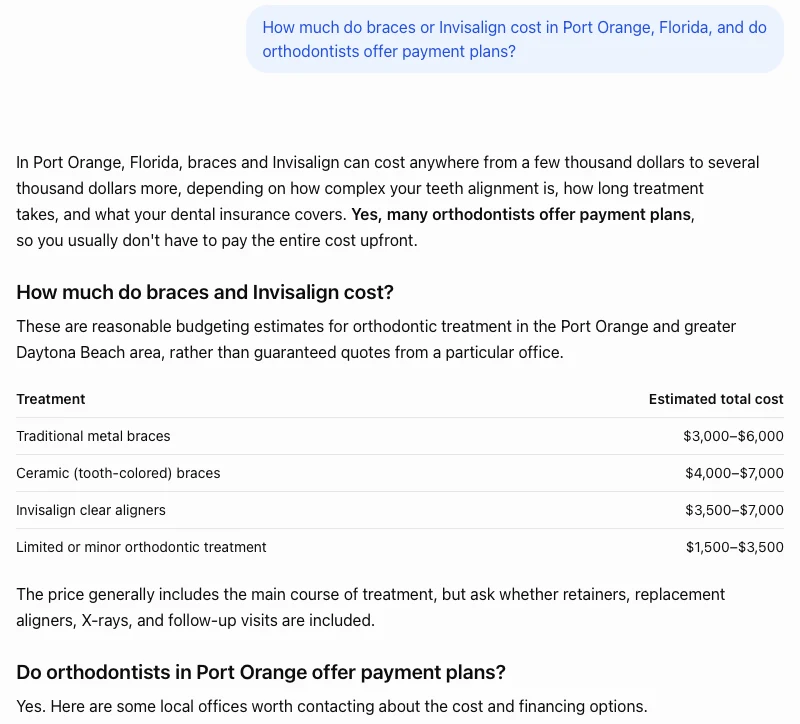
The real answer for the Port Orange cost question, cropped and untouched. The price table comes first. The offices it named come after this crop: general dental offices and dental groups, none of them an orthodontic specialty practice.
It opens with a table of four treatments and their ranges, and says they are budgeting estimates, not quotes.
It tells the parent to ask whether retainers, replacement aligners, X-rays and follow-up visits are included.
"Yes, many orthodontists offer payment plans" is the one bolded line in its opening.
What each AI named in each answer, as counts and kinds of offices. Practice names are left out. Logged-out ChatGPT and Google AI Mode through our own search data account, October 25, 2026, one run each. We do not judge any practice.
What this means for you. When the question was who offers a free consultation, an orthodontic practice was named first every time, and both AIs agreed. When the question was cost, the answer was built from price ranges and payment plans, and the offices named were often the ones that publish prices and financing, including general dental offices and dental groups. An orthodontic practice with clear fee, payment and first-visit pages has something specific for the AI to name on that question too.
What this does not prove. One run per question, one day, three towns in one Florida county, and listings change. Office types are classified from their names, not from company records. We do not say who is best, and the AI did not either: it told parents to compare two or three consultations. It does not promise your result.
The answers did not stop at names and prices. They told parents what to check before signing. Each card is copied from the saved answers, with the AI and town or the count. A page that answers these in your own words is a page the AI can use.
We quote these as what the AIs said. They are not our advice, and not a claim about any practice.
Free, included, specialist, timing, payment. Answer them on your site before the parent has to ask.
ChatGPT linked practice websites most often, including the consultation and financing pages of the offices it named. Google's answers showed business listings with star ratings and review counts, and drew on practice sites, a braces cost guide and the American Association of Orthodontists.
So being named is not one trick. The AI reads practice pages, listings and cost guides together, and it prefers a page that answers the exact question. A listing alone is not enough, and neither is a website with one contact page.
The AI reads practice pages, listings and cost guides. We write the practice pages that answer the exact question.
Consultation, financing and pricing pages of practices were the pages ChatGPT linked when it named an office on cost.
Google showed a rating and review count beside every practice in its consultation answers. Keep your listing accurate.
The American Association of Orthodontists was named or linked in 5 of the 6 how-to-choose answers.
A page on what a free first visit in Port Orange includes beats a general contact page for that question.
RunOctopus is an AI that does its own checking, so nothing waits for a person to say yes. What keeps dental content safe is what we choose to write, and what the checks refuse to publish.
We write practice-information pages from facts you give us in writing. We write no condition, treatment, diagnosis, outcome or credential-claim pages. Every sentence is checked automatically against your facts and a rule list. Anything we cannot trace to your own words is left out, not published.
The pages contain no clinical claims, so there is nothing clinical to review. We do not give dental advice. Fees and free-consultation offers appear only as you state them. You can read everything we publish, and every page is dated and recorded in your account.
No clinical pages. Every sentence traced to your own words, or left out.
Your orthodontists and their training, as you state them. Nothing added.
From your own list, kept current and dated. Fees only as you state them.
How to book, what the first visit includes and how payment plans work, in plain non-clinical terms.
No pages that tell a parent which treatment a child needs, and no condition or diagnosis pages.
No results, no smile galleries, no testimonials, no superlatives.
We do not ask for or use patient records, names, photos or stories.
HIPAA, state dental advertising rules and your group policies are yours. We follow the rules you give us.
Our AI agent, Ollie, does the research and the writing, checks every sentence against the facts you gave us, and publishes. You can read everything.
We find the questions, write the pages, check every sentence automatically, publish, and check every month.
We read your site and your Search Console, and list what parents ask in your towns.
We ask ChatGPT and Google AI consultation, cost and choosing questions, town by town, and save dated screenshots of who is named.
One page per office and topic: first visits, fees and payment plans, treatments offered. Real facts from you, never filler.
Every sentence is checked against your facts and a rule list. Anything that cannot be traced to your words is left out.
Pages go live with links to your related pages, then we load them to confirm.
We re-run the same questions and show you who is named now, next to last month.
Here is the shape of a page we would write for an orthodontic practice. The details change for every office and town, but the parts do not.
The title is the question. Written the way a parent would type it, with the town in it. Not "Our Practice" but "Braces and Payment Plans in Port Orange: How Our Fees Work."
The practical answer comes first. Whether the first visit is free, what it includes and how payment plans work, in two or three sentences.
Then the facts a parent can check. Your orthodontists, treatments offered, hours, address and the towns you serve. We write nothing clinical.
Then the questions that come next. A real FAQ about consultations, fees and booking, marked up for Google.
Then the paths. Links to the next page the parent needs: the orthodontist page, the office page, the payment page.
If you run a practice with one orthodontist, you do not need a big website. You need the right pages: one for you, one for what a first visit includes, one for how fees and payment plans work and one for each town you serve. In our check, the consultation answers named single-office orthodontic practices first in every town.
A handful of clear, current pages beats a long services list.
Whether it is free and what it includes. The question both AIs answered with a practice name.
Deposits, monthly plans and outside financing, in your words. The topic every cost answer covered.
Offers, fees and hours change. A dated, current page beats a stale one.
With several offices, the AI has to tell them apart and know they are one practice. Most multi-office sites fail the first: every office page says the same thing, so the AI names none of them.
We write a page for each office from that office's own facts: its orthodontists, hours, first-visit steps and the towns it serves. Brand rules live at the top. Local facts live at each office. We never invent an office.
Same brand rules everywhere, different facts at every office, rolled out in waves with one report for head office.
One practice name, one set of rules, and a clear page for each office.
The orthodontists, hours and first-visit steps of that office. No copied pages.
A Google profile for each real office, kept consistent.
We start where the check shows the biggest gap, then scale.
Which practices the AI named this month, with a dated screenshot per office.
One view for the practice or group manager: who is named where, and what changed.
Many orthodontists work inside a dental group or a support organization, where a central team runs the website and listings. We work inside your group's rules, or we tell you plainly when an office is not allowed its own pages.
We start with a pilot of three offices, inside your rules.
Good. We follow your brand rules and write the pages you allow.
Good. Your compliance team can read everything we publish, and every page is dated and recorded in your account.
Dental groups were named in several cost answers. Orthodontic pages for each office help the AI name the orthodontic service too.
You have probably been burned by marketing that takes a quarter to show anything. So here is the first week, and what you can see each day.
Google usually takes a few weeks to show new pages, so the first week is about getting the right pages live and your starting answers saved. The monthly re-check is where you see whether the AI's answer has moved.
We do not promise a result, because AI answers change and no one controls them. What we can do is show you the math you will run in your head anyway. Put in what one new case is worth to your practice.
Sample The starting numbers are an example. Type your own and watch it change.
If one extra new case a month does not cover it, this is not for you, and we will say so on the call.
2 offices x 1 extra case a month x $4,500 x 12 months.
Arithmetic only. We do not promise patients. Use your own numbers.
Right. That is why we write no clinical claims at all. We write practice facts, every sentence is checked against what you gave us, and anything we cannot trace is left out.
That is your call. What we saw is that the AI prints ranges anyway, from cost guides and the offices that do publish. A page on how your fees and payment plans work can say as much or as little as you choose.
We never use patient information. We write general practice-information pages. Your compliance contact decides anything about your site tools and pixels.
They do, and on the cost question they were named often. A clear page on your consultations and payment plans gives the AI an orthodontic office to name for the same question.
You write nothing. Everything we publish is on your site and recorded in your account.
We cannot promise patients. The 90 day guarantee covers how often Google shows your site, and you keep every page either way.
The Healthcare Providers page is the parent of all of these. Each one starts with its own check of what AI says in that specialty.
Most practices already pay for something. Here is what each one does about AI answers, in plain terms.
| Option | What It Does | AI Answers |
|---|---|---|
| Directory profiles | Lists you on their pages | Rarely the source in our 18 answers, and written by someone else |
| Paid search ads | Pays for a slot above the results | An ad beside the answer, not in it |
| A template website | Lists your treatments | Little specific for the AI to quote |
| A marketing agency | Reports, some posts, monthly calls | Sometimes, often not checked |
| RunOctopus | Writes pages from your facts, checks every sentence automatically, publishes and re-checks | Checked monthly, screenshots shown |
We write practice-information pages from what your practice gives us: who your orthodontists are, which treatments you offer, how a first visit works, your fees and payment plans as you state them, and where your offices are. We write no treatment, diagnosis or outcome pages, so there is no clinical content to approve. Every sentence is checked automatically against the facts you gave us and a rule list, and anything we cannot trace to your own words is left out. We do not give dental advice.
No. We never ask for or use patient records, names, photos or stories, and we do not write testimonials, before and after photos or outcome claims. Florida regulates dental advertising, so your compliance contact or counsel decides what may be said.
Many now ask ChatGPT or Google's AI what braces or clear aligners cost, who offers a free consultation and how to choose an orthodontist. In our October 2026 check of three Florida towns, all 6 cost answers printed price ranges and all 6 said payment plans are common.
In our check, an orthodontic practice was named first in all 6 free-consultation answers, and both AIs picked the same practice first in every town. On the cost question it was different: in both Port Orange cost answers no orthodontic specialty practice was named, only dental offices and dental groups that advertise aligners and financing.
That is your decision and your compliance contact's. What we saw is that every cost answer printed a price range and most answers talked about payment plans. A page that says in your own words how your fees, deposits and monthly plans work gives the AI something exact about your practice. We publish only the figures you give us, as you state them.
Keep those profiles accurate, but in our check the AIs drew mostly on practice websites, the American Association of Orthodontists and Google business listings. A directory profile is written by someone else. Your own pages say exactly what you offer, how a first visit works and how payment plans work.
Check with your group's marketing and compliance teams first, because many groups run the website centrally. Where an office is allowed its own pages, we write one per orthodontist and office from your facts, inside your group's rules. Where it is not, we tell you plainly.
We write a different page for each office, with its own orthodontists, hours, treatments and first-visit steps, under one brand. We start with the two or three offices where the check shows the biggest gap.
You do not write anything, and nobody has to say yes before a page goes live. Pages are checked automatically against the facts you gave us and a rule list, you can read everything we publish, and every page is dated and recorded in your account.
We cannot promise patients or cases, because AI answers change week to week. We put the right pages on your site, check each month who the AI names and show you the dated screenshots, and refund you if your Google appearances are not up after 90 days.
Access to your website and Google Search Console, your orthodontists, offices, treatments offered, how a first visit works and how your payment plans work. We look up the rest ourselves.
The pieces behind this page, in plain words.
How AI picks a local business, step by step.
What AI Search Visibility MeansThe idea behind being named in an answer.
Get Your Business on ChatGPTWhat to put on your site so ChatGPT can name you.
RunOctopus Compared with an SEO AgencySide by side, in plain terms.
RunOctopus for DentistsWhat the AIs said about finding a dentist in the same three towns.
RunOctopus for Healthcare ProvidersThe parent page for every kind of practice.

We research the questions and write the pages, every sentence is checked against your facts, and then we publish, check and show you each month who the AI named. If your Google numbers are not up at 90 days, you get your money back and keep every page.
Click Here to Start with the Free Scan →How the 90-day promise works: we compare how often your site is shown in Google in the 90 days after your first page goes live against the 90 days before. It covers how often Google shows your site, not a particular ranking or a spot in a particular AI answer, because nobody can promise those. The price you start at is the price you keep, even when it goes up for new customers.
Type your website. The free scan shows what AI can and can't read, and which pages you're missing.
Run My Free Scan