If you read nothing else
- Over the 28 days to October 10, the site earned 5,447 clicks from Google search, up from 3,645 in the 28 days before. The data begins on July 28, so there is no earlier measured period.
- Most of that rise is one new section. A species encyclopedia launched on September 6 and now accounts for about 43% of weekly clicks. The blog grew far more modestly, roughly 1.3 times.
- Google showed about 740 pages a week in late July. It showed about 9,800 pages in the week of October 5. Almost all of that increase is the encyclopedia.
- No single species page earned more than 14 clicks in a week. The encyclopedia is thousands of pages earning a few visits each, and that is a different thing from a few pages earning a lot.
- On two locked sets of questions, allanglescreatures.com was the most-cited domain in every AI answer set (61 citations in the first, 80 in the second). ChatGPT named the company on 4 of 8 generic buyer questions and on 8 of 8 questions shaped like the site's own comparison and ranked guides. On the generic isopod and springtail buying questions it was absent.
1. The result, in sixty words
Between July 28 and October 10, 2026, All Angles Creatures went from about 600 to about 1,400 weekly Google clicks. The blog carried the first part. A species encyclopedia, launched September 6, carried the second: from nothing to about 540 clicks a week and 8,700 pages shown in five weeks. We cannot measure what happened before July 28.
2. Where this came from
The following is in the founder's own words.
"The insect business is not a new business. Businesses have been around doing that stuff for a long time. Look how long Fluker's and some of these other ones, like Armstrong's Cricket Farm, have been around: decades. Even with the internet, all these businesses came to the internet, and then there are big people doing it. I thought to myself, 'Well, what if I got into it and I noticed online presence and everything wasn't great?' I just said, 'Well, it's going to be hard to win on Google search for broad and the highest intent searches. Let's check ChatGPT and other search engines.'"
The decisions that followed were deliberate:
- The industry was crowded with decades-old names that were already online.
- The short, obvious Google searches ("buy crickets") could not be won by a newcomer.
- He went to the AI assistants instead and read what their platforms say about how they choose sources.
- He named what he saw. He calls it epistemic retrieval: how an AI goes looking for the source that actually knows the answer and cites it.
- The opening was the long, high-intent questions and the comparisons the incumbents had not written.
That is a strategy against incumbents, not a lucky afternoon. It is also a belief about how search is changing, and the ten weeks of data below are one test of it.
3. What we were up against
A crowded field with long memories
Feeder insects are an old business. The best-known names have been selling them for decades and have the links, the brand and the shelf space to match. A new brand does not get to be the obvious answer to an obvious search.
A site that had changed hands, twice
The company's content began life on an older store platform. In April it was imported into a new site. Then, in late August, the site was moved again to its own hosting after the previous host stopped serving it. For a short period at the end of August every visitor received an error instead of a page. That is in the middle of the period this study measures, and it is the main reason we cannot treat the numbers as a clean experiment.
No measured past
Search Console's record for this property begins on July 28, 2026. There is no earlier measured period to compare against. The honest form of the claim is a level (where things stand) and a shape (how it moved since measurement began), never a before-and-after.
An unfair advantage and an unfair disadvantage
The founder is the author, so the page has an author who cannot be neutral. On the other side, the data is the company's own, in full, and a stranger with access could re-pull every figure here. We would rather be checkable than neutral.
4. Ten weeks, by section
Google search clicks per week, with the number of pages that appeared that week.
| Week starting | Blog clicks | Blog pages | Encyclopedia clicks | Encyclopedia pages |
|---|---|---|---|---|
| Jul 27 | 557 | 635 | 0 | 0 |
| Aug 10 | 670 | 660 | 0 | 0 |
| Aug 24 | 858 | 683 | 0 | 0 |
| Sep 7 | 831 | 1,070 | 34 | 846 |
| Sep 14 | 1,004 | 1,165 | 110 | 2,472 |
| Sep 21 | 922 | 981 | 392 | 6,070 |
| Sep 28 | 981 | 914 | 428 | 6,542 |
| Oct 5 (6 days) | 748 | 908 | 543 | 8,722 |
The blog went from 557 to 748 clicks a week, about 1.3 times, with a peak of 1,004 in mid-September. The encyclopedia went from nothing to 543 a week in five weeks.
What the table does not say: the final week has six days and not seven. The blog fell from 981 to 748 between the last two weeks. We do not know yet whether that is a seven-versus-six-day artifact, a ranking change or normal variation. It is the first thing to watch.
5. The encyclopedia, and what we can and cannot say about it
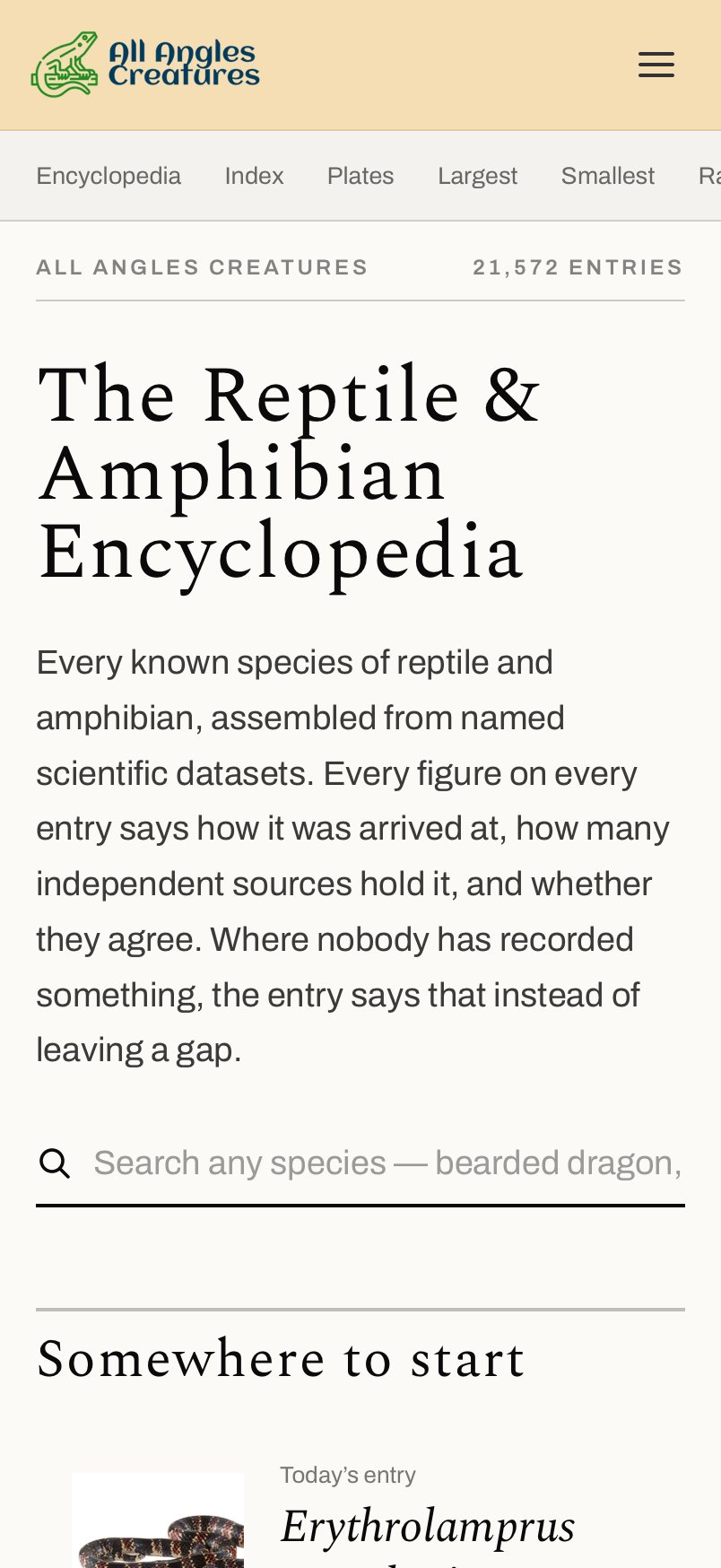
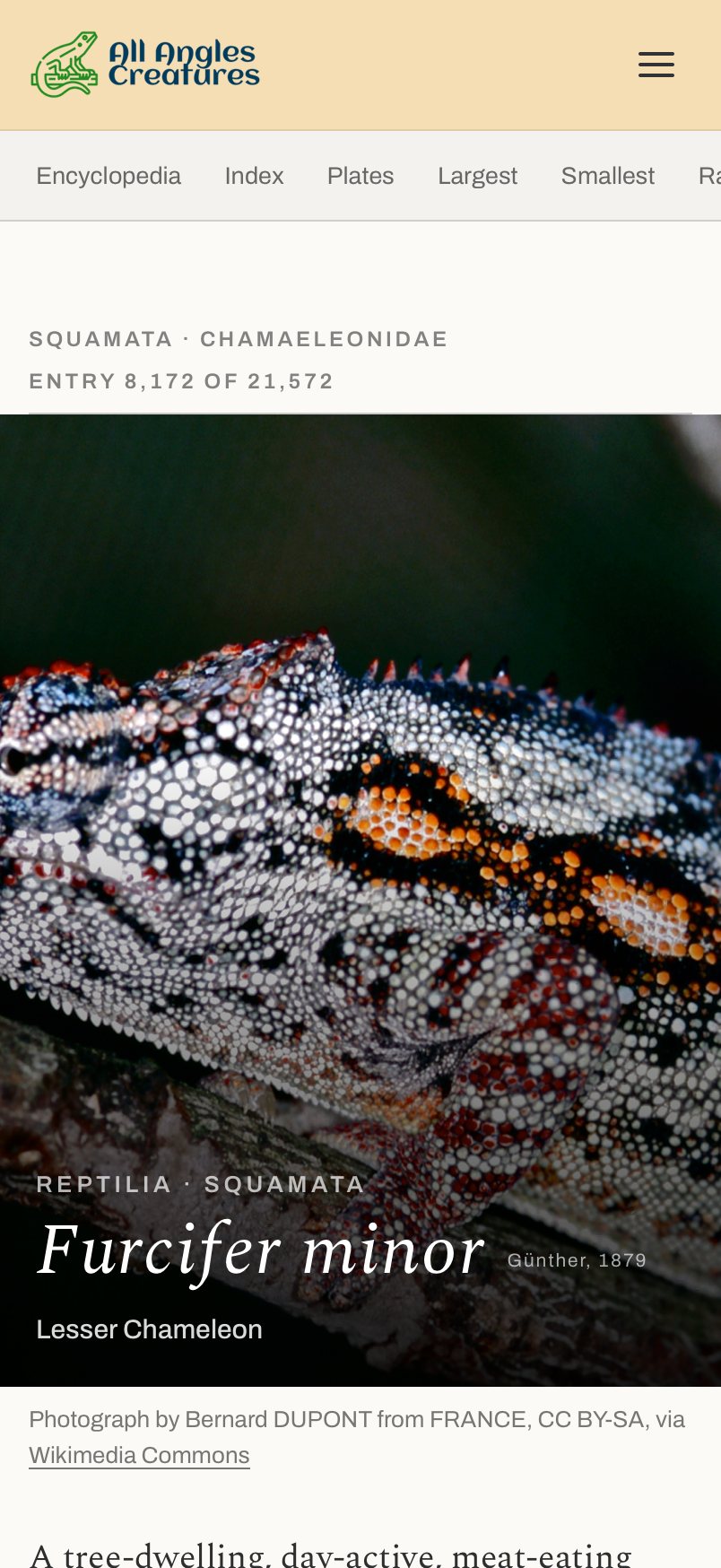
The species encyclopedia is a reference section: one page per reptile or amphibian species, built from open scientific datasets (taxonomic lists, trait databases, morph genetics), with the source named on every page and a plain statement of what it deliberately does not publish. It went live on September 6, 2026.
What we saw:
- It appeared in Google almost immediately: 846 pages in the first full week.
- Pages shown grew about threefold per week for three weeks, then slowed: 2,472, 6,070, 6,542, 8,722.
- Clicks rose from 34 to 543 a week.
- The clicks are a very long tail. The best single species page earned 14 clicks in its best week. The encyclopedia is thousands of pages earning a click or two, not a few pages earning many.
Checked on October 13: the site's sitemap lists 19,746 species pages. Google showed 8,722 of them in the most recent full week.
Why a section like this behaves like this: a reference page is a good answer to a narrow factual question, and there is an enormous number of narrow factual questions about animals. Each is asked rarely. A site that answers many of them accumulates many small visits. That is a different business from ranking for a few valuable searches.
What we cannot say: whether the encyclopedia's visits turn into anything the company sells. They are readers of species facts. Whether any of them buy feeders is not measured in Search Console and is not claimed.
6. The blog, which was already working
The blog is where the company's search presence started, and it still carries more than half of the weekly clicks. The pages doing most of the work are plain, practical guides:
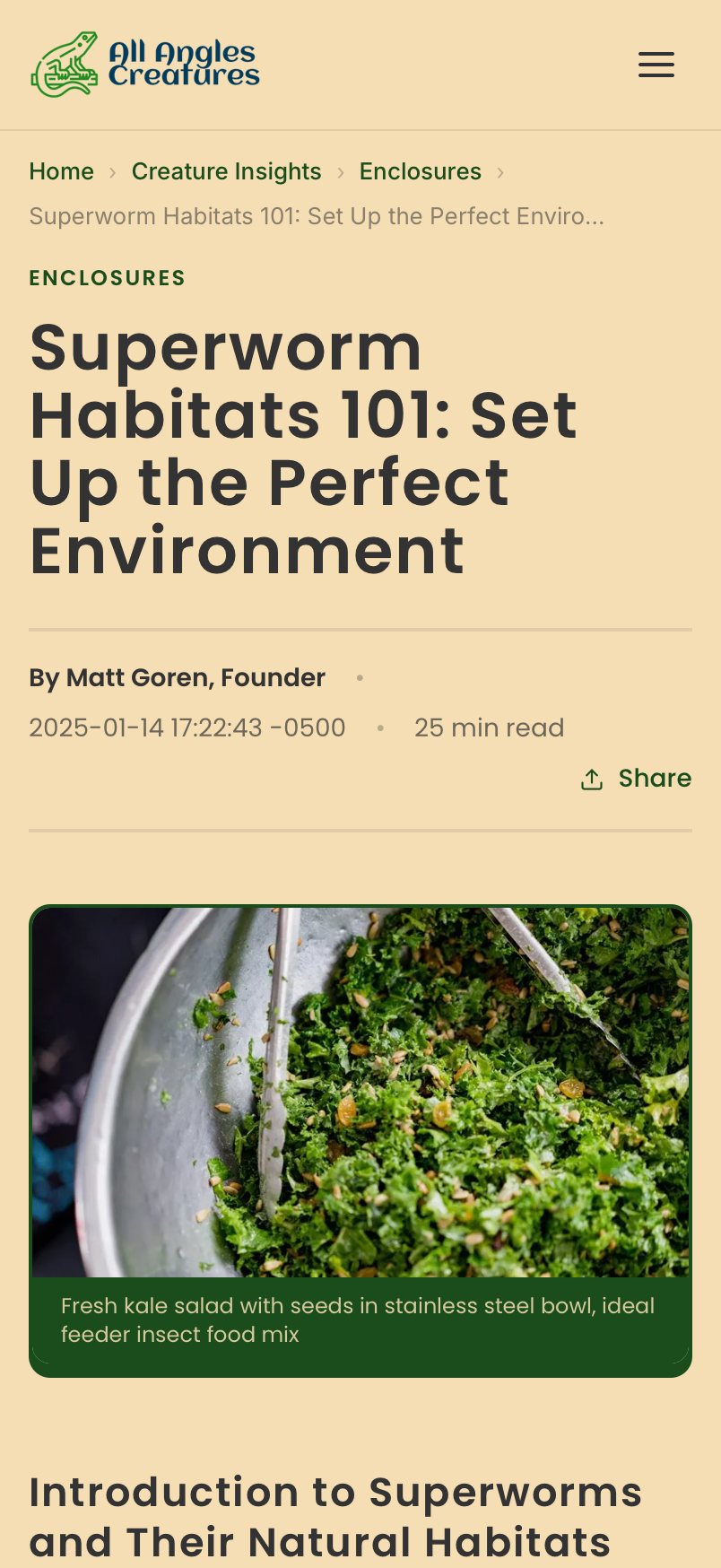
- Superworm habitats: set up the perfect environment: 138 clicks in the latest 28 days
- Superworms, the ultimate guide to raising and feeding them: 121
- Raising silkworms at home: 80
- Five facts about superworms: 65
- Best feeder insects for pacman frogs, ranked: 57
- Best isopods for bioactive terrariums, ranked: 55
- Discoid roaches versus dubia, the Florida-legal feeder: 53
These are how do I and which one should I pages, the long, specific questions the founder's original bet was about. Seven pages out of hundreds carry a large share of clicks. The home page earned 98 clicks in the same 28 days.
7. Who is searching, by name and by need
In the latest 28 days, a search for the company's own name ("all angles creatures") earned 32 clicks, and the misspelling "all angels creatures" earned 16. The rest of the visible searches are about animals and care: "discoid roaches for sale", "pink springtails", "why are dubia roaches illegal in Florida".
Search Console hides most rare searches, so this is a small view: about one click in five can be tied to a named search. Among the ones we can see, the company's name is a small share. Almost everything else is someone with a question or a purchase to make.
8. What changed in the ranking picture
Comparing the latest two equal 28-day windows:
| 28 days to Sep 12 | 28 days to Oct 10 | |
|---|---|---|
| Clicks | 3,645 | 5,447 |
| Pages earning impressions | 1,978 | 11,293 |
| Pages at position 10 or better | 1,470 | 9,571 |
| Pages at position 3 or better | 225 | 846 |
The large numbers on the right are the encyclopedia. A reader should not take "9,571 pages in the top ten" as nine thousand pages that matter. They are pages that appear near the top of the results for narrow factual searches, most of which are rarely typed.
9. AI answers
The founder's original idea was that AI assistants would be the opening, because the incumbents had not written for them. We tested it the way we test any client: question sets locked before the first run, asked of four assistants, three samples each, on October 13, 2026. Set A and B first, then set C once the first result raised a question.
Set A, buying: where can I buy live feeder insects online for my bearded dragon · best online store to buy isopods for a bioactive terrarium · where to buy springtails for a vivarium · what are the best feeder insects for a pacman frog
Set B, knowing: how do I set up a superworm habitat · why are dubia roaches illegal in Florida and what can I feed instead · how to raise silkworms at home · what is the difference between discoid roaches and dubia roaches
The result, question by question
| Question | ChatGPT | Claude | Gemini |
|---|---|---|---|
| Buy live feeder insects (bearded dragon) | Named and linked | Not shown | Named and linked |
| Buy isopods (bioactive) | Not shown | Not shown | Not shown |
| Buy springtails | Not shown | Not shown | Not shown |
| Best feeder insects (pacman frog) | Named and linked | Linked, not named | Linked, not named |
| Superworm habitat | Named and linked | Linked, not named | Linked, not named |
| Dubia roaches illegal in Florida | Not shown (1 answer) | Linked, not named | Did not answer |
| Raising silkworms | Not shown | Linked, not named | Did not answer |
| Discoid versus dubia roaches | Named and linked | Linked, not named | Did not answer |
Totals across the eight questions:
- ChatGPT named the company on 4 of 8 and linked to the site on 4.
- Claude linked to the site's pages on 5 of 8 and never named the brand. It used the pages as sources.
- Gemini answered 5 of 8 and linked to the site on 3 of those 5. Three questions returned errors.
- Perplexity returned errors on every question (a missing key). It is not counted either way.
The line that stands out
Across every answer in the run, the most-cited domain was allanglescreatures.com, 61 times. The next were Reddit (25), a specialist insect seller (17) and a roach-breeding site (16). Amazon (15) and Petco (12) were behind. The founder's personal website appeared 10 times as well, which should be read with care: it is a related property.
The second set: questions shaped like content the company already has
After the first run the founder asked the obvious question: did the buying questions miss because the content is weak, or because that kind of question is owned by someone else? So we wrote a third set (C), locked before it ran, from comparison and ranked-guide titles the site already publishes:
mealworms vs superworms which is better for my reptile · dwarf white vs dairy cow isopods which should I buy · silkworms vs hornworms which feeder is better · best feeder insects for leopard geckos ranked · best feeder insects for bearded dragons · dwarf white vs powder blue isopods which cleanup crew is better · bsfl vs mealworms which feeder is better for reptiles · best high-calcium feeder insects for reptiles
Result, same day, same engines, three samples:
- ChatGPT named and linked the company on all 8 of 8 questions.
- Claude linked to the site's pages on 7 of 8 and named the brand on none.
- Gemini and Perplexity returned errors on every question, so they are missing, not "no".
- Across every answer in set C, allanglescreatures.com was cited 80 times. The next domain was cited 11 times.
What the contrast says: the company is picked when the question matches a comparison or ranked guide it has already written (8 of 8 in ChatGPT). It was not picked on the two generic "where do I buy isopods or springtails" questions, where the assistants named specialist sellers and Reddit threads. It does not say the bioactive content is weak. The site has about 140 articles and a dozen products on isopods, springtails and bioactive setups, and the isopod comparison questions in set C were answered with its pages.
What it does not say: set C's questions were written from the site's own titles. That makes it a test of whether the content can be found when someone asks the exact question it answers. It is not a measure of how many people ask those questions. A generic buying question is where a newcomer is hardest to see.
One reason, checked on the pages themselves
For the two buying questions we compared the company's isopod and springtail category pages to the ones the assistants cited, fetched the same day.
- AAC's isopod category page is 184 words and its springtail page is 136 words. Both have a generic description ("Shop Isopods for Sale at All Angles Creatures.").
- The pages cited by the assistants are 541 to 2,529 words, with specific descriptions that state how they ship, how they raise the animals, which species and combinations they carry, and what they guarantee.
That is a gap we could see and fix. On October 13 both pages were rewritten (to 817 and 578 words, with specific descriptions and a plain note that the shop is not shipping). It is not proof that this will change what an assistant says. We will re-run the same questions on October 27 and report either way, and because the shop is paused an unchanged result will not tell us which reason mattered.
Where it is not shown, and that is the useful finding
- Both buying questions about isopods and springtails returned nothing for the company on any assistant, even though the site sells both and a springtail search earns clicks in Google. That is a gap, and it is a gap in what the pages say, not in what the company sells.
- Claude used the site's pages without naming the company. An answer can be built from your page and still not send anyone to you by name.
- ChatGPT was the only assistant that named the company (4 of 8). Gemini linked more than it named.
Limits
- These are eight questions we wrote. They are reasonable buyer questions but they are not a measured sample of what people ask.
- One day, three samples. Answers vary run to run and with the person asking. A trend needs the same questions on a schedule.
- A link is not a recommendation. "Linked" means the site's address was among an answer's cited sources.
- Three of Gemini's eight and all of Perplexity's returned errors. Missing answers are not "no", and we show them as missing.
- The founder owns the company. This is the company checking itself.
The long-tail check, October 13
The sets above are broad. People rarely type the broad version, so we ran a second set built from the site's real Search Console searches and the topics it publishes on.
Where the site is cited:
| Question | ChatGPT | Claude | Google AI Mode |
|---|---|---|---|
| are hornworms good for bearded dragons | linked | cited | |
| why are dubia roaches illegal in florida | linked | cited | |
| are dubia roaches legal to own in florida | linked | cited | |
| best isopods for a bioactive terrarium setup | linked | cited | |
| can bearded dragons eat silkworms every day | linked | cited | |
| leopard gecko feeding schedule by age and size | linked | cited |
The pattern: Claude uses the site's care and legality articles as sources for the specific question. These are the same questions that earn clicks in Search Console.
How these were chosen: from the site's real searches. The table shows the questions where it is cited, so read it as a list of where it appears, not a random sample of everything a customer might ask. One sample each, October 13. ChatGPT logged out, Claude through its API, and Google AI Mode in the owner's signed-in browser, which may favor sites it has visited.
For how assistants choose which businesses to name, see how AI assistants pick businesses and what generative engine optimization is.
10. What went wrong, and what did not move
- The site was down for visitors for a short time in late August, because the previous host stopped serving it. It was moved to its own hosting and verified. During that window no search visitor got a page.
- The blog's last week is down (981 to 748 clicks), with one fewer day. Not yet an explanation.
- We have no baseline and no measured before. Anything that sounds like growth over the whole site would be over-claiming.
- The encyclopedia is five weeks old. Search traffic to new reference sections can move a great deal in the first months. We do not know the shape yet.
- A very long tail is fragile. Thousands of pages earning one click each can disappear together if a search engine changes how it treats thin pages.
- The shop is out of stock on purpose (section 10b), so none of these clicks can have become an order. Clicks here are readers, not buyers.
10b. The shop is, on purpose, out of stock
At the time of writing, every product on the site shows "out of stock": the isopods, springtails, superworms, mealworms, discoid roaches, silkworms, hornworms and black soldier fly larvae. On the 60 collections we checked, 152 items carried the label and none was in stock. Product pages tell Google the same thing in their structured data, and the site invites visitors to join a restock list. This is deliberate. In the founder's words: "We're not currently selling." The company is not taking orders at the moment, and the shop reflects that.
That changes how every number above should be read.
- The clicks in this study did not become sales. About 5,400 clicks in 28 days went to a shop with nothing to buy. They are readers.
- It may be part of the AI-answer result. An assistant asked "where do I buy springtails" has little reason to send someone to a page that says nothing is available. We have not tested that. It is a hypothesis, and it competes with the other one, that the two category pages are thin.
- It makes the re-run ambiguous. If we rewrite the category pages and re-run the same questions while nothing is in stock, an unchanged result will not tell us which of the two reasons mattered.
- The question this study can honestly answer is narrower: can a feeder-insect company get found in search and by assistants for the things it knows, with the shop closed. The answer so far is yes for the knowing questions and the comparisons, and no for the buying ones.
11. Why it behaved this way
Why the encyclopedia appeared so fast
A site with an established history is revisited often and trusted more than a new one. New sections on a known domain are discovered and tried quickly. We see that on this site and on another in our care: new pages on the established property appeared in a few days, while pages on a brand-new site took about two weeks. What we have not isolated: how much of the speed came from the domain's history and how much from the pages being easy to understand.
Why the clicks are spread so thin
A reference section is a long tail. Each question is rare. Even a good answer earns a click or two. The total only looks large because there are so many.
Why the number of pages shown tells you little by itself
Pages shown is how many results appeared on a results page. It does not say anyone looked. 9,800 pages shown and 1,300 clicks a week is a very low click rate per page, which is normal for reference content and a warning for anyone who quotes the larger number alone.
What best explains what we saw
- How much of the encyclopedia's visibility is novelty and how much will stay. Only time answers this.
- Whether the late-August move to new hosting suppressed the blog, which would make the early weeks a low starting point and flatter the later growth.
- Whether the blog's slight drop in the last week is the start of a trend.
Terms used here are defined in the glossary, and the broader method is in the Search Playbook.
12. What we believe, and what this case did to it
This section is opinion.
Search did not shrink. It spread out. The company's clicks come from two very different places: a few practical guides, and thousands of narrow factual pages. A small number of searches are long-standing and valuable. A very large number are rare and cheap. Both are real.
The long question is the opening. An established incumbent can be hard to outrank on a short, obvious search. It is much harder to write the best answer to ten thousand narrow questions. That is a bet about where a newcomer can win, and these ten weeks are evidence for it, not proof.
Be specific enough to be checked. A species page that names its source, says what it does not know and links its data can be verified by anyone. We would rather be checkable than impressive.
We refuse to count appearances as wins. 9,800 pages shown is not 9,800 wins. Clicks are what we quote.
Where we think this goes: more questions will be answered inside the assistant and fewer will reach a page, and the sites that get named will be the ones that are specific and checkable. We may be wrong. This page will say so if we are.
13. What we are not claiming
- That the whole site grew from a known baseline. We have none.
- That the encyclopedia will hold its current clicks.
- That any of this turned into revenue.
- That the late-August outage did not matter.
- That the approach would work in another industry.
14. What we are watching next
Dated, and written down before the result.
- 28 days to November 8: weekly clicks stay above 1,000 and the encyclopedia stays above 400 a week. If either fails, we will say so.
- By November 10: pages shown a week for the encyclopedia is between 8,000 and 11,000.
- By November 10: the blog returns above 900 clicks a week or we explain why not.
- Within 30 days: the same eight questions on the same four assistants, with the isopod and springtail questions as the ones to watch.
15. How to check these numbers
Search Console, property https://www.allanglescreatures.com/, Performance → Search results, Search type Web, Pages tab. Filter by "contains /species" to see the encyclopedia and "contains /blogs" for the blog. Date ranges are per week, Monday to Sunday.
Appendix: questions people ask
How fast does a new section start earning clicks? On this site, the first clicks came in the first full week and clicks rose for five weeks. That is one data point.
Is "pages in the top ten" a good measure? It is a measure of presence, not demand. Most of those pages answer rarely typed questions.
Why publish a number that is lower than yesterday's? Because a result you cannot audit is not a result.
Can a small company compete with an established one in search? On long, specific questions it can, within limits. On short, obvious ones it is much harder.