If you read nothing else
- For thirteen months before the work, the site earned between 36 and 54 clicks a month from Google. It was flat.
- From July 2026, 350 articles were published (79 in July, 75 in August, 65 in September, 131 on October 6 and 7).
- Monthly clicks went to 87, 110, then 258 in September. The most recent 28 days earned 236 clicks against 175 in the 28 days before, up 35%.
- 177 of the 350 articles (51%) have appeared in Google. The median article first appeared four days after publishing. That is much faster than a brand-new site, and the reason is probably the site's history.
- Pages the articles did not touch also rose, about 2.4 times, mostly the home page. Ads ran in the same weeks. We cannot separate them, so this page does not say the articles caused all of it.
- The searches the company most wants are not won. "Kosher beef jerky" is not on the first two pages on a clean phone check. "Kosher biltong" is first.
1. The result, in sixty words
Between June 2025 and June 2026, thegrubcompany.com earned 36 to 54 Google search clicks a month. After 350 articles began publishing in July 2026, monthly clicks reached 258 in September, and the latest 28 days earned 236 against 175 before. Half the articles have appeared in Google. The two searches that matter most commercially are split: first for "kosher biltong", absent for "kosher beef jerky".
2. Who this is
The Grub Company is a small Florida company that makes certified Glatt Kosher biltong, a South African air-dried meat, and a line of beef jerky and meat snacks. It ships within the United States. Its customers are people looking for a kosher meat snack that is not an afterthought on a general shelf: observant households, gift buyers around the holidays, and people who simply like biltong and want a kosher one.
The goal the company set was blunt: to be found for kosher beef jerky and kosher biltong, and to stop being invisible to people who search for either.
The question this page answers: can a niche food company with a steady, tiny search footprint build one that matters, and how long does it take to see?
3. What we were up against
A very small starting footprint
For thirteen months before the work, Google sent the site between 36 and 54 clicks a month. It was not a site with a search problem to fix. It was a site that, in practice, search did not know about.
A field of specialists and giants
The searches that matter are held by specialist kosher meat sellers with hundreds of links each and by general marketplaces. On the clean phone check, the first three results for "kosher beef jerky" were three specialists, the first linked from 519 sites against the company's 424.
A confusing crowd of near-identical meanings
The single largest source of impressions on the site is a crossword clue. One article defining biltong earned 21,755 impressions and 3 clicks in 28 days, almost all from people typing variants of "south african dried and cured meat strips". These are people solving a puzzle, not buying a snack. Impressions on this site are an unreliable number, which is why this page quotes clicks.
A kosher company has rules a generic publisher does not
Claims about certification, the agency, and what is and is not kosher have to be right. Two planned topics were dropped because nothing confirmed their certification, and agency names are never printed.
What it had going for it
It is a real business with a real product that people discuss, and one query it owns outright: "kosher biltong".
4. What was shipped
Counts by kind and date only.
- July 2026: 79 articles. August: 75. September: 65. October 6 and 7: 131.
- 350 published in total, plus a set of interactive tools and updated category pages. The earlier 155 articles on the blog were already live. The count above is the new publishing.
- The work began in July. Twelve full months of Search Console data precede it.
We are not describing how topics were chosen, how articles were written or checked, or in what order.
5. Results, month by month
| Month | Clicks | Impressions |
|---|---|---|
| Jun 2025 | 52 | 3,000 |
| Jul 2025 | 47 | 3,000 |
| Aug 2025 | 54 | 3,000 |
| Sep 2025 | 39 | 2,000 |
| Oct 2025 | 37 | 2,000 |
| Nov 2025 | 45 | 2,000 |
| Dec 2025 | 46 | 2,000 |
| Jan 2026 | 54 | 3,000 |
| Feb 2026 | 47 | 3,000 |
| Mar 2026 | 41 | 3,000 |
| Apr 2026 | 42 | 2,000 |
| May 2026 | 36 | 2,000 |
| Jun 2026 | 37 | 3,000 |
| Jul 2026 | 87 | 11,000 |
| Aug 2026 | 110 | 14,000 |
| Sep 2026 | 258 | 58,000 |
| Oct 1 to 10 | 79 | 10,000 |
Impressions are rounded to the nearest thousand and are shown for context only.
Same months a year earlier: July 47 to 87, August 54 to 110, September 39 to 258. A seasonal explanation alone would have shown up last year, and it did not.
Latest two equal 28-day windows: 175 clicks, 232 pages in search, 147 at position 10 or better, then 236 clicks, 318 pages in search, 270 at position 10 or better.
6. How fast articles showed up
- 177 of 350 articles (51%) have appeared in Google. 163 have had a week averaging position 10 or better.
- The median article first appeared four days after publishing. A quarter appeared within one day, and three quarters within 14.
- By batch: of the 79 July articles, 78 have appeared. Of 75 in August, 65. Of 65 in September, 34. The 131 published on October 6 and 7 are too new to read.
- On a brand-new site the same measure was about sixteen days. Grub's thirteen months of history seem to buy a lot of speed.
7. Where the clicks came from
283 clicks reached the new articles. They are concentrated.
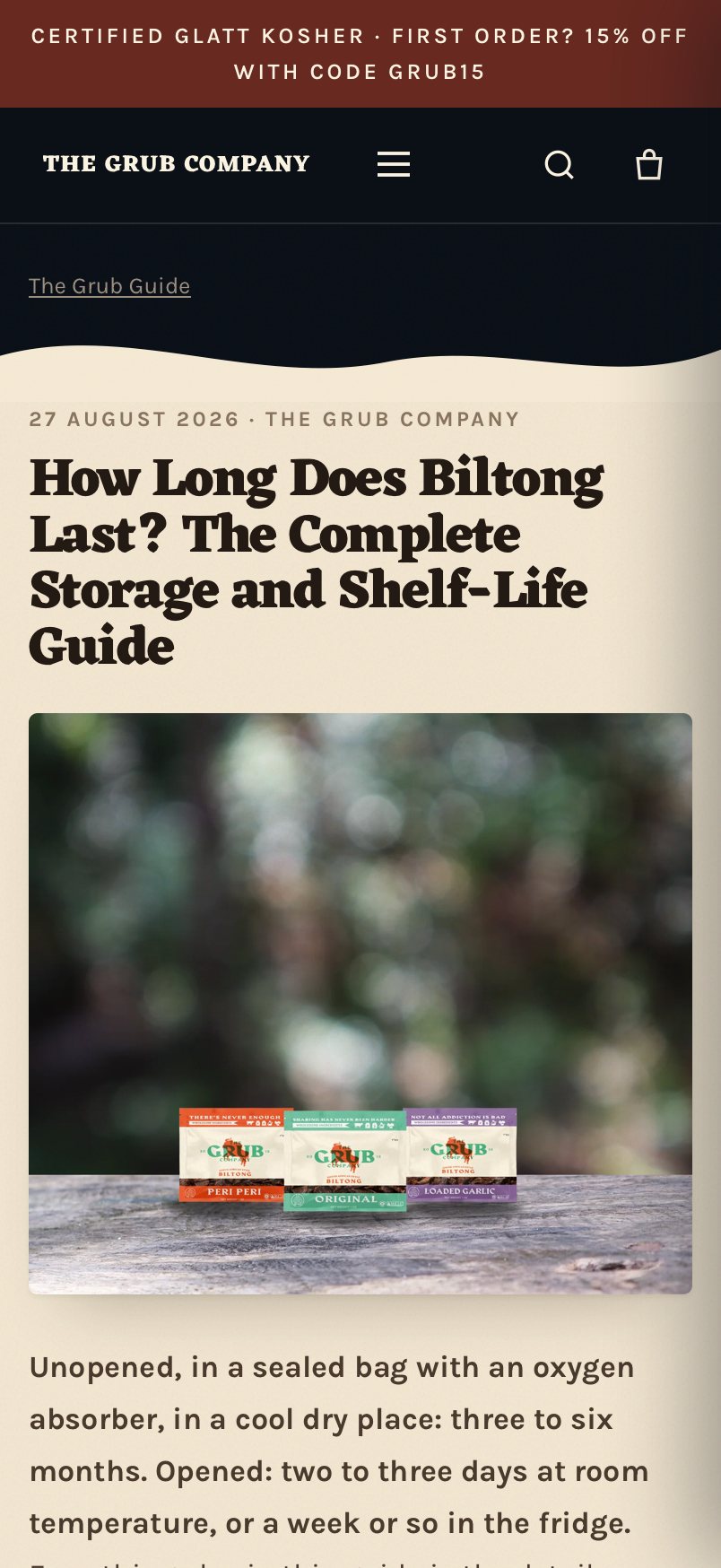
- The page about how long biltong lasts is the leader, and a clean check puts it at position 16 for "how long does biltong last", with Google's AI answer at the top citing it.
- A page about the science and history of meat curing earned 14 clicks in a month at position 6.5.
- A page about whether biltong is raw, cooked and safe earned 9.
- Most articles have earned none.
The pattern is the one seen elsewhere: a few practical answers carry the clicks, and most pages earn little.
8. The part we cannot separate
Pages the articles did not touch also rose. Weekly clicks to the home, product, collection and policy pages ran about 9 a week in May and June and about 22 a week across September 7 to October 5, roughly 2.4 times. Most of that is the home page, which also carries people typing the company's name.
Two things were happening at the same time:
- The articles may have raised awareness and sent people to the home page.
- Paid social ads ran in the same weeks, and a person who sees an ad often searches the name.
Search Console cannot tell these apart. We are not claiming either.
9. The searches the company wants
A clean phone check, no sign-in, United States, October 13:
| Search | Result |
|---|---|
| kosher biltong | #1 |
| how long does biltong last | #16, and Google's AI answer cites the company |
| buy biltong online | #19 |
| kosher beef jerky | not in the top 20 |
The stated goal, to lead for "kosher beef jerky", has not been reached. A collection page aimed at that search moved from about #31 in September to about #17 in early October on one tool, and today is not in the top 20 on another check. We treat both as noisy and will report the trend.
10. AI answers
Four assistants were asked four generic buying questions and four questions shaped like the company's articles, locked before the first run, three samples each, on October 13.
Generic buying questions: where can I buy kosher biltong online · best kosher beef jerky to buy online · where to buy biltong in the USA · kosher meat snacks gift basket for men
Article-shaped questions: how long does biltong last once opened and how should I store it · is biltong raw or cooked and is it safe to eat · biltong vs beef jerky what is the difference · how do I fix mold or texture problems when making biltong
Only one of the four assistants answered. The OpenAI account had no credits left, Gemini's quota was exhausted and Perplexity's key is not set up. That leaves Claude, and Claude only.
What Claude did, 24 answers:
- On "where can I buy kosher biltong online" it named the company in all three samples and linked to the site.
- On "where to buy biltong in the USA" it named the company once in three samples.
- On "best kosher beef jerky" and the gift basket question it did not.
- On the article-shaped questions it linked to the company's pages as a source on how long biltong lasts, in all three samples, and did not name the brand on any article-shaped question.
What we cannot say: how ChatGPT or Gemini answered. Those are the larger audiences, and until the keys and credits are restored this section stays incomplete. It is not a "no".
The long-tail check, October 13
The sets above are broad. People rarely type the broad version, so we ran a second set built from the site's real Search Console searches and the topics it publishes on.
Where the site is cited:
| Question | ChatGPT | Claude | Google AI Mode |
|---|---|---|---|
| best kosher biltong in the usa to order online | named, linked | named, linked | cited |
| where to buy glatt kosher biltong in the usa | named, linked | named, linked | cited |
| does kosher biltong need to be refrigerated after opening | linked | cited | |
| how long does kosher biltong last once opened | linked | cited | |
| can you freeze kosher biltong | linked | cited | |
| is kosher biltong raw meat or cooked | linked | ||
| is kosher biltong safe to eat if it is air dried | linked | cited |
The pattern: when the question says "kosher", both assistants name the company and link the kosher biltong collection. On the how-to questions Claude links the articles.
How these were chosen: from the site's real searches. The table shows the questions where it is cited, so read it as a list of where it appears, not a random sample of everything a customer might ask. One sample each, October 13. ChatGPT logged out, Claude through its API, and Google AI Mode in the owner's signed-in browser, which may favor sites it has visited.
For how assistants choose which businesses to name, see how AI assistants pick businesses and what generative engine optimization is.
11. What went wrong, and what did not move
- "Kosher beef jerky" is not won. It is the single search most worth having.
- A product we did not sell was described in our articles. A "sugar free" biltong variant that is a back-office listing, not something a customer can buy, was mentioned in 31 drafts, 27 of them live. It was found and replaced across all of them.
- A batch of internal links overwrote the buying line on five articles. It was found by an audit and restored.
- The crossword traffic is empty. Tens of thousands of impressions, almost no clicks.
- 173 of 350 articles have never appeared. 131 are under a week old. About 42 older articles are a real miss.
- The rankings check we planned for October 21 is still owed. These are figures from October 13.
12. Why it behaved this way
Why articles appeared in days. A site with a year of history is revisited often. A new section on a known domain is tried quickly. On a brand-new site the same pages took about sixteen days.
Why most clicks come from a few pages. Searches are a long tail. A few practical questions are asked often, and the rest are asked rarely.
Why the crossword article has so many impressions and no clicks. People solving a puzzle search the clue, see the result, and read the answer on the results page. They have no reason to click.
Why a good article can sit at position 16. For a question like "how long does biltong last", the first screen is held by a forum, a video and a large specialist. A page at 16 is on the second page. The AI answer at the top still cited it, which is a different kind of visibility.
Why "kosher biltong" is first but "kosher beef jerky" is not. The first is a term almost nobody else targets. The second is held by three specialists, one with more links than the company has.
Terms used here are defined in the glossary, and the broader method is in the Search Playbook.
13. What we believe, and what this case did to it
This section is opinion.
Be the answer, not the ad. The pages that earned clicks answered a narrow practical question completely. That is the whole bet.
Search did not shrink. It spread out. A company that was invisible a year ago appears for hundreds of searches, most of them small. A few big ones remain out of reach.
Honest numbers are the only ones worth publishing. A graph that stops flattering you is still a graph you can use.
What we refuse to do: we do not count impressions as wins, we do not promise a ranking, we do not name a kosher agency we cannot confirm, and we do not claim a product is certified when nothing confirms it.
What changed our mind: we expected the biggest-impression page to be the best. It is the emptiest.
14. What we are not claiming
- That the articles caused all of the rise. Ads and the home page confound it.
- That the result will repeat, or that 350 is the right number.
- That "kosher beef jerky" is within reach on a known date.
- That any of these clicks became orders. Search Console does not measure sales.
- That the AI-answer result applies to ChatGPT or Gemini. It is Claude only.
15. What we are watching next
Dated, and written down before the result.
- By October 21: the planned rankings check on "kosher beef jerky" and "kosher biltong".
- By November 8: monthly clicks above 200 for a full month, or we say so.
- By November 10: at least 85% of the 131 October articles have appeared in Google.
- When keys and credits are restored: the same eight questions on ChatGPT and Gemini.
16. How to check these numbers
Search Console, property thegrubcompany.com, Performance → Search results, Search type Web, date range June 1, 2025 to October 10, 2026, by month, and the Pages tab filtered to "contains /blogs/news". Weekly cuts are in the downloadable file.
Appendix: questions people ask
How long did it take to see a result? The first rise was in the second month, July to August, and the biggest was in the third, September.
Did the articles cause the rise? Probably much of it. The home page also rose and ads ran, so we do not claim all of it.
Why do you quote clicks and not impressions? Because an impression is a result shown, and a crossword puzzle can generate tens of thousands.
Is a kosher food company easier or harder? Easier on a term nobody else targets, harder on the large generic ones.