Get your clothing or shoe store named by ChatGPT and Google AI.
In 18 AI answers about wide fit shoes, merino basics and plus size clothing, small and specialist brands were named in 17 and Amazon in none. See the answers
When a shopper asks AI which shoes fit wide feet, which merino shirt to buy or where to find clothes that fit, it names a few brands and often a price. RunOctopus writes and publishes the size guides, comparisons and answers on your own store that those answers are built from, and every month shows you with dated screenshots who the AI named.
Run my free scanNames as the AIs printed them. One run, one day. A small direct to consumer brand was first in both.
A shopper used to type a few words into Google and open ten links. Now many of them ask a full question: which shoes fit wide feet, is merino worth the price, where do I find clothes that fit. The AI answers with a short list of brands, often with a price, and a link.
If your brand is on the list, the shopper lands on your store already trusting you. If it is not, the shopper never sees it, however good the product is. And the list is short, because the AI names a few, not a page of results.
Shoppers ask which one to buy. The AI names a few brands. Being one of them is the job.
Best for, versus, where to buy, is it worth it. The AI turns each into a short list of names and often a price.
In our 18 answers, Amazon was named in none. Zappos, Nordstrom, Old Navy and similar retailers appeared in 6, mostly as a place to buy.
Small and specialist brands such as Unbound Merino, Ridge Merino, Universal Standard and Kuru were named in 17 of 18 answers, beside the famous names.
ChatGPT linked brand sites in 8 of its 9 answers, not only a marketplace.
Google repeated one plus size brand size exchange policy by name in two answers. A clear policy on your own page is a fact the AI can use.
Online stores are not all built the same, and what gets you named is different for each. Pick the one that sounds like you and jump to it. The rest of the page applies to all four.
You can be named at any size. A small catalog needs real pages for the decisions shoppers make. A large one needs guides and collections, never a page for every item.
Under about fifty products. Start with your best sellers and the questions that decide the sale.
Hundreds or thousands of products. Guides and collection introductions first, never a page for every item.
A store that sells other people's brands. Say what you know that a brand page cannot.
Socks, tees, underwear and anything people reorder. Answer the worth it question honestly.
A shopper who wants shoes that fit wide feet does not browse for an hour. They type one question, read one answer and click one link. Everything we do aims at one of the steps in between.
The AI does not know your brand. It searches the way you would, reads the pages it finds (your store, reviews, forums, fashion and gear sites, comparison guides) and writes an answer from what those pages say. It leans on pages that answer the exact question asked: "Kuru vs Brooks vs New Balance: which is better for wide feet?"
That is the opening. A marketplace has millions of listings, but a listing rarely answers a comparison. A store that has a clear guide for the exact question can be the page the answer is built from. In our check, small and specialist brands were named in 17 of 18 answers.
Six things kept showing up in the brands that got named. None of them is "spend more on ads." All of them live on your own store, or on pages that point to it.
One page for each decision a shopper makes, the answer first, and facts only you can give.
"Wide Fit Shoes: Kuru vs Brooks vs New Balance" beats "Our Shoes" every time.
The difference, the price range or the verdict in the first two sentences. The AI quotes that line.
Your sizes, widths, fabric blends, care labels and exchange policy. Specific beats polished.
Reviews, forum threads, fashion and gear sites and editors that name you. The AI trusts what others say about you.
The same brand name, logo and facts everywhere, so the AI is sure every mention is one brand.
A price or spec page from three years ago tells the AI you stopped paying attention.
Shoppers ask AI in three ways, and each one needs a different page. A store that only has product pages is missing two of the three.
Sample These are real questions Google shows people (checked October 23, 2026) about shoes and clothes. On your account, every question comes from your own Search Console and what your shoppers really ask, and you see the list before we check it.
People ask which one is best, how two compare, and whether it is worth it or safe to buy. Write for all three.
"Are Hokas or Brooks better for wide feet?"
"What brand of sneakers are the widest?"
"Where can I find good quality plus size clothing?"
"Where can I buy a plus size business attire?"
"What is better than merino wool?"
"Does plus-size clothing cost more?"
"Why is the Universal Standard so expensive?"
"Are merino t-shirts worth it?"
"Are Universal Standard clothes good quality?"
"Can you machine wash 100% merino wool?"
"Does merino wool shrink if you wash?"
"Does 0.5 shoe size make a difference?"
A product page tells a shopper what a product is. The AI is usually asked something else: which one, how do they compare, is it worth it. Those answers come from other kinds of pages, and most stores do not have them.
Each kind below answers one family of questions, and each one links to your real products.
Keep your product pages. Add the guides, comparisons and answers the AI is asked for.
"Best for" pages. Who each product suits, what to look for, and your honest pick.
Two products, two brands or two types side by side, with a verdict and a table.
What it is made of, how it fits, which widths and sizes you carry. Facts only you can give.
How to wash it, wear it and make it last. The questions after the sale.
A real paragraph on top of a collection, so the page says what it is and who it is for.
Price, value and when not to buy. Honest pages are the ones people trust and quote.
Clothing and shoe shoppers asked which brand fits, and both AIs answered with fit facts: width codes, blend percentages, fabric weights and size ranges. Pick a category and see what each AI quoted, as printed on October 22 and 23, 2026.
These are the AIs' words and ranges, not quotes and not our prices. Nothing here is about foot pain, health or bodies, and our pages never make those claims.
The AI repeats the fit facts it can find. When it cannot find them, it guesses, and the two AIs guessed differently.
Both AIs used width codes, not just the word wide.
ChatGPT told shoppers to look for Wide (W or D for women), Extra Wide (2E) or XX-Wide (4E), and to check the size chart because width labels vary by brand. It printed up to 6E in some men's models for one brand and up to 4E for another, and warned that a wide shoe is not always a wide toe box.
Google AI printed a width table by brand: standard D or B, wide 2E or D, extra wide 4E or 2EE. For one brand it said wide versions come only on select models, and it sent shoppers to a store where they can filter by width code.
Width code for men and for women, toe box shape, and whether the insole comes out.
Print the width code on every shoe, men's and women's, and say plainly which models come in it.
Both AIs described merino tees by blend and fabric weight before price.
ChatGPT suggested about 150 to 190 GSM for everyday use, 100 percent merino for the most odor resistance and a nylon blend for durability. It printed one tee as 88% merino and 12% nylon, and listings from $48 to $98.
Google AI described tees as 100 percent superfine 17.5 micron merino, 78% merino with 22% nylon, 87% merino with 13% nylon, and 85 to 150 g/m2. It put basics at $70 to $130+.
Merino percent, nylon or spandex percent, fabric weight in GSM, and the care: a cool, gentle wash and air-drying.
Print the blend, the GSM and the care on every merino piece. A tee with no numbers gives the AI nothing to compare.
The two AIs printed size ranges for each brand, and not always the same ones.
ChatGPT printed styles up to size 40 for one brand, 14 to 32 for another and 10 to 30 for a third, and told shoppers to check garment measurements, fabric composition and the return policy.
Google AI printed 14 to 32 for one brand in one answer and 14 to 28 in two others, and 10 to 40 for another brand in one answer and 12 to 28 in two. It quoted one brand's size exchange program by its name in all three plus-size answers.
The size range for each style, garment measurements, fabric composition, and the exchange policy.
Print the exact size range on every style, and give your fit or exchange policy a name. The AI quoted the one that had a name.
A small, specialist or direct-to-consumer brand was named in 17 of the 18 answers. A well-known national brand was also named in 17. So the specialist usually sat right beside the famous name, and it was named first in 12.
One run per question over two days, read by hand. Which brand counts as a specialist is our judgment, and the big plus-size chains are counted on their own. It is not a ranking.
A specialist with clear fit facts sat beside, and often ahead of, the household names.
Wide-fit shoe makers, merino specialists and plus-size brands. ChatGPT named one in all 9 of its answers.
The one that did not was the plus-size comparison. ChatGPT also put a dollar price in 8 of 9.
A big shoe store, a department store or a large clothing chain. Amazon itself was named in none.
Every range the two AIs printed, on one scale. The gridlines mark $20, $50, $100 and $200. Orange is ChatGPT, purple is Google AI. Neither AI gave dollar ranges for plus-size clothing, so it is not on the ladder.
As printed on October 22 and 23, 2026. Not quotes and not our prices.
From $20 merino socks to $170 shoes, with a fit fact beside almost every price.
Exactly as printed on October 22 and 23, 2026. ChatGPT logged out and Google AI Mode through our own search data account, one run each. Not quotes.
In their answers, both AIs told shoppers what to check before paying. Each one is a line a clothing or shoe product page can answer first, so the AI finds it on your page instead of telling the shopper to go and ask.
Print the code, the chart, the blend, the measurements and the return terms.
ChatGPT and Google AI, shoes: look for the width code (D, 2E, 4E) for your size, not just the word wide.
ChatGPT, shoes: a wide shoe is not necessarily a shoe with a wide toe box. Compare the shape of the front of the shoe as well as the width label.
ChatGPT, shoes: width labels vary by brand, so check the size chart rather than assuming all wide shoes fit alike.
ChatGPT, shoes: check return shipping fees, sale-item restrictions, and whether worn shoes can be returned, before ordering.
ChatGPT, plus size: sizing, fabric and construction vary between garments, so check garment measurements and fabric composition.
ChatGPT and Google AI, merino: say whether it is 100 percent merino or a nylon blend, and the fabric weight. ChatGPT suggested about 150 to 190 GSM for everyday use.
ChatGPT and Google AI, merino: a cool or cold, gentle wash and air-drying. Google AI said no high-heat tumble drying.
Google AI, plus size: it quoted the size exchange program of one brand by name in all three answers. If your size or fit policy has a name, use it on every page.
On October 22 and 23, 2026 we asked both AIs about three kinds of clothing and shoes where small brands compete: wide fit everyday shoes, merino wool basics and plus size clothing. For each we asked best for, a brand comparison, and where to buy. That is 18 answers, with the misses left in.
Small and specialist brands were named in 17 of 18 answers. Amazon was named in none.
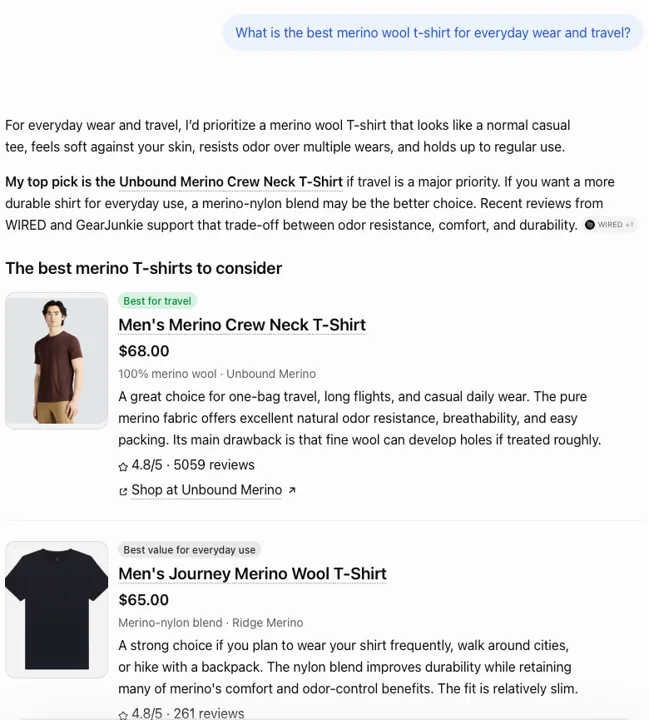
The real answer for the merino t-shirt question, cropped and untouched. It names Unbound Merino first and Ridge Merino second, with prices and review counts.
"My top pick is the Unbound Merino Crew Neck T-Shirt if travel is a major priority." A verdict with a condition is a line an AI can quote.
Unbound Merino and Ridge Merino lead, ahead of Icebreaker and Smartwool. Both are small brands with strong product pages.
Pure merino resists odor but can develop holes. A blend lasts longer. Honest trade-offs like that come from pages that state them.
Brands named in each answer, in the order each AI listed them. Logged-out ChatGPT and Google AI Mode through our own search data account, October 22 and 23, 2026, one run each.
What this means for you. The AI did not simply name the biggest brand or a marketplace. It named small and specialist brands such as Unbound Merino, Universal Standard and Kuru beside HOKA, Smartwool and Lane Bryant. Where a shopper asked where to buy, it often linked the brand's own site.
What we have not shown. We have no apparel or shoe client result yet, and we do not claim one. The parent E-Commerce page has the one example we can share, from a food store, with its limits.
What this does not prove. Three categories, one run per question, two days. Which brands count as small or specialist is our judgment, and some, such as Torrid or Lane Bryant, are large specialty chains. AI answers change, so we re-check every month. It does not promise your result.
The answers showed where they got their picks. ChatGPT linked a brand's own site in 8 of its 9 answers. Google and ChatGPT also pointed to independent sources: Reddit threads, WIRED, GearJunkie, RunRepeat, Verywell Fit, Business Insider and Makers Row.
So being named is not one trick. The AI reads what others say about you and what you say about yourself, and it prefers a page that answers the exact question. A product page alone is not enough.
The AI reads reviews, forums, editors and your own pages. We write the pages that answer the exact question.
ChatGPT linked brand sites such as Unbound Merino, Ridge Merino, Universal Standard and Kuru. A clear brand page gets the link.
WIRED and GearJunkie were cited for merino, and RunRepeat and Business Insider for shoes and plus size. Being on pages like these helps, and we do not buy placement.
Shoppers ask and answer there. We do not post for you. We write pages that answer the same questions clearly.
ChatGPT told shoppers to check each brand size chart rather than assume widths match. Clear size and fit facts matter.
Zappos, Nordstrom, Old Navy and H and M appeared as places to buy in 6 of 18 answers. They are an option, not the whole answer.
Google cited small fashion blogs and roundups on the plus size comparison. Guides are a way in for a small store.
You do not write or approve anything. Our AI agent, Ollie, does the research and the writing, our team checks it, and it goes live on your site.
You write nothing. We find the questions, write and publish the pages, then check every month.
We read your catalog, your collections, your Search Console and the pages of your competitors, and list the questions shoppers ask in your categories.
We ask ChatGPT and Google AI those questions and save dated screenshots of which brands get named.
Buying guides, comparisons, ingredient and care pages, collection introductions. Real facts about your products, never filler.
Each page goes live with its FAQ and links to your real products, then we load it to confirm.
We re-run the same questions and show you who is named now, next to last month.
Your brand name, logo and details cleaned up so the AI reads one brand.
Here is the shape of a comparison page we would write for a shoe store. The details change for every product, but the parts do not.
The title is the question. Written the way a shopper would type it. Not "Our Shoes" but "Wide Fit Shoes: Which Brand Fits Wider?"
The answer comes first. The difference in two or three sentences: which widths each brand makes, how the toe box fits, and what each costs.
Then a table. Side by side, so the AI has clean facts to quote and a shopper can scan.
Then facts only you have. Your sizes and widths, your return and exchange policy, and which of your products is which.
Then the paths. Links to the next question and to the real product page.
You have probably been burned by marketing that takes a quarter to show anything. So here is the first week, and what you can see each day. You do not write or approve anything along the way.
Google usually takes a few weeks to show new pages, so the first week is about getting the right pages live and your starting answers saved. The monthly re-check is where you see whether the AI's answer has moved.
We do not promise a result, because AI answers change and no one controls them. What we can do is show you the math you will run in your head anyway. Put in what one order is worth to you.
Sample The starting numbers are an example. Type your own and watch it change. It shows revenue, not profit.
If a few extra orders a month do not cover it, this is not for you, and we will say so on the call.
3 product areas x 5 extra orders a month x $60 x 12 months.
Arithmetic only. We do not promise orders. Use your own numbers.
In our 18 answers Amazon was not named once. Zappos, Nordstrom and similar retailers appeared in 6, mostly as a place to buy, and small or specialist brands were named in 17.
A description says what a product is. The AI is asked which one to buy and whether it is worth it. Those answers come from guides and comparisons.
Ask any provider what it checks each month. We run the same questions in ChatGPT and Google AI and show dated screenshots of who was named.
Small and direct to consumer brands were named beside famous brands. The work is real pages for real questions.
You write nothing and approve nothing. Everything we publish is on your site and recorded in your account.
We cannot promise orders. The 90 day guarantee covers how often Google shows your site, and you keep every page either way.
These store pages are being written next. Each one starts with its own check of what AI says in that category.
Most online stores already pay for something. Here is what each one does about AI answers, in plain terms.
| Option | What It Does | AI Answers |
|---|---|---|
| Marketplace listings | Sells your product on their page | Their name on the listing, not your brand in the answer |
| Paid ads and shopping feeds | Rents you a click | An ad beside the answer, not in it |
| An SEO app | Edits titles and tags on existing pages | Nothing new for the AI to quote |
| An SEO or content agency | Reports, some posts, monthly calls | Sometimes, often not checked |
| RunOctopus | Writes, publishes and checks the guides and comparisons, every week | Checked monthly, screenshots shown |
Many now ask ChatGPT or Google's AI which brand to buy and where to buy it. Each answer names a few brands, often with a price, and the ones named get the click. We do not quote a share of shoppers, because the figures we found had no source.
In our check of 18 answers across three kinds of clothing and shoes, Amazon was not named in any. A mass retailer or marketplace such as Zappos, Nordstrom or Old Navy appeared in 6 of 18, mostly as a place to buy. Small, specialist or direct to consumer brands were named in 17 of 18.
Size did not decide it in our check. Small and direct to consumer brands such as Unbound Merino, Ridge Merino, Universal Standard and Orthofeet were named beside the big names. What mattered was a page that answers the exact question, and other sites that back it up.
Prices, sizes and widths, fabric facts, care steps and policies. Several Google answers repeated one brand's size exchange policy by name. Clear facts on your own pages are what an AI can quote.
A product page says what a product is. The AI is asked which one fits, which is better, and whether it is worth the price. Those answers live on guides, comparisons and fit pages, not on a product description.
Buying guides, comparison pages, fabric and material pages, size and fit guides, care and how-to pages, and real introductions for your collections. Each one answers a question a shopper actually asks, and links to your real products.
No. We write only what your own product pages and labels already state, and we leave out health, comfort and environmental claims you cannot back up. We do not invent fabrics, certifications or reviews.
RunOctopus began with Shopify stores and also works with WordPress sites. Other platforms are case by case. Tell us your platform when you scan and we will say plainly what we can publish and what we hand to you.
No. AI answers change week to week and nobody controls them. We put the right pages on your store, check each month who the AI names and show dated screenshots, and refund you if your Google appearances are not up after 90 days.
An SEO app edits titles, descriptions and tags on the pages you already have. We write the missing pages the AI quotes, publish them, and check the answers every month.
A marketplace sells you a slot on its page, and ads rent you a click. An AI answer names a few brands with reasons, and nobody sells that slot. Your pages stay on your own site whether or not you keep paying.
No. We research the questions, write the pages in your brand's voice, publish them and check them live. You can read everything, but nothing waits on you.
Access to your store and Google Search Console, and anything that makes your products different, such as fabric sourcing, sizing and fit notes. We look up the rest ourselves.
One honest note on size: AI answers are one channel among several, and for most stores search and email still bring most orders. The work is to build the pages that answer real questions well, and to check each month which ones the AI now trusts.
The pieces behind this page, in plain words.
Our library of guides for online stores, in one place.
The Answer-Engine PlaybookHow AI picks the stores it names, step by step.
What AI Search Visibility MeansThe idea behind being named in an answer.
Get Your Business on ChatGPTWhat to put on your site so ChatGPT can name you.
RunOctopus Compared with an SEO AgencySide by side, in plain terms.
A Case Study, Misses IncludedA recruiting site we write for, with every number and every miss.
We research the questions, write and publish the pages, check every one, and show you each month who the AI named. If your Google numbers are not up at 90 days, you get your money back and keep every page.
Click Here to Start with the Free Scan →How the 90-day promise works: we compare how often your site is shown in Google in the 90 days after your first page goes live against the 90 days before. It covers how often Google shows your site, not a particular ranking or a spot in a particular AI answer, because nobody can promise those. The price you start at is the price you keep, even when it goes up for new customers.
Type your store's address. The free scan shows what AI can and can't read, and which pages you're missing.
Run My Free Scan