Get your store and your products named by ChatGPT and Google AI.
In 18 AI answers about mattresses, rugs and cast iron cookware, direct and specialty brands were named in 17 and Amazon in 2. See the answers
When a shopper asks AI which one to buy, or where to buy it, it names a few brands and often a price. RunOctopus writes and publishes the guides, comparisons and answers on your own store that those answers are built from, and every month shows you with dated screenshots who the AI named.
Run my free scanNames as the AIs printed them. One run, one day. Google card order is approximate.
A shopper used to type a few words into Google and open ten links. Now many ask a full question: which mattress is best for a side sleeper, are washable rugs worth it, is an expensive pan worth the money. The AI answers with a short list of brands, often with a price, and a link.
Home goods are a considered purchase. The shopper is spending real money on something that sits in the house for years, so they ask before they buy. If your brand is on the AI's short list, the shopper arrives already trusting you. If it is not, they never see you.
Shoppers ask which one to buy and whether it is worth the price. The AI names a few brands. Being one of them is the job.
A mattress, a rug or a good pan is not an impulse buy. Shoppers ask which one, how two compare, and whether it is worth it.
ChatGPT put a dollar price next to the brands in 8 of its 9 answers, so a store with honest prices on its pages can be quoted.
In 18 answers Amazon was named in 2, both as a place to buy. Mass retailers and marketplaces appeared in 9.
ChatGPT linked the brand's own site in 8 of its 9 answers, not only a retailer.
The answers to versus questions leaned on comparison guides, review sites and Reddit threads. A store with a clear comparison page can be one of those sources.
Online stores are not all built the same, and what gets you named is different for each. Pick the one that sounds like you and jump to it. The rest of the page applies to all four.
You can be named at any size. A small catalog needs real pages for the decisions shoppers make. A large one needs guides and collections, never a page for every item.
Under about fifty products. Start with your best sellers and the questions that decide the sale.
Hundreds or thousands of products. Guides and collection introductions first, never a page for every item.
A store that sells other people's brands. Say what you know that a brand page cannot.
Custom sizes, long lead times, handmade pieces. Answer the wait and the worth it questions plainly.
A shopper who needs a new rug does not browse for an hour. They type one question, read one answer and click one link. Everything we do aims at one of the steps in between.
The AI does not know your brand. It searches the way you would, reads the pages it finds (your store, reviews, forums, review sites, comparison guides) and writes an answer from what those pages say. It leans on pages that answer the exact question asked: "Ruggable vs Rugs USA washable rugs: which is better?"
That is the opening. A marketplace has millions of listings, but a listing rarely answers a comparison. A store that has a clear guide for the exact question can be the page the answer is built from. In our check, direct and specialty brands were named in 17 of 18 answers.
Six things kept showing up in the brands that got named. None of them is "spend more on ads." All of them live on your own store, or on pages that point to it.
One page for each decision a shopper makes, the answer first, and facts only you can give.
"Washable Rugs for Kids and Pets" beats "Our Rugs" every time.
The difference, the price range or the verdict in the first two sentences. The AI quotes that line.
Your materials, your sourcing, your testing, your dimensions. Specific beats polished.
Reviews, forum threads, review sites and editors that name you. The AI trusts what others say about you.
The same brand name, logo and facts everywhere, so the AI is sure every mention is one brand.
A price or size page from three years ago tells the AI you stopped paying attention.
Shoppers ask AI in three ways, and each one needs a different page. A store that only has product pages is missing two of the three.
Sample These are real questions Google shows people (checked October 23, 2026) in the three categories we tested. On your account, every question comes from your own Search Console and what your shoppers really ask, and you see the list before we check it.
People ask which one is best, how two compare, and whether it is worth it or safe to buy. Write for all three.
"What firmness of mattress should a side sleeper use?"
"Which cast iron skillet to get?"
"What type of rug is best for a kid's room?"
"Is it better to buy a mattress online?"
"Which washable rug is better, Tumble or Ruggable?"
"What's better than Ruggable?"
"How long should a $1000 mattress last?"
"What are the downsides of washable rugs?"
"Are handmade rugs better?"
"How long do cast iron pans last?"
"Can you use soap on cast iron pans?"
"Which cast iron is worth money?"
A product page tells a shopper what a product is. The AI is usually asked something else: which one, how do they compare, is it worth it. Those answers come from other kinds of pages, and most stores do not have them.
Each kind below answers one family of questions, and each one links to your real products.
Keep your product pages. Add the guides, comparisons and answers the AI is asked for.
"Best for" pages. Who each product suits, what to look for, and your honest pick.
Two products, two brands or two types side by side, with a verdict and a table.
What it is made of, what size to pick and what to avoid. Facts only you can give.
How to use it, store it, clean it and make it last. The questions after the sale.
A real paragraph on top of a collection, so the page says what it is and who it is for.
Price, value and when not to buy. Honest pages are the ones people trust and quote.
A direct-to-consumer or specialty brand was named in 17 of the 18 answers. The small makers came up in cast iron, where the AIs named four of them. A big store or marketplace was named in 9 of 18.
One run on one day, read by hand. Which brand counts as small or specialty is our judgment. It is not a ranking.
The AIs named the brands that explain themselves, from a foundry founded in 1896 to a new maker.
The one miss was a Google mattress answer whose brand names sat in product cards that did not come through as text.
All six were cast iron answers. Lodge, founded in 1896, was also named in all six.
A big store or marketplace of any kind, Amazon, Walmart, Home Depot, Wayfair, Pottery Barn, Etsy, Macy's or a mattress chain, came up in 9 of 18.
Every range the two AIs printed, on one scale. The gridlines mark $10, $100, $1,000 and $10,000. Orange is ChatGPT, purple is Google AI. A missing bar means that AI gave no range for it.
As printed on October 23, 2026. Not quotes and not our prices.
From a $20 pan to a $10,000 rug, with a verdict on the premium at every step.
Exactly as printed on October 23, 2026. ChatGPT logged out and Google AI Mode through our own search data account, one run each. Not quotes.
In their answers, both AIs told shoppers what to check before paying. Each one is a line a home goods product page can answer first, so the AI finds it on your page instead of telling the shopper to go and ask.
Print the trial, the fees, the fiber, the construction and the real size.
ChatGPT, mattresses: before buying, check the current price, return fees and at-home trial terms. It said one brand typically charges a $99 return processing fee.
Both AIs, mattresses: one brand includes in-home delivery and setup, the other ships in a box with setup as an extra. Say which you do.
Google AI, mattresses: look for brands with good sleep trials, free returns and solid warranties, ideally 10+ years.
ChatGPT and Google AI, rugs: not every rug sold as wool is all wool. Read the material specifications so you do not buy a wool and synthetic blend by accident.
ChatGPT, rugs: a hand-knotted, a hand-tufted and a machine-made wool rug can have very different prices and lifespans. Check the exact construction and dimensions of the rug.
ChatGPT and Google AI, washable rugs: check the care instructions and the capacity of your washer before buying a large size. Washable does not mean easy to wash at home.
ChatGPT, cast iron: the advertised diameter of a skillet is measured across the top, not the flat cooking surface.
Google AI, mattresses: on budget marketplace mattresses, inspect foam densities and review return policies carefully, because returning an expanded mattress is a chore.
On October 23, 2026 we asked both AIs about three kinds of home products where small and mid-size stores compete: mattresses, washable and wool rugs, and cast iron and carbon steel cookware. For each we asked best for, a brand comparison, and where to buy. That is 18 answers, with the misses left in.
Direct and specialty brands were named in 17 of 18 answers. Amazon was named in 2.
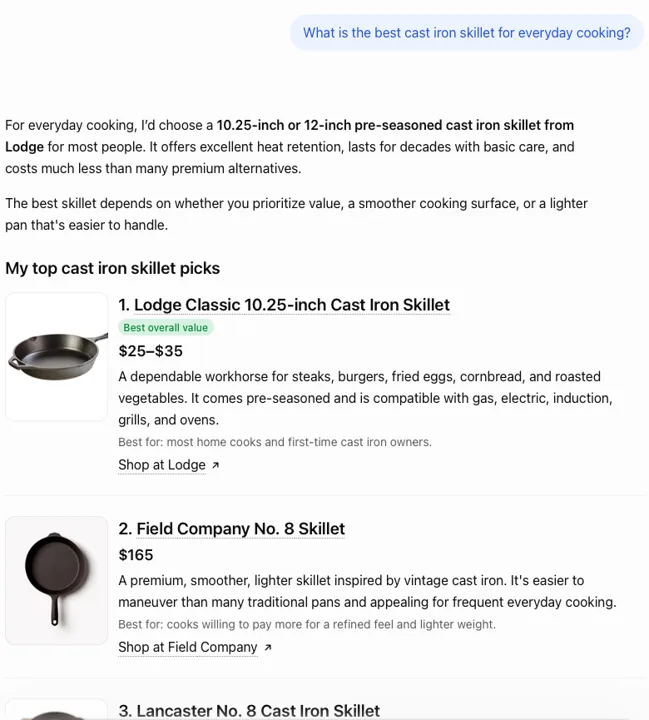
The real answer for the cast iron question, cropped and untouched. It names Lodge first, then Field Company, a small maker.
Lodge is $25 to $35 and the best overall value. Field Company is $165 for a smoother, lighter pan. Prices and reasons are what an AI can quote.
Field Company and Lancaster were named in the same answer as Lodge, a company founded in 1896.
Each pick came with a link to the brand's own store: Shop at Lodge, Shop at Field Company.
Brands named in each answer, in the order each AI listed them. Logged-out ChatGPT and Google AI Mode through our own search data account, October 23, 2026, one run each.
What this means for you. The AI did not simply name the biggest brand or a marketplace. In cast iron, small makers such as Field Company, Lancaster and Smithey were named beside Lodge. In mattresses, the names were mid-size direct brands such as Helix, Saatva and Nectar, and no tiny maker appeared. Where a shopper asked where to buy, the AI often sent them to the brand's own site.
What this does not prove. Three categories, one run per question, one day. Which brands count as small is our judgment. Google's answer to the best mattress question put its brand names in product cards that did not come through as text, so we counted it as naming no brand. AI answers change, so we re-check every month. It does not promise your result.
The answers showed where they got their picks. ChatGPT linked a brand's own site in 8 of its 9 answers. Google and ChatGPT also pointed to independent sources: Serious Eats, Wirecutter, The Kitchn, Taste of Home, Sleep Foundation, Consumer Reports, Good Housekeeping, House Beautiful and Reddit threads.
So being named is not one trick. The AI reads what others say about you and what you say about yourself, and it prefers a page that answers the exact question. A product page alone is not enough.
The AI reads reviews, forums, editors and your own pages. We write the pages that answer the exact question.
ChatGPT linked brand sites such as Ruggable, Tumble, Helix, Saatva and Field Company. A clear brand page gets the link.
Serious Eats, Wirecutter, Sleep Foundation and Good Housekeeping were cited. We do not buy placement on any of them.
Shoppers ask and answer there, and Reddit was cited on rugs, mattresses and cast iron. We do not post for you. We write pages that answer the same questions clearly.
The versus questions leaned on comparison pages such as Mattress Clarity. A store with a clear comparison page can be a source.
Walmart, Home Depot, Wayfair, Pottery Barn, Macy's and Amazon appeared as places to buy in 9 of 18 answers. They are an option, not the whole answer.
Some review sites earn a commission when you buy. We cannot judge any one site, so we write pages on your own store and never buy a place on someone else's list.
You do not write or approve anything. Our AI agent, Ollie, does the research and the writing, our team checks it, and it goes live on your site.
You write nothing. We find the questions, write and publish the pages, then check every month.
We read your catalog, your collections, your Search Console and the pages of your competitors, and list the questions shoppers ask in your categories.
We ask ChatGPT and Google AI those questions and save dated screenshots of which brands get named.
Buying guides, comparisons, ingredient and care pages, collection introductions. Real facts about your products, never filler.
Each page goes live with its FAQ and links to your real products, then we load it to confirm.
We re-run the same questions and show you who is named now, next to last month.
Your brand name, logo and details cleaned up so the AI reads one brand.
Here is the shape of a buying guide we would write for a rug store. The details change for every product, but the parts do not.
The title is the question. Written the way a shopper would type it. Not "Our Rugs" but "Washable Rugs for Kids and Pets: What to Look For and What They Cost."
The answer comes first. The pick and the reason in two or three sentences: which kind of rug suits a busy room, what it costs and what the trade-off is.
Then a table. Side by side, such as one-piece and two-piece washable rugs, so the AI has clean facts to quote and a shopper can scan.
Then facts only you have. Your materials, your sizes, your care instructions, and which of your products is which.
Then the paths. Links to the next question and to the real product page.
You have probably been burned by marketing that takes a quarter to show anything. So here is the first week, and what you can see each day. You do not write or approve anything along the way.
Google usually takes a few weeks to show new pages, so the first week is about getting the right pages live and your starting answers saved. The monthly re-check is where you see whether the AI's answer has moved.
We do not promise a result, because AI answers change and no one controls them. What we can do is show you the math you will run in your head anyway. Put in what one order is worth to you.
Sample The starting numbers are an example. Type your own and watch it change. It shows revenue, not profit.
If a few extra orders a month do not cover it, this is not for you, and we will say so on the call.
3 product areas x 5 extra orders a month x $60 x 12 months.
Arithmetic only. We do not promise orders. Use your own numbers.
In our 18 answers Amazon was named in 2, both as a place to buy. Direct and specialty brands were named in 17.
A description says what a product is. The AI is asked which one to buy and whether it is worth it. Those answers come from guides and comparisons.
Ask any provider what it checks each month. We run the same questions in ChatGPT and Google AI and show dated screenshots of who was named.
In cast iron, small makers were named beside Lodge. In mattresses the names were mid-size direct brands, so size can matter more in some categories. The work is real pages for real questions.
You write nothing and approve nothing. Everything we publish is on your site and recorded in your account.
We cannot promise orders. The 90 day guarantee covers how often Google shows your site, and you keep every page either way.
These store pages are being written next. Each one starts with its own check of what AI says in that category.
Most online stores already pay for something. Here is what each one does about AI answers, in plain terms.
| Option | What It Does | AI Answers |
|---|---|---|
| Marketplace listings | Sells your product on their page | Their name on the listing, not your brand in the answer |
| Paid ads and shopping feeds | Rents you a click | An ad beside the answer, not in it |
| An SEO app | Edits titles and tags on existing pages | Nothing new for the AI to quote |
| An SEO or content agency | Reports, some posts, monthly calls | Sometimes, often not checked |
| RunOctopus | Writes, publishes and checks the guides and comparisons, every week | Checked monthly, screenshots shown |
Many now ask ChatGPT or Google's AI which one to buy, which is better, and where to buy it. Each answer names a few brands, often with a price, and the ones named get the click. We do not quote a share of shoppers, because the figures we found had no source.
In our check of 18 answers about mattresses, rugs and cast iron cookware, Amazon was named in 2, both times as a place to buy. A mass retailer or marketplace such as Walmart, Home Depot, Wayfair, Pottery Barn or Macy's was named or linked in 9. Direct-to-consumer and specialty brands were named in 17.
It depends on the category. In cast iron, small makers such as Field Company, Lancaster and Smithey were named beside Lodge. In mattresses, the names were mid-size direct brands, and no tiny maker appeared. What helped was a page that answers the exact question, and other sites that back it up.
A product page says what a product is. The AI is asked which one to buy, which is better, and whether it is worth the price. Those answers live on guides, comparisons and buying pages, not on a product description.
Yes. Editors and review sites such as Serious Eats, Wirecutter, Sleep Foundation and Good Housekeeping were cited in the answers, along with Reddit. Some mattress review sites earn commissions when readers buy, and public reports from 2016 described lawsuits over how a few disclosed that. We cannot say how any one site behaves. We do not buy placement or write fake reviews. We write pages on your own site.
Buying guides, comparison pages, material and size pages, care and how-to pages, and real introductions for your collections. Each one answers a question a shopper actually asks, and links to your real products.
RunOctopus began with Shopify stores and also works with WordPress sites. Other platforms are case by case. Tell us your platform when you scan and we will say plainly what we can publish and what we hand to you.
No. Every page is about your real catalog, checked against your public product pages. We do not invent products, materials, certifications or reviews.
No. AI answers change week to week and nobody controls them. We put the right pages on your store, check each month who the AI names and show dated screenshots, and refund you if your Google appearances are not up after 90 days.
An SEO app edits titles, descriptions and tags on the pages you already have. We write the missing pages the AI quotes, publish them, and check the answers every month.
A marketplace sells you a slot on its page, and ads rent you a click. An AI answer names a few brands with reasons, and nobody sells that slot. Your pages stay on your own site whether or not you keep paying.
No. We research the questions, write the pages in your brand's voice, publish them and check them live. You can read everything, but nothing waits on you.
Access to your store and Google Search Console, and anything that makes your products different, such as materials, sourcing, sizing or testing. We look up the rest ourselves.
One honest note on size: AI answers are one channel among several, and for most stores search and email still bring most orders. The work is to build the pages that answer real questions well, and to check each month which ones the AI now trusts.
The pieces behind this page, in plain words.
Our library of guides for online stores, in one place.
The Answer-Engine PlaybookHow AI picks the stores it names, step by step.
What AI Search Visibility MeansThe idea behind being named in an answer.
Get Your Business on ChatGPTWhat to put on your site so ChatGPT can name you.
RunOctopus Compared with an SEO AgencySide by side, in plain terms.
A Case Study, Misses IncludedA recruiting site we write for, with every number and every miss.

We research the questions, write and publish the pages, check every one, and show you each month who the AI named. If your Google numbers are not up at 90 days, you get your money back and keep every page.
Click Here to Start with the Free Scan →How the 90-day promise works: we compare how often your site is shown in Google in the 90 days after your first page goes live against the 90 days before. It covers how often Google shows your site, not a particular ranking or a spot in a particular AI answer, because nobody can promise those. The price you start at is the price you keep, even when it goes up for new customers.
Type your store's address. The free scan shows what AI can and can't read, and which pages you're missing.
Run My Free Scan