Get your jewelry store and its pieces named by ChatGPT and Google AI.
In 18 AI answers about lab-grown rings, earrings and custom necklaces, small and independent brands were named in 13 and Amazon in none. See the answers
When a shopper asks AI which engagement ring brand, earrings or custom necklace to buy, or where to buy it, it names a few brands and often a price. RunOctopus writes and publishes the guides, comparisons and answers on your own store that those answers are built from, and every month shows you with dated screenshots who the AI named.
Run my free scanNames as the AIs printed them. One run, one day. Small brands led, with Etsy beside them.
A shopper used to type a few words into Google and open ten links. Now many of them ask a full question: which one should I buy, is it worth the price, where do I get it. The AI answers with a short list of brands, often with a price, and a link.
If your brand is on the list, the shopper lands on your store already trusting you. If it is not, the shopper never sees it, however good the product is. And the list is short, because the AI names a few, not a page of results.
Shoppers ask which one to buy. The AI names a few brands. Being one of them is the job.
Best for, versus, where to buy, is it worth it. The AI turns each into a short list of names and often a price.
In our 18 answers, Amazon was named in none. Etsy was named in 7, all on necklaces, and Nordstrom and Walmart once each.
Small and independent brands were named in 13 of 18 answers. Big chains were named in 14, often because the shopper asked about them.
ChatGPT linked a brand or shop site in 7 of its 9 answers, not only a marketplace.
In an earlier check, Google listed two guides from a specialty food store we work with as sources on a biltong question.
Online stores are not all built the same, and what gets you named is different for each. Pick the one that sounds like you and jump to it. The rest of the page applies to all four.
You can be named at any size. A small catalog needs real pages for the decisions shoppers make. A large one needs guides and collections, never a page for every item.
Under about fifty pieces. Start with your best sellers and the questions that decide the sale.
Hundreds or thousands of pieces. Guides and collection introductions first, never a page for every item.
A store that sells other people's brands. Say what you know that a brand page cannot.
Personalized pieces. Say what you make, how long it takes and what the shopper can change.
A shopper who wants an anniversary necklace does not browse for an hour. They type one question, read one answer and click one link. Everything we do aims at one of the steps in between.
The AI does not know your brand. It searches the way you would, reads the pages it finds (your store, reviews, forums, jewelry blogs, comparison guides) and writes an answer from what those pages say. It leans on pages that answer the exact question asked: "Etsy vs Mejuri vs Pandora: where should I buy a custom necklace?"
That is the opening. A marketplace has millions of listings, but a listing rarely answers a comparison. A store that has a clear guide for the exact question can be the page the answer is built from. In our check, small and independent brands were named in 13 of 18 answers.
Six things kept showing up in the brands that got named. None of them is "spend more on ads." All of them live on your own store, or on pages that point to it.
One page for each decision a shopper makes, the answer first, and facts only you can give.
"Gold Filled vs Gold Plated vs Solid Gold" beats "Our Products" every time.
The difference, the price range or the verdict in the first two sentences. The AI quotes that line.
Your materials, your making process, your sizes, your lead times and return window. Specific beats polished.
Reviews, forum threads, jewelry blogs and editors that name you. The AI trusts what others say about you.
The same brand name, logo and facts everywhere, so the AI is sure every mention is one brand.
A price or material page from three years ago tells the AI you stopped paying attention.
Shoppers ask AI in three ways, and each one needs a different page. A store that only has product pages is missing two of the three.
Sample These are real questions Google shows people (checked October 23, 2026) about engagement rings, everyday jewelry and custom pieces. On your account, every question comes from your own Search Console and what your shoppers really ask, and you see the list before we check it.
People ask which one is best, how two compare, and whether it is worth it. Write for all three, and for the care questions after the sale.
"What is a good reliable company for engagement rings?"
"Which brand is best for lab grown diamonds?"
"What is a reputable online jeweler?"
"What is an affordable jewelry brand that does not tarnish?"
"Is Etsy jewelry high quality?"
"Is Mejuri jewelry high quality?"
"Do lab diamonds look better than natural diamonds?"
"Is it worth buying a lab-grown diamond engagement ring?"
"How much should a man spend on an engagement ring?"
"Is luxury jewelry worth it?"
"How long does gold-plated jewelry last?"
"How much does it cost to have custom jewelry made?"
A product page tells a shopper what a piece is. The AI is usually asked something else: which one, how do they compare, is it worth it. Those answers come from other kinds of pages, and most stores do not have them.
Each kind below answers one family of questions, and each one links to your real products.
Keep your product pages. Add the guides, comparisons and answers the AI is asked for.
"Best for" pages. Who each product suits, what to look for, and your honest pick.
Two products, two brands or two types side by side, with a verdict and a table.
What it is made of and what that means for wear and price. Facts only you can give.
How to wear it, store it, clean it and make it last. The questions after the sale.
A real paragraph on top of a collection, so the page says what it is and who it is for.
Price, value and when not to buy. Honest pages are the ones people trust and quote.
Both AIs explained the metal, not just the store. All 12 earring and necklace answers we read, six from ChatGPT and six from Google AI, talked about plated, vermeil, gold-filled or solid gold. Pick a metal and see what each AI told shoppers, as printed on October 23, 2026.
These are the AIs' words and ranges, not quotes and not our prices. Nothing here is about skin or health, and our pages never make those claims.
The AI sorts shoppers by metal first. A product page that states its metal plainly is the one it can quote.
Google AI, typical price for a pair of gold-plated earrings.
A thinner gold coating over another metal. ChatGPT said the finish can wear off and called it best for occasional wear and trendy designs. It said it would not pay much extra for ordinary plated jewelry unless the shopper loved the design.
Google AI put gold-plated at as little as 0.05% gold by weight, lasting months before fading or peeling, and best only for trendy, seldom-worn pieces.
ChatGPT warned shoppers that gold tone, gold overlay and gold bonded do not automatically mean gold-filled or solid gold.
Say plated, and say what metal is underneath. A vague gold word is the one thing both AIs told shoppers to distrust.
Neither AI gave vermeil a price range by itself. Google AI priced one brand at $50 to $250+ across its vermeil and solid gold pieces.
Vermeil means gold over sterling silver. ChatGPT called it a nice middle ground for a gift without the cost of solid gold, and said it can wear over time.
Google AI described a thick layer of 18k gold on sterling silver that will eventually wear down with sweat, perfume and daily showers, revealing the silver underneath.
ChatGPT told shoppers that gold vermeil and gold plating are different.
Say vermeil, give the karat of the gold layer, and say it sits on sterling silver.
ChatGPT, where it would start for a necklace worn often, in sterling silver or gold-filled.
ChatGPT called sterling silver marked 925 a good option for many everyday necklaces, and said sterling silver can tarnish.
Google AI said hand-forged solid metals, sterling silver and 10K or 14K gold, hold up for a lifetime.
The mark ChatGPT named: 925.
Print 925 on the page, and say how to care for it so it does not tarnish.
Google AI, typical price for a pair of gold-filled earrings. Listings ChatGPT found: $61 and $68.
A substantial layer of gold bonded to a base metal, typically brass, at least 1/20 gold by weight in the US. ChatGPT said it is much more durable than thin plating, though the outer gold can eventually wear through.
Google AI said at least 5% (1/20th) real gold by weight, 10 to 30+ years with proper care, and called it the sweet spot for value and longevity.
The specification ChatGPT told shoppers to look for: 1/20 14K GF. GF means gold-filled, and 1/20 means a twentieth of the weight is 14K gold.
Print the full gold-filled specification, not just the word gold.
Google AI, typical price for a pair of solid gold earrings. Listings ChatGPT found ran $98 to $743.
Commonly 10K, 14K or 18K. ChatGPT said it will not lose its gold finish, can be repaired and has some resale value, and added that solid gold does not mean indestructible.
Google AI said solid gold never loses its color and can be passed down. It priced one brand's solid gold hoops and studs from about $98 to $118.
The marks ChatGPT named: 14K or 585. 585 means 58.5% gold, the same as 14K.
State the karat for every part. ChatGPT told shoppers to check that the posts and backs are solid gold too.
Every range the two AIs printed, lined up on one scale. The gridlines mark $10, $100, $1,000 and $10,000. Orange is ChatGPT, purple is Google AI. A missing bar means that AI gave no range for it.
As printed on October 23, 2026. Not quotes and not our prices. Where an AI named a store, the row says what kind of store it was instead.
From a $10 plated pair to an $8,000 natural diamond. Shoppers get a budget before they get a name.
Exactly as printed on October 23, 2026. ChatGPT logged out and Google AI Mode through our own search data account, one run each. Not quotes.
In its ring, earring and necklace answers, ChatGPT told shoppers what to check before paying. Each one is a line a jewelry product page can answer first, so the AI finds it on your page instead of telling the shopper to go and ask.
Put the metal, the stamp, the returns and the timing on the page.
ChatGPT, earrings: check the exact metal rather than assuming every gold-tone piece is solid gold, and check that the posts and backs are solid gold, not a different base metal.
ChatGPT, earrings and necklaces: for solid gold look for 14K or 585, for gold-filled a specification such as 1/20 14K GF (GF means gold-filled), for sterling silver 925.
ChatGPT, rings: ask for a report from a recognized independent lab such as IGI or GIA, and verify the report number.
ChatGPT, rings and necklaces: one retailer allowed returns of unworn items within 30 days but excluded engraved, customized or resized rings, and personalized pieces may be excluded from returns.
ChatGPT, rings: one published warranty covered manufacturing defects, not ordinary wear, lost stones or theft. Check resizing, cleaning and repairs. Google AI compared three retailers on returns, resizing and warranty in one table.
ChatGPT, necklaces: personalized jewelry can take longer to make than to ship. Check the estimated delivery date and the spelling. One listing it found was made to order in 3 to 4 weeks.
ChatGPT, necklaces: look at chain thickness, clasp quality, whether the pendant is solid or hollow, and whether the chain is included in the price.
ChatGPT, earrings: check the dimensions before buying. Rings: check whether the setting is included in the advertised price.
On October 23, 2026 we asked both AIs about three kinds of jewelry where small stores compete: lab-grown engagement rings, everyday earrings and personalized necklaces. For each we asked best for, a brand comparison, and where to buy. That is 18 answers, with the misses left in.
Small and independent brands were named in 13 of 18 answers. Amazon was named in none.
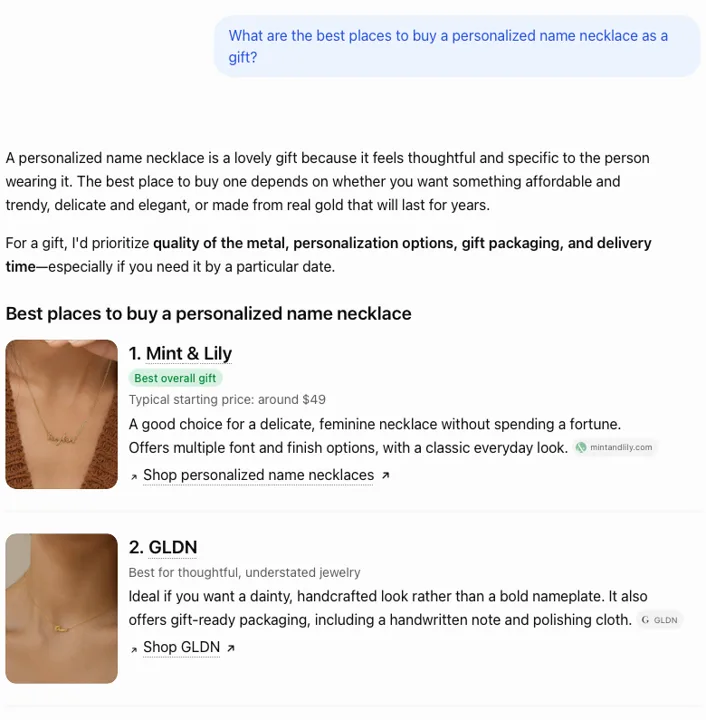
The real answer for the name necklace question, cropped and untouched. It names two small brands first, Mint and Lily and GLDN.
"Quality of the metal, personalization options, gift packaging, and delivery time." A line a store can write on its own page.
Mint and Lily leads with a starting price of about $49, and GLDN follows with a reason. Each links to its own store.
It warns that some options use plated metals. Pages that state the exact metal are the ones to trust.
Brands named in each answer, in the order each AI listed them. Logged-out ChatGPT and Google AI Mode through our own search data account, October 22 and 23, 2026, one run each.
What this means for you. The AI did not simply name the biggest brand or a marketplace. It named smaller brands such as Ritani, Catbird, GLDN and Tini Lux beside Blue Nile, Mejuri and Pandora. Where a shopper asked where to buy, it often sent them to the brand's own site. Five answers named only big brands, and all five were questions that named those brands or asked lab-grown against natural. On necklaces, Etsy was in every answer.
A store we work with. A specialty food store we work with was the first store ChatGPT listed for where to buy authentic biltong, and Google's answer to biltong vs beef jerky listed two of that store's guides as sources, next to Healthline. This is one check on one day, and a mention is not a sale.
What this does not prove. Three categories, one run per question, one day. Which brands count as small or independent, and which as big chains, is our judgment. AI answers change, so we re-check every month. It does not promise your result.
The answers showed where they got their picks. ChatGPT linked a brand or shop site in 7 of its 9 answers. Google cited Reddit, jewelry blogs and editors such as Forbes and Who What Wear, and many Google shopping cards.
So being named is not one trick. The AI reads what others say about you and what you say about yourself, and it prefers a page that answers the exact question. A product page alone is not enough.
The AI reads reviews, forums, editors and your own pages. We write the pages that answer the exact question.
ChatGPT linked brand sites such as Ritani, Clean Origin, Mejuri and GLDN. A clear brand page gets the link.
Jewelry blogs, Forbes and gift guides such as The Knot were cited. Being on pages like these helps, and we do not buy placement.
Reddit rings and diamonds threads were cited in 2 of 9 Google answers. We do not post for you. We write pages that answer the same questions clearly.
Answers told shoppers to check the return window, the exact stone and the metal before ordering. Pages that state those facts plainly give the AI something to quote.
Etsy was named in 7 of 18 answers, all on necklaces plus one earring link. Nordstrom and Walmart appeared once. Amazon appeared in none.
Guides from a specialty food store we work with were listed as sources on a biltong question in an earlier check. Guides are a way in for a small store.
You do not write or approve anything. Our AI agent, Ollie, does the research and the writing, our team checks it, and it goes live on your site.
You write nothing. We find the questions, write and publish the pages, then check every month.
We read your catalog, your collections, your Search Console and the pages of your competitors, and list the questions shoppers ask in your categories.
We ask ChatGPT and Google AI those questions and save dated screenshots of which brands get named.
Buying guides, comparisons, ingredient and care pages, collection introductions. Real facts about your products, never filler.
Each page goes live with its FAQ and links to your real products, then we load it to confirm.
We re-run the same questions and show you who is named now, next to last month.
Your brand name, logo and details cleaned up so the AI reads one brand.
Here is the shape of a comparison page we would write for a jewelry store. The details change for every product, but the parts do not.
The title is the question. Written the way a shopper would type it. Not "Our Products" but "Gold Filled vs Gold Plated vs Solid Gold: What Is the Difference?"
The answer comes first. The difference in two or three sentences: what is in each, how they compare on wear and price, and which one suits which shopper.
Then a table. Side by side, so the AI has clean facts to quote and a shopper can scan.
Then facts only you have. Your materials, your making process, your return window, and which of your pieces is which.
Then the paths. Links to the next question and to the real product page.
You have probably been burned by marketing that takes a quarter to show anything. So here is the first week, and what you can see each day. You do not write or approve anything along the way.
Google usually takes a few weeks to show new pages, so the first week is about getting the right pages live and your starting answers saved. The monthly re-check is where you see whether the AI's answer has moved.
We do not promise a result, because AI answers change and no one controls them. What we can do is show you the math you will run in your head anyway. Put in what one order is worth to you.
Sample The starting numbers are an example. Type your own and watch it change. It shows revenue, not profit.
If a few extra orders a month do not cover it, this is not for you, and we will say so on the call.
3 product areas x 5 extra orders a month x $120 x 12 months.
Arithmetic only. We do not promise orders. Use your own numbers.
In our 18 answers Amazon was named in none. Etsy was named in 7, all on necklaces, and small and independent brands were named in 13.
A description says what a product is. The AI is asked which one to buy and whether it is worth it. Those answers come from guides and comparisons.
Ask any provider what it checks each month. We run the same questions in ChatGPT and Google AI and show dated screenshots of who was named.
Smaller brands such as Ritani, Catbird and GLDN were named beside Blue Nile, Mejuri and Pandora. The work is real pages for real questions.
You write nothing and approve nothing. Everything we publish is on your site and recorded in your account.
We cannot promise orders. The 90 day guarantee covers how often Google shows your site, and you keep every page either way.
These store pages are being written next. Each one starts with its own check of what AI says in that category.
Most online stores already pay for something. Here is what each one does about AI answers, in plain terms.
| Option | What It Does | AI Answers |
|---|---|---|
| Marketplace listings | Sells your product on their page | Their name on the listing, not your brand in the answer |
| Paid ads and shopping feeds | Rents you a click | An ad beside the answer, not in it |
| An SEO app | Edits titles and tags on existing pages | Nothing new for the AI to quote |
| An SEO or content agency | Reports, some posts, monthly calls | Sometimes, often not checked |
| RunOctopus | Writes, publishes and checks the guides and comparisons, every week | Checked monthly, screenshots shown |
Many now ask ChatGPT or Google's AI which brand to buy and where to buy it. Each answer names a few brands, often with a price, and the ones named get the click. We do not quote a share of shoppers, because the figures we found had no source.
In our check of 18 answers about lab-grown rings, earrings and custom necklaces, Amazon was named in none. Etsy was named in 7, all on necklaces plus one earring link. Small and independent brands were named in 13 of 18.
Size did not decide it in our check. Smaller brands such as Ritani, Catbird and GLDN were named beside the big chains. What mattered was a page that answers the exact question, and other sites that back it up. Some answers named only big brands, but those were questions that named the big brands.
A product page says what a piece is. The AI is asked which one to buy, which brand is better, and whether it is worth the price. Those answers live on guides, comparisons and buying pages, not on a product description.
Buying guides, comparison pages, material and care pages, gift guides, and real introductions for your collections. Each one answers a question a shopper actually asks, and links to your real pieces.
RunOctopus began with Shopify stores and also works with WordPress sites. Other platforms are case by case. Tell us your platform when you scan and we will say plainly what we can publish and what we hand to you.
No. Every page is about your real catalog, checked against your public product pages. We do not invent products, materials, certifications or reviews.
No. AI answers change week to week and nobody controls them. We put the right pages on your store, check each month who the AI names and show dated screenshots, and refund you if your Google appearances are not up after 90 days.
An SEO app edits titles, descriptions and tags on the pages you already have. We write the missing pages the AI quotes, publish them, and check the answers every month.
A marketplace sells you a slot on its page, and ads rent you a click. An AI answer names a few brands with reasons, and nobody sells that slot. Your pages stay on your own site whether or not you keep paying.
No. We research the questions, write the pages in your brand's voice, publish them and check them live. You can read everything, but nothing waits on you.
No. We never add origin, ethical, sustainable, hypoallergenic or metal-purity claims. Pages repeat only what your own documents and facts support. The US FTC Jewelry Guides set rules for how lab-grown stones must be described, so the claim stays yours and your counsel should review it.
Access to your store and Google Search Console, and anything that makes your pieces different, such as materials, making process or return policy. We look up the rest ourselves.
One honest note on size: AI answers are one channel among several, and for most stores search and email still bring most orders. The work is to build the pages that answer real questions well, and to check each month which ones the AI now trusts.
The pieces behind this page, in plain words.
Our library of guides for online stores, in one place.
The Answer-Engine PlaybookHow AI picks the stores it names, step by step.
What AI Search Visibility MeansThe idea behind being named in an answer.
Get Your Business on ChatGPTWhat to put on your site so ChatGPT can name you.
RunOctopus Compared with an SEO AgencySide by side, in plain terms.
A Case Study, Misses IncludedA recruiting site we write for, with every number and every miss.
We research the questions, write and publish the pages, check every one, and show you each month who the AI named. If your Google numbers are not up at 90 days, you get your money back and keep every page.
Click Here to Start with the Free Scan →How the 90-day promise works: we compare how often your site is shown in Google in the 90 days after your first page goes live against the 90 days before. It covers how often Google shows your site, not a particular ranking or a spot in a particular AI answer, because nobody can promise those. The price you start at is the price you keep, even when it goes up for new customers.
Type your store's address. The free scan shows what AI can and can't read, and which pages you're missing.
Run My Free Scan