Get your store and your gear named by ChatGPT and Google AI.
In 18 AI answers about outdoor gear, small makers and independent shops were named in 5 and Amazon in none. See the answers
When a shopper asks AI which trail shoe, kayak or sleeping bag to buy, or where to buy it, it names a few brands and often a price. RunOctopus writes and publishes the guides, comparisons and answers on your own store that those answers are built from, and every month shows you with dated screenshots who the AI named.
Run my free scanNames as the AIs printed them. One run, one day. Both AIs mixed big retailers and brands with small makers.
A shopper used to type a few words into Google and open ten links. Now many of them ask a full question: which one should I buy, is it worth the price, where do I get it. The AI answers with a short list of brands, often with a price, and a link.
If your brand is on the list, the shopper lands on your store already trusting you. If it is not, the shopper never sees it, however good the product is. And the list is short, because the AI names a few, not a page of results.
Shoppers ask which one to buy. The AI names a few brands. Being one of them is the job.
Best for, versus, where to buy, is it worth it. The AI turns each into a short list of names and often a price.
In our 18 answers, Amazon was named in none. Specialty retailers appeared in 9 and sporting goods chains in 4, mostly as a place to buy.
Most best for answers named established brands. Small makers showed up mainly on where to buy and on niche gear such as quilts.
ChatGPT showed a price or range in 5 of its 9 answers, so a shopper compares before clicking.
Down or synthetic, pedal or paddle, Hoka or Altra. The AI answered each with a table or a plain rule, the kind of page a store can write.
Online stores are not all built the same, and what gets you named is different for each. Pick the one that sounds like you and jump to it. The rest of the page applies to all four.
You can be named at any size. A small catalog needs real pages for the decisions shoppers make. A large one needs guides and collections, never a page for every item.
Under about fifty products. Start with your best sellers and the questions that decide the sale.
Hundreds or thousands of products. Guides and collection introductions first, never a page for every item.
A store that sells other people's brands. Say what you know that a brand page cannot.
Gear people buy before a season. Be the page that is current when they search.
A shopper who wants a new sleeping bag does not browse for an hour. They type one question, read one answer and click one link. Everything we do aims at one of the steps in between.
The AI does not know your brand. It searches the way you would, reads the pages it finds (your store, reviews, forums, gear sites, comparison guides) and writes an answer from what those pages say. It leans on pages that answer the exact question asked: "down vs synthetic sleeping bag for backpacking: which is better?"
That is the opening. A marketplace has millions of listings, but a listing rarely answers a comparison. A store that has a clear guide for the exact question can be the page the answer is built from. In our check, small makers and independent shops were named in 5 of 18 answers, and established brands in 14.
Six things kept showing up in the brands that got named. None of them is "spend more on ads." All of them live on your own store, or on pages that point to it.
One page for each decision a shopper makes, the answer first, and facts only you can give.
"Down vs Synthetic Sleeping Bag" beats "Our Products" every time.
The difference, the price range or the verdict in the first two sentences. The AI quotes that line.
Your specs, your materials, your testing, your weights. Specific beats polished.
Reviews, gear sites and editors that name you. The AI trusts what others say about you.
The same brand name, logo and facts everywhere, so the AI is sure every mention is one brand.
A price or spec page from three years ago tells the AI you stopped paying attention.
Shoppers ask AI in three ways, and each one needs a different page. A store that only has product pages is missing two of the three.
Sample These are real questions Google shows people (checked October 23, 2026) about trail shoes, kayaks and sleeping bags. On your account, every question comes from your own Search Console and what your shoppers really ask, and you see the list before we check it.
People ask which one is best, how two compare, and whether it is worth it or safe to buy. Write for all three.
"What are the best trail running shoes?"
"What makes a good running shoe for beginners?"
"Who makes the best down sleeping bags?"
"Are Altra and HOKA the same?"
"Which trail running shoes are better, Topo, Altra, or HOKA?"
"What are the key differences between hiking shoes and trail running shoes?"
"What are the pros and cons of a pedal kayak?"
"Can I use a sleeping bag as a quilt?"
"Is it worth getting a down sleeping bag?"
"Is a 40 degree sleeping bag good?"
"Where is the cheapest place to buy kayaks?"
"How often should you replace trail running shoes?"
A product page tells a shopper what a product is. The AI is usually asked something else: which one, how do they compare, is it worth it. Those answers come from other kinds of pages, and most stores do not have them.
Each kind below answers one family of questions, and each one links to your real products.
Keep your product pages. Add the guides, comparisons and answers the AI is asked for.
"Best for" pages. Who each product suits, what to look for, and your honest pick.
Two products, two brands or two types side by side, with a verdict and a table.
What it is made of, how it is rated and what that means. Only the specs you publish, never a safety claim.
How to use it, store it, clean it and make it last. The questions after the sale.
A real paragraph on top of a collection, so the page says what it is and who it is for.
Price, value and when not to buy. Honest pages are the ones people trust and quote.
Outdoor shoppers asked which one, and both AIs answered with rules: this kayak for that water, this bag for that weather, this shoe for that foot. Pick a product, then the situation, and see what each AI told the shopper, as printed on October 23, 2026.
These are the AIs' words and ranges, not quotes and not our prices. Nothing here is about injuries, foot health or safety, and our pages never make those claims.
The AI matches the product to the trip. A page that says which trip it is for is the one it can match.
ChatGPT: pedal for large lakes and reservoirs, windy open water, and long days casting and repositioning.
Google AI: pedal is better if you fish large lakes, slow-moving rivers or bays where you need to cover water and hold your spot in the wind.
ChatGPT: paddle for very shallow creeks and marshes, and for rocky rivers and obstacle-filled water.
Google AI: a paddle kayak glides over shallow flats and heavy weeds, where a pedal drive can get fouled or stuck.
ChatGPT: paddle fishing kayaks typically run $400 to $1,200, dedicated pedal models $1,800 to $4,000+.
Google AI: paddle $400 to $1,200 and virtually maintenance-free, pedal $1,500 to $4,000+ with moving parts.
ChatGPT: usually paddle. Pedal kayaks are heavier and harder to load on a vehicle.
Google AI: pedal kayaks are often 70 to 100+ lbs, and a paddle kayak is lighter and easier to load and carry solo.
Prices both AIs gave: paddle $400 to $1,200, pedal $1,500 or $1,800 to $4,000+. Google AI added that shipping a kayak direct can add $150 to $400+ in freight.
Say which water each kayak is for, its weight in pounds, and the delivery cost to the door.
ChatGPT: down for ultralight backpacking, multi-day trips with a small pack, and cold, dry mountain conditions.
Google AI: choose down if you are counting ounces and backpacking long distances in generally dry or predictable climates.
ChatGPT: synthetic, or treated down with excellent waterproof storage.
Google AI: choose synthetic if you backpack in wet, rainy or ultra-humid places, because it keeps insulating when damp.
ChatGPT: synthetic for budget backpacking and for beginners who want easy care.
Google AI: synthetic is much friendlier on the wallet, the go-to for budget-conscious backpackers or beginners.
ChatGPT: a quilt is absolutely worth considering to save pack weight, and great for side sleepers and warm-weather trips. A bag is easier in cold, windy conditions.
Google AI: for most three-season backpackers a quilt is definitely worth it, and it suits side sleepers. Stick with a bag in deep winter.
Listings ChatGPT found: a budget down bag $190 to $210, a down quilt around $340, a premium 20 degree bag around $640, 0 degree bags $358.95 to $810.
Print the temperature rating type (comfort or limit), the fill power, the weight and the packed size, and say which trips it is for.
ChatGPT: Hoka is generally better for cushioning and comfort over long distances, and great for rocky, technical trails.
Google AI: Hoka is the pick for high-stack cushioning and a rockered roll, with deep 5mm lugs on steep rocky descents.
ChatGPT: Altra for natural toe splay and a typically roomier toe box.
Google AI: Altra for a wide, splay-friendly toe box. It said Hoka can squeeze wide forefeet.
ChatGPT: Hoka is usually an easier transition for runners coming from regular shoes, and to move to zero-drop gradually.
Google AI gave the numbers instead: Hoka 4 to 5mm heel-to-toe drop, Altra 0mm.
ChatGPT: a hybrid shoe for routes that alternate between roads, sidewalks and smooth dirt paths.
Google AI: if you only run on paved paths or light hard-packed gravel, stick to road shoes, because trail lugs wear down quickly on asphalt.
ChatGPT: most people can start at $90 to $140, and do not necessarily need to spend $160 to $200. Listings it found ran $69.99 to $160.
Print the heel-to-toe drop in millimeters, the toe box shape, the lug depth and the terrain it is built for.
Known outdoor brands were named in 14 of 18 answers, and most product answers named only them. The small makers showed up where shoppers asked where to buy, and specialty stores were named in half the answers.
One run on one day, read by hand. Which maker counts as small is our judgment, and these counts are lower bounds. It is not a ranking.
The answer sent shoppers to the store that knows the gear, not the biggest store.
Outdoor or running shops such as REI, Backcountry, Fleet Feet, Running Warehouse and Road Runner. Big sporting-goods chains came up in 4, all on where to buy a kayak or shoes.
Cottage sleeping bag and quilt makers, and on the kayak question ChatGPT mapped local kayak shops near Ormond Beach and named one first.
The pedal or paddle and down or synthetic questions got a verdict and a list of pros and cons. The page that explains the rule is the one quoted there.
Every range the two AIs printed, on one scale. The gridlines mark $100, $1,000 and $10,000. Orange is ChatGPT, purple is Google AI. A missing bar means that AI gave no range for it.
As printed on October 23, 2026. Not quotes and not our prices.
From a $60 trail shoe to a $4,000 pedal kayak, and the freight in between.
Exactly as printed on October 23, 2026. ChatGPT logged out and Google AI Mode through our own search data account, one run each. Not quotes.
In their answers, both AIs told shoppers what to check before paying. Each one is a line an outdoor product page can answer first, so the AI finds it on your page instead of telling the shopper to go and ask.
Print the freight, the demo, the rating, the drop and the fit policy.
ChatGPT and Google AI, kayaks: check freight charges and delivery before buying direct. Google AI said freight can add $150 to $400+.
ChatGPT, kayaks: ask a dealer about demo days or an on-water test. Google AI said specialized local shops often let you test-paddle models.
ChatGPT, kayaks: some brands do not sell direct and send buyers to dealers. Check warranty coverage, and on a used kayak whether the warranty transfers.
ChatGPT, kayaks: confirm included accessories, capacity, shipping and availability, and budget for a paddle if one is not included.
ChatGPT, sleeping bags: check the comfort rating, not just the advertised temperature limit. Google AI said quilt ratings have no universal standard test.
ChatGPT and Google AI, bags and quilts: use an insulated pad with the right R-value. Google AI suggested 3.5 or higher for cool weather with a quilt.
ChatGPT and Google AI, shoes: both printed the drop in millimeters, Hoka about 4 to 8, Altra 0. Print yours.
ChatGPT, shoes: one running store offers a 30-day fit guarantee and free shipping over $99. Read the return terms, and check whether a membership fee pays for itself.
On October 23, 2026 we asked both AIs about three kinds of outdoor gear: trail running shoes, fishing kayaks and backpacking sleeping bags. For each we asked best for, a comparison, and where to buy. That is 18 answers, with the misses left in.
Small makers and independent shops were named in 5 of 18 answers, established brands in 14. Amazon was named in none.
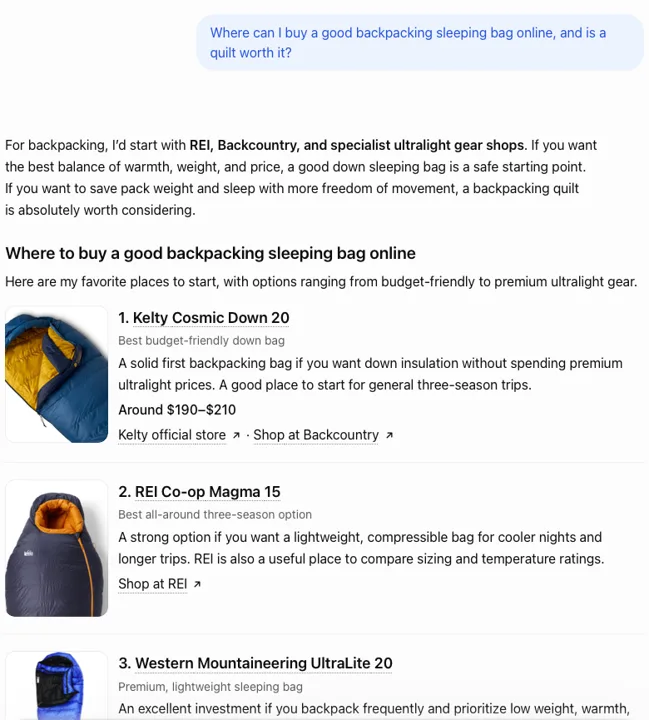
The real answer for the sleeping bag where to buy question, cropped and untouched. It lists Kelty, REI Co-op and Western Mountaineering here, and Enlightened Equipment further down.
A big brand, a retailer house bag and a premium maker sit side by side, and a cottage quilt maker follows.
Around $190 to $210 for the first bag. A shopper can compare before clicking.
"Absolutely worth considering," with reasons. A plain answer a store can write on its own page.
Brands named in each answer, in the order each AI listed them. Logged-out ChatGPT and Google AI Mode through our own search data account, October 22 and 23, 2026, one run each.
What this means for you. The AI did not name Amazon once. Most best for answers named established brands such as Hoka, Saucony, Old Town and Therm-a-Rest. Small makers such as Enlightened Equipment and Zpacks, and local kayak shops, showed up when the shopper asked where to buy. Both AIs often linked the brand's or shop's own site.
A local angle. Asked where to buy a fishing kayak, ChatGPT added a map of local kayak shops and told the shopper to start with a local dealer. A store with a real local presence has another way in. This is one check on one day, and a mention is not a sale.
What this does not prove. Three categories, one run per question, one day. Which makers and shops count as small is our judgment. AI answers change, so we re-check every month. It does not promise your result.
The answers showed where they got their picks. ChatGPT linked a brand or shop site in 7 of its 9 answers. The two AIs also pointed to independent sources: Backpacker, CleverHiker, Outside Online, REI Expert Advice, Run to the Finish and Switchback Travel.
So being named is not one trick. The AI reads what others say about you and what you say about yourself, and it prefers a page that answers the exact question. A product page alone is not enough.
The AI reads reviews, forums, editors and your own pages. We write the pages that answer the exact question.
ChatGPT linked brand sites such as Hoka, Altra, Kelty and Enlightened Equipment. A clear brand page gets the link.
Backpacker, CleverHiker, Outside Online and Switchback Travel were cited. Being on pages like these helps, and we do not buy placement.
REI Expert Advice and its trail shoe guide were cited. A specialist retailer guide can be the source an answer leans on.
YouTube and Facebook appeared as sources on some Google answers. We do not post for you. We write pages that answer the same questions clearly.
REI, Backcountry, Fleet Feet and Running Warehouse appeared in 9 of 18 answers, and sporting goods chains in 4. They are an option, not the whole answer.
ChatGPT showed local kayak shops on a map. A real local store can be named there too.
You do not write or approve anything. Our AI agent, Ollie, does the research and the writing, our team checks it, and it goes live on your site.
You write nothing. We find the questions, write and publish the pages, then check every month.
We read your catalog, your collections, your Search Console and the pages of your competitors, and list the questions shoppers ask in your categories.
We ask ChatGPT and Google AI those questions and save dated screenshots of which brands get named.
Buying guides, comparisons, ingredient and care pages, collection introductions. Real facts about your products, never filler.
Each page goes live with its FAQ and links to your real products, then we load it to confirm.
We re-run the same questions and show you who is named now, next to last month.
Your brand name, logo and details cleaned up so the AI reads one brand.
Here is the shape of a comparison page we would write for an outdoor store. The details change for every product, but the parts do not.
The title is the question. Written the way a shopper would type it. Not "Our Products" but "Down vs Synthetic Sleeping Bag: Which Is Better for Backpacking?"
The answer comes first. The verdict in two or three sentences: down for weight and dry cold, synthetic for wet weather and budget.
Then a table. Side by side, so the AI has clean facts to quote and a shopper can scan.
Then facts only you have. Your fill power, your weights, your published temperature rating, and which of your bags is which.
Then the paths. Links to the next question and to the real product page.
You have probably been burned by marketing that takes a quarter to show anything. So here is the first week, and what you can see each day. You do not write or approve anything along the way.
Google usually takes a few weeks to show new pages, so the first week is about getting the right pages live and your starting answers saved. The monthly re-check is where you see whether the AI's answer has moved.
We do not promise a result, because AI answers change and no one controls them. What we can do is show you the math you will run in your head anyway. Put in what one order is worth to you.
Sample The starting numbers are an example. Type your own and watch it change. It shows revenue, not profit.
If a few extra orders a month do not cover it, this is not for you, and we will say so on the call.
3 product areas x 5 extra orders a month x $120 x 12 months.
Arithmetic only. We do not promise orders. Use your own numbers.
In our 18 answers Amazon was not named once. Specialty retailers such as REI appeared in 9 and sporting goods chains in 4, mostly as a place to buy.
A description says what a product is. The AI is asked which one to buy and whether it is worth it. Those answers come from guides and comparisons.
Ask any provider what it checks each month. We run the same questions in ChatGPT and Google AI and show dated screenshots of who was named.
Honestly, most best for answers named established brands. Small makers and local shops were named on where to buy and on niche gear. A real page for the exact question is how a small store earns a place.
You write nothing and approve nothing. Everything we publish is on your site and recorded in your account.
We cannot promise orders. The 90 day guarantee covers how often Google shows your site, and you keep every page either way.
These store pages are being written next. Each one starts with its own check of what AI says in that category.
Most online stores already pay for something. Here is what each one does about AI answers, in plain terms.
| Option | What It Does | AI Answers |
|---|---|---|
| Marketplace listings | Sells your product on their page | Their name on the listing, not your brand in the answer |
| Paid ads and shopping feeds | Rents you a click | An ad beside the answer, not in it |
| An SEO app | Edits titles and tags on existing pages | Nothing new for the AI to quote |
| An SEO or content agency | Reports, some posts, monthly calls | Sometimes, often not checked |
| RunOctopus | Writes, publishes and checks the guides and comparisons, every week | Checked monthly, screenshots shown |
Many now ask ChatGPT or Google's AI which trail shoe, kayak or sleeping bag to buy and where to buy it. Each answer names a few brands, often with a price, and the ones named get the click. We do not quote a share of shoppers, because the figures we found had no source.
In our check of 18 answers across three outdoor categories, Amazon was not named in any. Specialty retailers such as REI, Backcountry and Fleet Feet appeared in 9 of 18, and sporting goods chains such as Academy and Dick's in 4, mostly as a place to buy.
In our check, small makers and independent shops were named in 5 of 18 answers, mostly on where to buy and on niche gear such as quilts, and most best for answers named established brands. Size did not decide it. A page that answers the exact question, and other sites that back it up, is how a small store earns a place.
A product page says what a product is. The AI is asked which one to buy, which is better, and whether it is worth the price. Those answers live on guides, comparisons and buying pages, not on a product description.
Buying guides, comparison pages, material and spec pages, care and how-to pages, and real introductions for your collections. Each one answers a question a shopper actually asks, and links to your real products.
No. Pages stick to the specs, ratings and testing your own brand or the maker publishes. We do not write that a product is safe, warm enough or rated for anything your own published facts do not say.
RunOctopus began with Shopify stores and also works with WordPress sites. Other platforms are case by case. Tell us your platform when you scan and we will say plainly what we can publish and what we hand to you.
No. Every page is about your real catalog, checked against your public product pages. We do not invent products, specs, certifications or reviews.
No. AI answers change week to week and nobody controls them. We put the right pages on your store, check each month who the AI names and show dated screenshots, and refund you if your Google appearances are not up after 90 days.
An SEO app edits titles, descriptions and tags on the pages you already have. We write the missing pages the AI quotes, publish them, and check the answers every month.
A marketplace sells you a slot on its page, and ads rent you a click. An AI answer names a few brands with reasons, and nobody sells that slot. Your pages stay on your own site whether or not you keep paying.
Access to your store and Google Search Console, and anything that makes your products different, such as materials, testing or how you fit and size. We look up the rest ourselves.
One honest note on size: AI answers are one channel among several, and for most stores search and email still bring most orders. The work is to build the pages that answer real questions well, and to check each month which ones the AI now trusts.
The pieces behind this page, in plain words.
Our library of guides for online stores, in one place.
The Answer-Engine PlaybookHow AI picks the stores it names, step by step.
What AI Search Visibility MeansThe idea behind being named in an answer.
Get Your Business on ChatGPTWhat to put on your site so ChatGPT can name you.
RunOctopus Compared with an SEO AgencySide by side, in plain terms.
A Case Study, Misses IncludedA recruiting site we write for, with every number and every miss.

We research the questions, write and publish the pages, check every one, and show you each month who the AI named. If your Google numbers are not up at 90 days, you get your money back and keep every page.
Click Here to Start with the Free Scan →How the 90-day promise works: we compare how often your site is shown in Google in the 90 days after your first page goes live against the 90 days before. It covers how often Google shows your site, not a particular ranking or a spot in a particular AI answer, because nobody can promise those. The price you start at is the price you keep, even when it goes up for new customers.
Type your store's address. The free scan shows what AI can and can't read, and which pages you're missing.
Run My Free Scan