Get your cardiology practice, every provider and every office named by ChatGPT and Google AI when patients ask who to see.
In 18 AI answers about finding a cardiologist in three Florida towns, a small or independent practice was named in 11. A hospital system and a multi-office group were each named in 12. See the answers
When someone asks AI how to choose a cardiologist, who is taking new patients near them and whether they need a referral, it names a few practices and tells them to call. RunOctopus writes the practice-information pages on your website that those answers draw on. Pages contain no clinical claims, every sentence is checked automatically against the facts you give us, and every month we show you with dated screenshots who the AI named.
Run my free scanNames as the AIs printed them. One run, one day. ChatGPT also told the patient to call and confirm Medicare and referral rules.
Cardiology is a referral and trust decision, and more and more patients start by asking an AI. They type who is accepting new patients near them, whether they need a referral, or how to choose a cardiologist, and read one answer that names a few practices and says to call and confirm.
If your practice is one of the few named, the patient calls you. If it is not, they may never see you, however good the care is. The pages that help are plain ones: who your providers are, which plans you accept, whether a referral is needed, which tests your office offers and how to become a new patient.
Patients ask AI who to see. It names a few practices. Clear practice pages are how you get named.
16 of 18 answers raised referrals. They said it depends on the insurance plan, so a practice that explains its own rules gives the AI a clear line.
A small or independent practice was named in 11 of 18 answers. A hospital system was named in 12, and a multi-office group in 12.
The AI explained how to choose: check board certification, hospital affiliation, insurance and how the office communicates. Pages that say these things get used.
A directory such as Healthgrades or WebMD was named or cited in 7 of 18 answers. Profiles are written by someone else and can be out of date.
We write practice facts only. Every sentence is checked against what you gave us, and anything we cannot trace to your own words is left out.
Practices are not all built the same, and what gets you named is different for each. Pick the one that sounds like you and jump to it. The rest of the page applies to all four.
You can be named at any size. A small practice needs clear provider and new-patient pages. A group or program needs a real page for each provider and office, never a copy.
One or two cardiologists. A page for each provider and a clear way to become a patient.
One practice, several offices. A real page for each office and each provider.
Many cardiologists across a region. Provider pages, referral steps and one page per service line.
Many sites and departments. Brand rules at the top, local facts at each site, your compliance rules followed.
A patient with a referral in hand does not browse. They type one sentence, read one answer and call. Everything we do aims at one of the steps in between.
The AI does not know your practice. It searches the way a patient would, reads the pages it finds (your site, directories, hospital pages, reviews) and writes an answer from what those pages say. It leans on pages that answer the exact question: "which cardiologist in Ormond Beach is accepting new patients, and do I need a referral?"
That is the opening. A directory listing can be out of date. A page on your own site can say, in your words, who you are, which plans you accept and how to book. In our check of three Florida towns, a small or independent practice was named in 11 of 18 answers, beside hospital systems and groups.
Six things kept showing up in the practices that got named. None of them is advice or a claim about results. All of them live on your own website.
One page per provider and location, the practical answer first, and facts only you can give.
"Cardiology in Port Orange: Our Providers and Hours" beats "Our Services."
Whether you take new patients, which plans you accept, whether a referral is needed, in the first lines. The AI quotes that.
Your providers, languages spoken, hours, address, and whether you take new patients. Specific beats polished.
Directories, hospital pages and local listings that name you. The AI trusts what others say.
The same name, address, phone and provider list everywhere, so the AI is sure every mention is one practice.
Accepting new patients and plans accepted change. A dated, refreshed page reads as alive.
Patients ask AI about finding a cardiologist in three ways, and each one needs a different page. A practice that only writes "call us to schedule" is missing all three.
Sample These are real questions Google shows people about finding a provider (checked October 23, 2026), and the kinds of pages we build. They are about choosing and booking care, never about treating a condition. One of them asks who the best cardiologist is: we never answer that, and nobody should. On your account the questions come from your own Search Console and what people in your market ask, and you see the list before we check it.
People ask how to get an appointment, what it will cost and how to choose. Write for all three.
"Can I just go see a cardiologist without a referral?"
"How long does a referral to a cardiologist take?"
"What is the average wait time to see a cardiologist?"
"How to find a cardiologist?"
"Can my cardiologist also be my primary care physician?"
"What are the three types of cardiologists?"
"Is a heart doctor a specialist?"
"Who is the best cardiologist in Florida?"
"What to wear to a cardiologist appointment?"
"What not to do before a cardiologist appointment?"
"Does Medicare have a copay for doctor visits?"
"How much does a heart echo scan cost?"
The answers we read were practical. They listed practices with addresses and phone numbers, said which plans were taken, and told the patient what to ask: is the practice taking new patients, is it in network, is a referral needed, which tests are done in the office. Those are facts a practice can put on a page.
We write practice-information pages from what you give us. We do not write medical condition or treatment pages at all.
Practice facts get quoted. We write no medical pages.
Who your providers are, their training and the ages they see, in your clinicians words. Checked automatically against your words.
How to become a patient, what to bring and wear, and how fast a first visit usually is.
The plans you accept at each location, and how to check yours. Kept current.
Address, hours, parking, languages spoken and the providers at each office.
Whether a patient needs a referral, how long it takes, and how your office handles one. The most common question in our check.
Which tests your office offers, such as stress tests, echocardiograms and heart monitoring, and how to book them. Stated in your own words. Never advice.
On October 22 and 23, 2026 we asked both AIs three find-a-cardiologist questions in DeLand, Ormond Beach and Port Orange: who is taking new patients and whether a referral is needed, how to choose, and which practice offers stress tests, echocardiograms and heart monitoring and takes Medicare. That is 18 answers, with the limits left in. We asked only how to find and choose a provider, never a medical question.
A small or independent practice was named in 11 of 18 answers. A hospital system and a multi-office group were each named in 12.
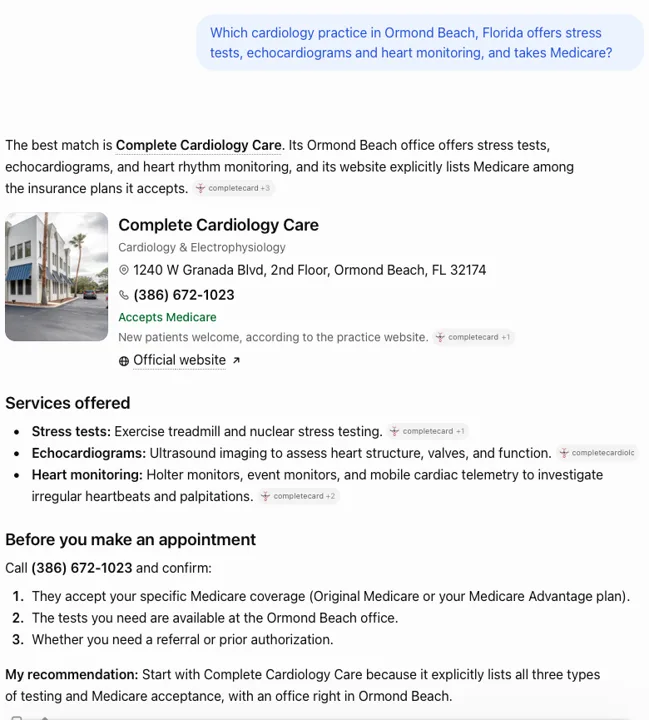
The real answer for the Ormond Beach testing question, cropped and untouched. It names Complete Cardiology Care and says to call and confirm Medicare coverage, the tests offered and any referral.
It lists the three testing services and says the practice website explicitly lists Medicare. Specific pages give it specific lines.
It tells the patient to confirm the Medicare plan, which tests are offered at the office and whether a referral or prior authorization is needed.
A small cardiology practice is the answer here, with a recommendation to start with it. We do not judge any practice.
Practices named in each answer, in the order each AI listed them. Physician names are left off. Logged-out ChatGPT and Google AI Mode through our own search data account, October 22 and 23, 2026, one run each. We do not judge any practice.
What this means for you. A hospital system and a multi-office group were each named in two thirds of the answers, so a small cardiology practice is competing with groups and systems. A small or independent practice still appeared in 11 of 18 answers, most often on the questions about testing and Medicare, where its own pages gave the AI specific lines.
What this does not prove. One run per question, one day, one state, and listings change. We do not say who is best, and the AI does not either: it told patients to call and confirm. It does not promise your result.
ChatGPT drew on AdventHealth's provider pages, directory listings such as Healthgrades and WebMD, and individual practice websites. Google's answers showed map-style listings with ratings and drew on practice sites and hospital pages.
So being named is not one trick. The AI reads directories, hospital pages and your own pages together, and it prefers a page that answers the exact question. A profile alone is not enough, and neither is a website with one contact page.
The AI reads directories, hospital pages and your own pages. We write the practice pages that answer the exact question.
AdventHealth provider profiles were cited often. If you are affiliated, your profile there matters.
Healthgrades, WebMD, AcceptsMedicare and Healthline showed up as named or cited sources in 7 of 18 answers. Keep yours accurate.
Practices such as Complete Cardiology Care, Atlantic Cardiology and Daytona Heart Group were cited from their own sites, with the tests they list and the plans they accept.
A page on referrals and new patients in Port Orange beats a general contact page for that question.
RunOctopus is an AI that does its own checking, so nothing waits for a person to say yes. What keeps medical content safe is what we choose to write, and what the checks refuse to publish.
We write practice-information pages from facts you give us in writing. We write no condition, treatment, diagnosis, outcome or credential-claim pages. Every sentence is checked automatically against your facts and a rule list. Anything we cannot trace to your own words is left out, not published.
The pages contain no clinical claims, so there is nothing clinical to review. We do not give medical advice. You can read everything we publish, and every page is dated and recorded in your account.
No clinical pages. Every sentence traced to your own words, or left out.
Your providers, as you state them. Nothing added.
From your own list, kept current and dated.
How to book, what to bring and how a first visit works, in plain non-clinical terms.
No condition, treatment or diagnosis pages at all.
No results, no testimonials, no patient stories, no superlatives.
We do not ask for or use patient records, names, photos or stories.
HIPAA, state advertising rules and your system policies are yours. We follow the rules you give us.
Our AI agent, Ollie, does the research and the writing, checks every sentence against the facts you gave us, and publishes. You can read everything.
We find the questions, write the pages, check every sentence automatically, publish, and check every month.
We read your site, your Search Console and the directories, and list what patients ask in your towns.
We ask ChatGPT and Google AI find-a-provider questions, town by town, and save dated screenshots of who is named.
One page per provider and location: who you see, plans accepted, how to book. Real facts from you, never filler.
Every sentence is checked against your facts and a rule list. Anything that cannot be traced to your words is left out.
Pages go live with links to your related pages, then we load them to confirm.
We re-run the same questions and show you who is named now, next to last month.
Here is the shape of a page we would write for a practice. The details change for every provider and town, but the parts do not.
The title is the question. Written the way a patient would type it, with the town in it. Not "Our Practice" but "Cardiology in Ormond Beach: New Patients and Referrals."
The practical answer comes first. Whether you take new patients, whether a referral is needed, which plans you accept and how to book, in two or three sentences.
Then the facts a patient can check. Your providers, languages, hours, address and parking. We write nothing clinical.
Then the questions that come next. A real FAQ about booking and insurance, marked up for Google.
Then the paths. Links to the next page the patient needs: the provider page, the location page, the insurance page.
If you run a practice with one or two providers, you do not need a big website. You need the right pages: one for each provider, one for each location and one that says how to become a patient. The AI cares about the answer on the page, not the size of the practice behind it.
A handful of clear, current pages beats a long services list.
One page per provider: who they are and who they see, in your clinicians words.
New patients, plans accepted, how to book. The page patients and the AI both look for.
Accepting new patients changes. A dated, current page beats a stale one.
With several offices, the AI has to tell them apart and know they are one practice. Most multi-location sites fail the first: every location page says the same thing, so the AI names none of them.
We write a page for each location from that location's own facts: its providers, hours, plans accepted and how to book. Brand rules live at the top. Local facts live at each location. We never invent an office.
Same brand rules everywhere, different facts at every location, rolled out in waves with one report for head office.
One practice name, one set of rules, and a clear page for each location.
The providers, hours and plans of that location. No copied pages.
A Google profile for each real location, kept consistent.
We start where the check shows the biggest gap, then scale.
Which practices the AI named this month, with a dated screenshot per location.
One view for the practice manager: who is named where, and what changed.
For a system, the questions are about control. Your marketing, legal and compliance teams set the rules, and many systems control their website tightly. We work inside those rules, or we tell you plainly when a location is not allowed its own pages.
We start with a pilot of three sites, inside your rules.
Good. We follow your brand rules and write the pages you allow.
Good. Your compliance team can read everything we publish, and every page is dated and recorded in your account.
The AI named a hospital system in 12 of 18 answers. Ask your system whether each provider or office may have its own pages.
You have probably been burned by marketing that takes a quarter to show anything. So here is the first week, and what you can see each day.
Google usually takes a few weeks to show new pages, so the first week is about getting the right pages live and your starting answers saved. The monthly re-check is where you see whether the AI's answer has moved.
We do not promise a result, because AI answers change and no one controls them. What we can do is show you the math you will run in your head anyway. Put in what a new patient is worth to your practice in a year.
Sample The starting numbers are an example. Type your own and watch it change.
If one extra new patient a month does not cover it, this is not for you, and we will say so on the call.
3 locations or towns x 1 extra job a month x $450 x 12 months.
Arithmetic only. We do not promise patients. Use your own numbers.
Right. That is why we write no medical claims at all. We write practice facts, every sentence is checked against what you gave us, and anything we cannot trace is left out.
A directory was named or cited in 7 of 18 answers, so keep it accurate. The AI also cited practice and hospital sites. Your own pages say exactly what you want patients to know.
We never use patient information. We write general educational and practice-information pages. Your compliance contact decides anything about your site tools and pixels.
Ask your system whether providers or locations may have their own pages. We work inside your rules or tell you plainly when not.
You write nothing. Everything we publish is on your site and recorded in your account.
We cannot promise patients. The 90 day guarantee covers how often Google shows your site, and you keep every page either way.
These practice-type pages are being written next. Each one starts with its own check of what AI says in that specialty.
Most practices already pay for something. Here is what each one does about AI answers, in plain terms.
| Option | What It Does | AI Answers |
|---|---|---|
| Directory profiles (Healthgrades, Zocdoc) | Lists you on their pages | Often cited, but written and kept by someone else |
| Paid search ads | Pays for a slot above the results | An ad beside the answer, not in it |
| A template website | Lists your services | Little specific for the AI to quote |
| A marketing agency | Reports, some posts, monthly calls | Sometimes, often not checked |
| RunOctopus | Writes pages from your facts, checks every sentence automatically, publishes and re-checks | Checked monthly, screenshots shown |
We write general educational and practice-information pages from what your practice gives us, such as who your providers are, which plans you accept, how to become a new patient and what a visit involves. We write no condition, treatment, diagnosis or outcome pages, so there is no clinical content to approve. Every sentence is checked automatically against the facts you gave us and a rule list, and anything we cannot trace to your own words is left out. We do not give medical advice, and we make no claims about clinical accuracy.
No. We never ask for or use patient records, names, photos or stories, and we do not write testimonials or outcome claims. If a vendor or tool on your site touches patient information, that is a separate question for your compliance contact.
Many people now ask ChatGPT or Google's AI how to choose a heart doctor, who is taking new patients and whether they need a referral. In our October 2026 check, every answer named real practices, and 15 of 18 told the patient to confirm or call.
In our check of three Florida towns, a small or independent cardiology practice was named in 11 of 18 answers. A hospital system was named in 12 of 18, and a larger multi-office group in 12 of 18. A small practice is not alone, but it is competing with groups and systems. AI tends to name the practices that detailed, specific pages and other sources describe.
A directory such as Healthgrades or WebMD was named or cited in 7 of the 18 answers, so keep those profiles accurate. AI also cited practice and hospital websites. A directory profile is written by someone else. Your own pages say exactly who you are, which plans you accept, whether a referral is needed and how to book.
Check with your system's marketing and compliance teams first, because many systems control their websites. Where a location or provider is allowed its own pages, we write one per provider and location from your facts.
We write a different page for each location, with its own providers, hours, plans accepted and new-patient steps, under one brand. We start with the two or three locations where the check shows the biggest gap.
You do not write anything, and nobody has to say yes before a page goes live. Pages are checked automatically against the facts you gave us and a rule list, you can read everything we publish, and every page is dated and recorded in your account.
We cannot promise patients, because AI answers change week to week. We put the right pages on your site, check each month who the AI names and show you the dated screenshots, and refund you if your Google appearances are not up after 90 days.
Access to your website and Google Search Console, your providers, locations, plans accepted and how new patients book. We look up the rest ourselves.
The pieces behind this page, in plain words.
How AI picks a local business, step by step.
What AI Search Visibility MeansThe idea behind being named in an answer.
Get Your Business on ChatGPTWhat to put on your site so ChatGPT can name you.
RunOctopus Compared with an SEO AgencySide by side, in plain terms.
A Case Study, Misses IncludedA recruiting site we write for, with every number and every miss.
RunOctopus for Healthcare ProvidersThe parent page, with the guardrails for every specialty.
RunOctopus for Home ServicesAnother industry page, with the same kind of check.

We research the questions and write the pages, every sentence is checked against your facts, and then we publish, check and show you each month who the AI named. If your Google numbers are not up at 90 days, you get your money back and keep every page.
Click Here to Start with the Free Scan →How the 90-day promise works: we compare how often your site is shown in Google in the 90 days after your first page goes live against the 90 days before. It covers how often Google shows your site, not a particular ranking or a spot in a particular AI answer, because nobody can promise those. The price you start at is the price you keep, even when it goes up for new customers.
Type your website. The free scan shows what AI can and can't read, and which pages you're missing.
Run My Free Scan