Get your practice, every pediatrician and every office named by ChatGPT and Google AI when parents ask who to see.
In 18 AI answers about finding a pediatrician in three Florida towns, a small or independent practice was named in 15. See the answers
When a parent asks AI who is accepting new patients, where to go for a same-day sick visit, or how to choose a pediatrician for a newborn, it names a few practices and tells them to call. RunOctopus writes the practice-information pages on your website that those answers draw on. Pages contain no clinical claims, every sentence is checked automatically against the facts you give us, and every month we show you with dated screenshots who the AI named.
Run my free scanNames as the AIs printed them. One run, one day. Both told the parent to call and confirm hours.
Parents choose on trust and on timing. They ask an AI who is taking new patients, where to go today when a child is sick, or how to choose before a baby arrives, and read one answer that names a few practices and says to call and confirm.
If your practice is one of the few named, the parent calls you. If it is not, they may never see you, however good the care is. The pages that help are plain ones: who your pediatricians are, which plans you accept, whether you offer same-day and after-hours care, and how a newborn becomes a patient.
Parents ask AI who to see. It names a few practices. Clear practice pages are how you get named.
Who is accepting new patients, where to go for a same-day sick visit, and how to choose for a newborn. Each needs its own page.
In the 18 answers, a small or independent practice was named in 15. A hospital system appeared in 17.
Answers gave hours, walk-in rules and phone numbers, then told the parent to confirm. Pages that state them get used.
For newborns the AI explained how to choose: check insurance, ask about after-hours care, meet the practice first. Pages that say these things get used.
We write practice facts only. Every sentence is checked against what you gave us, and anything we cannot trace to your own words is left out.
Practices are not all built the same, and what gets you named is different for each. Pick the one that sounds like you and jump to it. The rest of the page applies to all four.
You can be named at any size. A small practice needs clear provider and new-patient pages. A group or system needs a real page for each provider and location, never a copy.
One or two pediatricians. A page for each and a clear way for a family to become patients.
One brand, several offices. A real page for each office and each pediatrician.
Many pediatricians across a region. Provider pages, newborn steps and one page per office.
Many sites and departments. Brand rules at the top, local facts at each site, your compliance rules followed.
A parent with a sick child, or a baby on the way, does not browse. They type one sentence, read one answer and call. Everything we do aims at one of the steps in between.
The AI does not know your practice. It searches the way a patient would, reads the pages it finds (your site, directories, hospital pages, reviews) and writes an answer from what those pages say. It leans on pages that answer the exact question: "where can my child be seen today in Ormond Beach?"
That is the opening. A directory listing can be out of date. A page on your own site can say, in your words, who you are, which plans you accept and how to book. In our check of three Florida towns, a small or independent practice was named in 15 of 18 answers.
Six things kept showing up in the practices that got named. None of them is advice or a claim about results. All of them live on your own website.
One page per provider and location, the practical answer first, and facts only you can give.
"Same-Day Sick Visits in Port Orange: Hours and How to Book" beats "Our Services."
Who you see, which plans you accept, same-day and after-hours options, how to book, in the first lines. The AI quotes that.
Your pediatricians, languages spoken, hours, address, walk-in rules and whether you take new patients. Specific beats polished.
Directories, hospital pages and local listings that name you. The AI trusts what others say.
The same name, address, phone and provider list everywhere, so the AI is sure every mention is one practice.
Accepting new patients, hours and plans accepted change. A dated, refreshed page reads as alive.
Parents ask AI about finding care for a child in three ways, and each one needs a different page. A practice that only writes "call us to schedule" is missing all three.
Sample These are real questions Google shows people about finding a pediatrician (checked October 23, 2026), and the kinds of pages we build. They are about choosing and booking care, never about treating a condition. On your account the questions come from your own Search Console and what people in your market ask, and you see the list before we check it.
Parents ask to find a practice, check insurance and decide how to choose. Write for all three.
"How to select a pediatrician before a baby is born?"
"Do I need to set up a pediatrician before my baby is born?"
"Can I self refer to a pediatrician?"
"Do pediatricians work a 9 to 5?"
"What is a same day sick appointment?"
"What are the differences between a family physician and a pediatrician?"
"What is the point of well-child visits?"
"Is it hard to switch pediatricians?"
"At what age do you switch from a pediatrician to a doctor?"
"How to find out if a doctor is covered under your insurance?"
"Does Medicaid cover pediatric visits?"
"How much does a pediatric urgent care visit cost?"
The answers we read were practical. They listed practices with addresses, phone numbers and posted hours, said which plans were taken, and told the parent what to ask: is the practice taking new patients, is it in network, can a sick child be seen today, how fast is the first newborn visit. Those are facts a practice can put on a page.
We write practice-information pages from what you give us. We do not write medical condition or treatment pages at all.
Practice facts get quoted. We write no medical pages.
Who your pediatricians are, their training and the ages they see, in your clinicians words. Checked automatically against your words.
How a family becomes a patient, what to bring to a first visit, and how newborns are scheduled.
The plans you accept at each location, and how to check yours. Kept current.
Address, hours, parking, languages spoken and the providers at each office.
Your sick-visit slots, walk-in rules, hours and nurse line, stated plainly. Parents and AI both look for them.
A plain, non-clinical description of how a visit works, from your own words. Never advice, never outcome claims.
On October 22 and 23, 2026 we asked both AIs three find-a-pediatrician questions in DeLand, Ormond Beach and Port Orange: who is accepting new patients, where to go for a same-day sick visit, and how to choose for a newborn. That is 18 answers, with the limits left in. We asked only how to find and choose a practice, never a medical question.
A small or independent practice was named in 15 of 18 answers. A hospital system was named in 17 and a larger group or urgent care chain in 10.
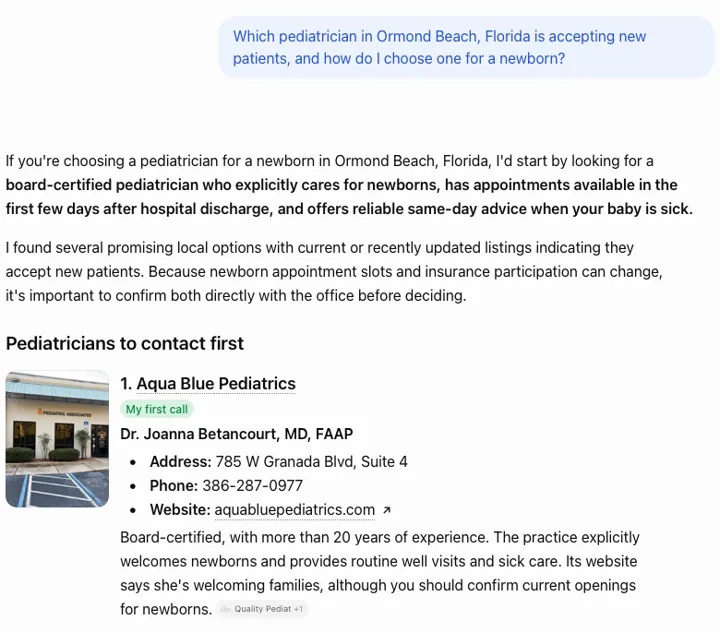
The real answer for the Ormond Beach sick-visit question, cropped and untouched. It names Twilight Pediatrics first and Pediatric Associates second, with posted hours. It also adds an emergency note of its own, which is the AI speaking, not us.
Twilight Pediatrics is named for after-hours care with its posted evening and weekend hours and a walk-in note.
Hours can change, so it tells the parent to confirm today's hours before leaving.
A small pediatric clinic is named first and a larger pediatric group second. Both appear.
Practices named in each answer, in the order each AI listed them. Logged-out ChatGPT and Google AI Mode through our own search data account, October 22 and 23, 2026, one run each. We do not judge any practice, and we leave out individual doctors' names.
What this means for you. A hospital system was named in nearly every answer and a larger group or urgent care chain in more than half, so a small practice is competing with big names. Small and independent practices still appeared in five of every six answers, and they were the ones with clear pages on hours and new patients.
What this does not prove. One run per question, one day, one state, and listings change. We do not say who is best, and the AI does not either: it told patients to call and confirm. It does not promise your result.
ChatGPT linked the American Academy of Pediatrics' parent site, Healthgrades, Pediatric Associates, AdventHealth and Halifax Health pages, and individual practice websites. Google's answers showed map-style listings with ratings and hours, and drew on practice and system sites.
So being named is not one trick. The AI reads directories, hospital pages and your own pages together, and it prefers a page that answers the exact question. A profile alone is not enough, and neither is a website with one contact page.
The AI reads directories, hospital pages and your own pages. We write the practice pages that answer the exact question.
AdventHealth and Halifax Health pages were linked often. If you are affiliated, your profile there matters.
Healthgrades appeared in two ChatGPT answers. Keep yours accurate.
Practices such as Twilight Pediatrics and Port Orange Pediatrics were linked from their own sites.
A page on same-day sick visits in Port Orange beats a general contact page for that question.
RunOctopus is an AI that does its own checking, so nothing waits for a person to say yes. What keeps medical content safe is what we choose to write, and what the checks refuse to publish.
We write practice-information pages from facts you give us in writing. We write no condition, treatment, diagnosis, outcome or credential-claim pages. Every sentence is checked automatically against your facts and a rule list. Anything we cannot trace to your own words is left out, not published.
The pages contain no clinical claims, so there is nothing clinical to review. We do not give medical advice. You can read everything we publish, and every page is dated and recorded in your account.
No clinical pages. Every sentence traced to your own words, or left out.
Your providers, as you state them. Nothing added.
From your own list, kept current and dated.
How to book, what to bring and how a first visit works, in plain non-clinical terms.
No condition, treatment or diagnosis pages at all.
No results, no testimonials, no patient stories, no superlatives.
We do not ask for or use patient records, names, photos or stories.
HIPAA, state advertising rules and your system policies are yours. We follow the rules you give us.
Our AI agent, Ollie, does the research and the writing, checks every sentence against the facts you gave us, and publishes. You can read everything.
We find the questions, write the pages, check every sentence automatically, publish, and check every month.
We read your site, your Search Console and the directories, and list what patients ask in your towns.
We ask ChatGPT and Google AI find-a-provider questions, town by town, and save dated screenshots of who is named.
One page per provider and location: who you see, plans accepted, how to book. Real facts from you, never filler.
Every sentence is checked against your facts and a rule list. Anything that cannot be traced to your words is left out.
Pages go live with links to your related pages, then we load them to confirm.
We re-run the same questions and show you who is named now, next to last month.
Here is the shape of a page we would write for a practice. The details change for every provider and town, but the parts do not.
The title is the question. Written the way a patient would type it, with the town in it. Not "Our Practice" but "Same-Day Sick Visits in Ormond Beach: Hours and How to Book."
The practical answer comes first. Whether you offer same-day sick visits, your hours, which plans you accept and how to book, in two or three sentences.
Then the facts a patient can check. Your pediatricians, languages, hours, address and parking. We write nothing clinical.
Then the questions that come next. A real FAQ about booking and insurance, marked up for Google.
Then the paths. Links to the next page the patient needs: the provider page, the location page, the insurance page.
If you run a practice with one or two pediatricians, you do not need a big website. You need the right pages: one for each pediatrician, one for each office, one on same-day and after-hours care and one that says how a newborn becomes a patient. The AI cares about the answer on the page, not the size of the practice behind it.
A handful of clear, current pages beats a long services list.
One page per pediatrician: who they are and which ages they see, in your clinicians words.
New patients, newborns, plans accepted, how to book. The page parents and the AI both look for.
Hours and accepting new patients change. A dated, current page beats a stale one.
With several offices, the AI has to tell them apart and know they are one practice. Most multi-location sites fail the first: every location page says the same thing, so the AI names none of them.
We write a page for each location from that location's own facts: its providers, hours, plans accepted and how to book. Brand rules live at the top. Local facts live at each location. We never invent an office.
Same brand rules everywhere, different facts at every location, rolled out in waves with one report for head office.
One practice name, one set of rules, and a clear page for each location.
The providers, hours and plans of that location. No copied pages.
A Google profile for each real location, kept consistent.
We start where the check shows the biggest gap, then scale.
Which practices the AI named this month, with a dated screenshot per location.
One view for the practice manager: who is named where, and what changed.
For a system, the questions are about control. Your marketing, legal and compliance teams set the rules, and many systems control their website tightly. We work inside those rules, or we tell you plainly when a location is not allowed its own pages.
We start with a pilot of three sites, inside your rules.
Good. We follow your brand rules and write the pages you allow.
Good. Your compliance team can read everything we publish, and every page is dated and recorded in your account.
The AI linked hospital and urgent care pages often. Ask your system whether each provider or location may have its own pages.
You have probably been burned by marketing that takes a quarter to show anything. So here is the first week, and what you can see each day.
Google usually takes a few weeks to show new pages, so the first week is about getting the right pages live and your starting answers saved. The monthly re-check is where you see whether the AI's answer has moved.
We do not promise a result, because AI answers change and no one controls them. What we can do is show you the math you will run in your head anyway. Put in what a new patient is worth to your practice in a year.
Sample The starting numbers are an example. Type your own and watch it change.
If one extra new patient a month does not cover it, this is not for you, and we will say so on the call.
3 locations or towns x 1 extra job a month x $450 x 12 months.
Arithmetic only. We do not promise patients. Use your own numbers.
Right. That is why we write no medical claims at all. We write practice facts, every sentence is checked against what you gave us, and anything we cannot trace is left out.
Healthgrades appeared in two of nine ChatGPT answers, so keep it accurate. The AI also linked practice and hospital sites. Your own pages say exactly what you want patients to know.
We never use patient information. We write general educational and practice-information pages. Your compliance contact decides anything about your site tools and pixels, which matters for a practice that sees children, because scheduling pages can pass details to third parties.
Ask your system whether providers or locations may have their own pages. We work inside your rules or tell you plainly when not.
You write nothing. Everything we publish is on your site and recorded in your account.
We cannot promise patients. The 90 day guarantee covers how often Google shows your site, and you keep every page either way.
These practice-type pages are being written next. Each one starts with its own check of what AI says in that specialty.
Most practices already pay for something. Here is what each one does about AI answers, in plain terms.
| Option | What It Does | AI Answers |
|---|---|---|
| Directory profiles (Healthgrades, Zocdoc) | Lists you on their pages | Often cited, but written and kept by someone else |
| Paid search ads | Pays for a slot above the results | An ad beside the answer, not in it |
| A template website | Lists your services | Little specific for the AI to quote |
| A marketing agency | Reports, some posts, monthly calls | Sometimes, often not checked |
| RunOctopus | Writes pages from your facts, checks every sentence automatically, publishes and re-checks | Checked monthly, screenshots shown |
We write general educational and practice-information pages from what your practice gives us, such as who your pediatricians are, which plans you accept, how a family becomes a new patient and what a first visit involves. We write no condition, treatment, diagnosis or outcome pages, so there is no clinical content to approve. Every sentence is checked automatically against the facts you gave us and a rule list, and anything we cannot trace to your own words is left out. We do not give medical advice, and we make no claims about clinical accuracy.
No. We never ask for or use patient records, names, photos or stories, and we never use photos of children. We do not write testimonials or outcome claims. If a tool on your site touches patient information, that is a separate question for your compliance contact.
Many parents now ask ChatGPT or Google's AI how to choose a pediatrician, who is accepting new patients and where to go for a same-day sick visit. In our October 2026 check, every answer named real practices, and nearly all told the parent to call and confirm.
In our check of three Florida towns, a small or independent practice was named in 15 of 18 answers. A hospital system was named in 17 of 18 and a larger multi-office group or urgent care chain in 10 of 18. AI tends to name the practices that detailed, specific pages and other sources describe.
Healthgrades appeared in two of the nine ChatGPT answers, so keep that profile accurate. ChatGPT also linked practice websites and the American Academy of Pediatrics' parent site. A directory profile is written by someone else. Your own pages say exactly who you are, who you see and how to book.
Check with your system's marketing and compliance teams first, because many systems control their websites. Where a location or pediatrician is allowed its own pages, we write one per provider and location from your facts.
We write a different page for each office, with its own pediatricians, hours, plans accepted and new-patient steps, under one brand. We start with the two or three offices where the check shows the biggest gap.
You do not write anything, and nobody has to say yes before a page goes live. Pages are checked automatically against the facts you gave us and a rule list, you can read everything we publish, and every page is dated and recorded in your account.
We cannot promise patients, because AI answers change week to week. We put the right pages on your site, check each month who the AI names and show you the dated screenshots, and refund you if your Google appearances are not up after 90 days.
Access to your website and Google Search Console, your pediatricians, offices, plans accepted and how new patients book. We look up the rest ourselves.
The pieces behind this page, in plain words.
How AI picks a local business, step by step.
What AI Search Visibility MeansThe idea behind being named in an answer.
Get Your Business on ChatGPTWhat to put on your site so ChatGPT can name you.
RunOctopus Compared with an SEO AgencySide by side, in plain terms.
A Case Study, Misses IncludedA recruiting site we write for, with every number and every miss.
RunOctopus for Healthcare ProvidersThe parent page: every kind of practice, with the same kind of check.

We research the questions and write the pages, every sentence is checked against your facts, and then we publish, check and show you each month who the AI named. If your Google numbers are not up at 90 days, you get your money back and keep every page.
Click Here to Start with the Free Scan →How the 90-day promise works: we compare how often your site is shown in Google in the 90 days after your first page goes live against the 90 days before. It covers how often Google shows your site, not a particular ranking or a spot in a particular AI answer, because nobody can promise those. The price you start at is the price you keep, even when it goes up for new customers.
Type your website. The free scan shows what AI can and can't read, and which pages you're missing.
Run My Free Scan