Get your company, every branch and every town you serve named by ChatGPT and Google AI.
In 18 AI answers about house cleaning in three Florida towns, local companies were named in at least 16. See the answers
When a homeowner asks AI who to call for house cleaning, a move-out clean or a maid they can trust, it names a few companies, and often gives a price. RunOctopus writes and publishes the pages on your website that those answers are built from, one team or fifty locations, and every month shows you with dated screenshots who the AI named.
Run my free scanNames as the AIs printed them. One run, one day. Two franchise brands appeared beside two locals.
A homeowner choosing a cleaner is letting a stranger into the house. They want a price and a reason to trust you, and they now ask an AI for both. The AI answers with a few companies, a price range, and a warning to ask about insurance and background checks.
If you are one of the few named, you get the call, and a recurring client can be worth every other week for years. If you are not, the homeowner never sees you, however good your team is. The companies that publish a real price and say plainly how they screen their cleaners give the AI something to quote.
People ask for a price and for trust. AI gives a few names. Being one of them is the job.
Every answer in our check told homeowners to ask about insurance, bonding and background checks. Say yours plainly on your page.
Recurring answers gave a price range first. One local company was named the best for price transparency because it published a rate.
Local companies were named in at least 16 of 18 answers. Franchise brands appeared in 9 of 18 and led once.
Every other week is about 26 visits a year. One name that comes up can mean years of visits.
The big brands were named in half the answers. A franchise owner with a real local page has a better chance to be the one named.
Home service companies are not all built the same, and what gets you named is different for each. Pick the one that sounds like you and jump to it. The rest of the page applies to all four.
You can be named at any size. A single team needs real job pages. Many towns or many branches need a real page for each place, never a copy.
You run it and do the jobs. Start with the services that pay your bills.
One base, teams that cover 15 towns. A real page for each town, and no fake offices.
Several locations under one brand. A different page for each branch, rolled out in waves.
Many owners, one brand. Brand rules at the top, local facts at each location. Check your franchise agreement first.
A homeowner with guests coming on Friday does not browse. They type one sentence, read one paragraph and call. Everything we do aims at one of the steps in between.
The AI does not know your company. It searches the way you would, reads the pages it finds (your site, reviews, local sites, forums, directories) and writes an answer from what those pages say. It leans hardest on pages that answer the exact question asked: "who does move-out cleaning in Port Orange, and what does it cost?"
That is the opening. A national brand has a famous name, but it rarely has a page for your town. A local company can. In our check of three Florida towns, local companies were named in nearly every answer. The big names showed up mostly in the paid ads beside the answer.
Six things kept showing up in the companies that got named. None of them is "spend more on ads." All of them live on your own website.
One page per exact job and town, the answer in the first lines, and facts only you can give.
"Move-Out Cleaning in Port Orange" beats "Our Services" every time.
Price ranges, how long it takes, what is included, in the first two sentences. The AI quotes that line.
Your license, your response time, the neighborhoods you work, the parts you stock. Specific beats polished.
Reviews, local press, directories and forum threads that name you. The AI trusts what others say about you.
The same name, address, phone and logo everywhere, so the AI is sure every mention is one company.
A price page from 2023 tells the AI you stopped paying attention. Dated, refreshed pages read as alive.
Homeowners ask AI about house cleaning in three ways, and each one needs a different page. A company that only writes "call us for a free estimate" is missing all three.
Sample These are real questions Google shows people about house cleaning (checked October 22, 2026), and the kinds we build pages for. On your account, every question comes from your own Search Console, your towns and what people in your market really ask, and you see the list before we check it.
People ask to hire, to price a job, and to decide what to do themselves. Write for all three.
"How much does a house cleaning service cost in DeLand for a 3 bedroom home every two weeks, and who does it?"
"Who does move-out or deep cleaning in Port Orange, and what should I expect to pay?"
"How much does a house cleaning service cost, and how do cleaners charge?"
"What is the average cost to clean a 2000 square foot house?"
"What are the differences between a deep cleaning and a regular cleaning?"
"What does a move out clean consist of?"
"How do I prepare my house for a cleaning lady?"
"Do housekeepers bring their own cleaning supplies?"
"How much should I tip a house cleaner?"
"How long does it take to deep clean a house?"
"What are typical cleaning fees for an Airbnb turnover?"
"How do I find a reliable cleaning service, and is Merry Maids a good one?"
In our check, the recurring-cleaning answers opened with a price range, and ChatGPT named one DeLand company as the best for price transparency because it published a rate for a 3 bedroom, 2 bathroom home. The insured-and-background-checked answers told homeowners exactly what to ask for.
A company that hides its price and its insurance gives the AI nothing to quote. A company that states a real range, what is included, and how it screens and insures its team gives the AI a clean answer and the homeowner a reason to call.
State your price range and your trust facts. The AI quotes them and the homeowner relaxes.
What a standard clean costs for a 3 bedroom home, every two weeks or monthly, and what changes it.
What each includes, how long it takes and what it costs. The AI quoted these in every town.
Your insurance, bonding and screening, stated plainly. We ask you for the facts and never claim them for you.
What to do before the cleaners come, what they bring, how to tip. Real questions people ask.
Rental and Airbnb turnover cleaning, with a price range and a response time.
A plain comparison a homeowner can use, written from your own facts.
On October 22, 2026 we asked both AIs about house cleaning in DeLand, Ormond Beach and Port Orange: a recurring clean for a 3 bedroom home, move-out or deep cleaning, and whether maids are insured and background checked. That is 18 answers, with the misses left in.
Local companies were named in at least 16 of 18 answers. A franchise brand showed up in 9 of 18 and led once.
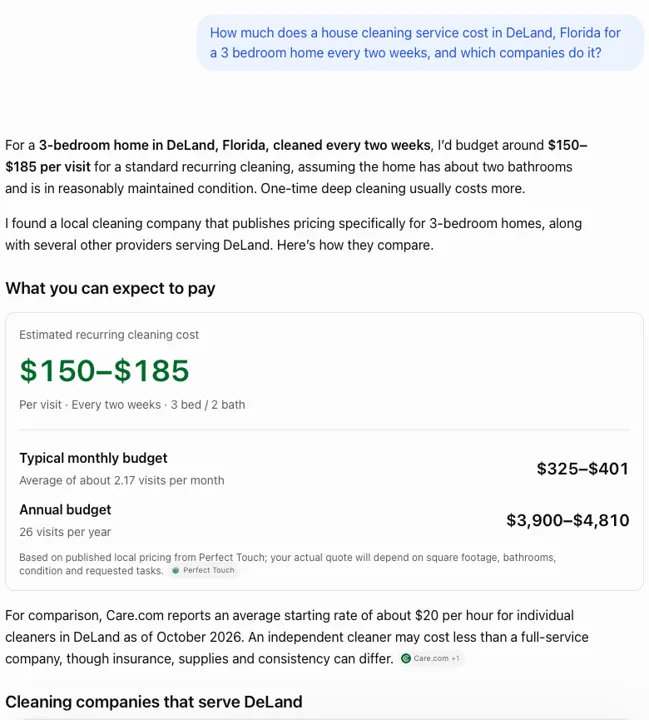
The real answer for the DeLand recurring-cleaning question, cropped and untouched. It opens with a price range from a local company that publishes its rate.
$150 to $185 a visit for a 3 bedroom, 2 bath home, then the monthly and yearly budget. A number a homeowner can plan around.
The price is based on Perfect Touch, a local company that publishes a rate for exactly this home. Publishing a price made it the source.
Care.com is cited for independents at about $20 an hour, with a note that insurance and consistency can differ. Honest comparisons earn trust.
Companies named in each answer, in the order each AI listed them. Logged-out ChatGPT and Google AI Mode through our own search data account, October 22, 2026, one run each.
What this means for you. Franchise brands, Merry Maids, Molly Maid, MaidPro and The Cleaning Authority, appeared in 9 of 18 answers, most often in ChatGPT. They led once. Local companies were named in at least 16 of 18, so a detailed local page still beats a famous name. The two Google answers that named no company gave a price range and pointed to Thumbtack, Angi or Care.com, which is the opening a local page can take.
An earlier check agrees. On October 1 and 5, 2026 we asked ChatGPT, Google AI and Claude for a plumber and an AC company in Richmond, Virginia and DeLand, Florida. Local companies led, and the big chains appeared only in Google's paid ads beside them.
What this does not prove. One run per question, one day, one state. AI answers change, so we re-check every month. It does not promise your result.
ChatGPT showed sources beside each name: Care.com, Google listings and the companies' own websites. Google's answers cited price guides, Care.com and Thumbtack, and showed map-style listings with ratings and offers.
So being named is not one trick. The AI reads what others say about you and what you say about yourself, and it prefers a page that answers the exact question. A marketplace profile alone is not enough, and neither is a website with one services page.
The AI reads listings, price guides, reviews and your own pages. We write the pages that answer the exact question.
Google showed ratings and offers beside each company. Keep your profile accurate and consistent with your site.
Care.com, Thumbtack and Angi were cited or named. We do not buy leads there. We make sure your details match.
The price and the inclusions came from company websites. A page that fits the question gets used.
A page about move-out cleaning in Port Orange beats a general services page for that question.
You do not write or approve anything. Our AI agent, Ollie, does the research and the writing, our team checks it, and it goes live on your site.
You write nothing. We find the questions, write and publish the pages, then check every month.
We read your Search Console, your reviews and your competitors' pages, and list the jobs and towns where homeowners ask.
We ask ChatGPT and Google AI those questions, town by town, and save dated screenshots of who gets named.
One page per job and place: the price range, the process, the neighborhoods. Real facts about how you work, never filler.
Each page goes live with its FAQ and links to your related pages, then we load it to confirm.
We re-run the same questions and show you who is named now, next to last month.
Your name, logo and listings cleaned up so the AI reads one company.
Here is the shape of a page we would write for a cleaning company. The details change for every job and town, but the parts do not.
The title is the question. Written the way a homeowner would type it, with the town in it. Not "Our Services" but "House Cleaning in Port Orange: What It Costs for a 3 Bedroom Home."
The answer comes first. Price range, time and what is included, in two or three sentences, so the AI has a clean line to quote.
Then the proof. Facts a reader can check: your license, the insurance and bonding you carry, the neighborhoods you work, a real job from last month with what it cost.
Then the questions that come next. A real FAQ: how long does it take, do you bring supplies, what does a deep clean add, how do I cancel.
Then the paths. Links to the next page the homeowner needs: the move-out page, the town page, the trust page.
If you run the business and do the jobs, you do not need a big website. You need the right pages: one for each job you really do and each town you really work. The AI cares about the answer on the page, not the size of the company behind it.
Ten honest job pages beat a long list of services.
Standard, deep, move-out, recurring. Whatever pays your bills. One page each, with real price ranges.
Your name, your license, how long you have worked here, a real photo. The AI and the homeowner both look for a person.
A treatment you did last month in a real neighborhood, with what you found and what it cost. That is the page nobody else has.
Many home service companies have one shop and teams that cover a wide area. The mistake is to copy one page twenty times with a different town name, or worse, to invent an office in each town. Google can suspend a listing for a fake address, and AI can tell a copy when it reads one.
A real town page says where your teams start, how fast you get there, what you have done in that town and what is different about working there.
Real town pages for the towns you really serve. Never a fake address, never a copy.
"Serving Port Orange from our Daytona Beach shop, about 15 minutes away." True, specific and useful.
Real jobs in that town: the rental turnovers, the move-outs, the homes that book every other week.
Permit rules, the local climate, the age of the homes. Facts a copy cannot have.
One Google Business Profile can list many service areas. You do not need 15 profiles.
We check which towns the AI names you for and which it skips, and write the first three towns where you are missing.
About twenty pages at a time. We read Search Console between waves and stop to fix anything that is not working.
| Town | Homes Searching | AI Names You? | Order |
|---|---|---|---|
| Port Orange | High | No | Wave 1 |
| Ormond Beach | High | No | Wave 1 |
| Daytona Beach Shores | Medium | No | Wave 1 |
| Holly Hill | Medium | Sometimes | Wave 2 |
| South Daytona | Medium | Yes | Keep fresh |
When a company has twelve locations, the AI has to do two things: tell the branches apart and know they are one company. Most multi-location sites fail the first. Every branch page says the same thing, so the AI names none of them.
We write a page for each branch from that branch's own facts: its team, its jobs, its neighborhoods, its hours and its reviews. Brand rules live at the top. Local facts live at each location.
Same brand rules everywhere, different facts at every branch, rolled out in waves with one report for head office.
One company name, one logo, one set of rules, and a clear page for each location so the AI knows they belong together.
The team, the jobs, the neighborhoods and the hours of that branch. Copied pages are the trap, so none are made.
A Google profile and review story for each real location, kept consistent.
We start where the check shows the biggest gap, prove it, then scale to the rest.
Which towns the AI named this month, which it did not, with a dated screenshot per branch.
A single view for corporate or the franchisor: who is named where, and what changed since last month.
Good. Each manager can read their own pages and report. Nothing waits on them to write.
We work inside your brand rules and your approvals. Pages follow the rules you give.
Franchise rules and local facts both fit. We write per location, with the brand at the top.
Templates are why branch pages read the same. We keep your layout and replace the copy with real local facts.
| Branch | Named by ChatGPT | Named by Google AI | Since Last Month |
|---|---|---|---|
| Branch A | Yes | Yes | Same |
| Branch B | No | Yes | New in ChatGPT |
| Branch C | No | No | Pages live, watching |
| Branch D | Yes | No | Lost in Google, fixing |
You have probably been burned by marketing that takes a quarter to show anything. So here is the first week, and what you can see each day. You do not write or approve anything along the way.
Google usually takes a few weeks to show new pages, so the first week is about getting the right pages live and your starting answers saved. The monthly re-check is where you see whether the AI's answer has moved.
We do not promise a result, because AI answers change and no one controls them. What we can do is show you the math you will run in your head anyway. Put in what one job pays you.
Sample The starting numbers are an example. Type your own and watch it change.
If one extra job a month does not cover it, this is not for you, and we will say so on the call.
3 locations or towns x 1 extra job a month x $450 x 12 months.
Arithmetic only. We do not promise jobs. Use your own numbers.
In our check a franchise brand appeared in 9 of 18 answers and led once. Local companies were named in at least 16. A detailed local page is how you get named beside them.
Ask any provider what it checks. We run the same questions every month in ChatGPT and Google AI and show dated screenshots of who was named.
Referrals ask AI too. When a neighbor says "call Maria," the next move is a search. Be the name that comes back.
The work is the same: real pages for real jobs and places. It scales from one truck to hundreds of locations.
You write nothing and approve nothing. Everything we publish is on your site and recorded in your account.
We cannot promise calls. The 90 day guarantee covers how often Google shows your site, and you keep every page either way.
These trade pages are being written next. Each one starts with its own check of what AI says in that trade.
Most home service companies already pay for something. Here is what each one does about AI answers, in plain terms.
| Option | What It Does | AI Answers |
|---|---|---|
| Lead sites (Angi, HomeAdvisor) | Sells you leads on their pages | Not your site, so not your name in the answer |
| Local Services Ads | Pays for a slot above the results | An ad beside the answer, not in it |
| A template website | Lists your services | Nothing specific for the AI to quote |
| An SEO agency | Reports, some posts, monthly calls | Sometimes, often not checked |
| RunOctopus | Writes, publishes and checks a page per job and place, every week | Checked monthly, screenshots shown |
A real range for a real home, in plain words. For example, what a standard clean costs for a 3 bedroom, 2 bathroom home every two weeks, what a deep clean or move-out clean costs, and what changes the price. In our check ChatGPT named one DeLand company as having the best price transparency because it published a rate for exactly that home.
Only what is true for your company, stated plainly: whether you carry liability insurance and workers' compensation, whether you are bonded, and whether your cleaners are background checked and how. Every answer in our check told homeowners to ask for exactly these. We never claim anything on your behalf, and we ask you for the facts.
Experiences vary. Some home service owners in public forums say shared leads are hard to turn into jobs and that cancelling can be hard. Others report good results on some platforms. We can't speak for every owner. A page on your own site is yours, and an AI can name it without a fee for each lead.
Many now ask ChatGPT or Google's AI who cleans houses nearby and what it costs. Each answer names a few companies, and the ones named get the first call.
In our October 22, 2026 check of three Florida towns, local companies were named in at least 16 of 18 answers. A franchise brand was named in 9 of 18 and led only once. AI tends to name the businesses that detailed pages and other sources vouch for.
Check your franchise agreement first, because some brands control the website. Where you are allowed your own pages, we write one for each town you serve from your own facts. Where you are not, we tell you plainly and do not touch it.
Yes. The work is one clear page per service and per town you really serve. One team can be named as easily as a large company.
We write a different page for each branch, with its own team, services and neighborhoods, under one brand. We start with the two or three locations where the check shows the biggest gap, then roll out in waves.
No, and you should never invent one. A real page for each town you serve says where your teams start and shows real jobs there. One Google profile can list many service areas.
No. We research the questions, write the pages in your voice, publish them and check them live. You can read everything, but nothing waits on you.
We cannot promise calls, because AI answers change week to week. We put the right pages on your site, check each month who the AI names and show you the dated screenshots, and refund you if your Google appearances are not up after 90 days.
Those sell you a slot on someone else's page. An AI answer names a few companies with reasons, and nobody sells that slot. Your pages stay on your own site whether or not you keep paying.
Access to your website and Google Search Console, the towns and branches you serve, and anything that makes you different. We look up the rest ourselves.
One honest note on size: on a Florida recruiting site we work on, a typical page earns well under one click a month at first, and half of all clicks came from 20 pages. The work is to build the pages that answer real questions well, and to check each month which ones the AI now trusts.
The pieces behind this page, in plain words.
How AI picks a local business, step by step.
What AI Search Visibility MeansThe idea behind being named in an answer.
Get Your Business on ChatGPTWhat to put on your site so ChatGPT can name you.
RunOctopus Compared with an SEO AgencySide by side, in plain terms.
A Case Study, Misses IncludedA recruiting site we write for, with every number and every miss.
RunOctopus for Home ServicesThe parent page: pest control, plumbing, cleaning and more.

We research the questions, write and publish the pages, check every one, and show you each month who the AI named. If your Google numbers are not up at 90 days, you get your money back and keep every page.
Click Here to Start with the Free Scan →How the 90-day promise works: we compare how often your site is shown in Google in the 90 days after your first page goes live against the 90 days before. It covers how often Google shows your site, not a particular ranking or a spot in a particular AI answer, because nobody can promise those. The price you start at is the price you keep, even when it goes up for new customers.
Type your website. The free scan shows what AI can and can't read, and which pages you're missing.
Run My Free Scan