Get your company, every branch and every town you serve named by ChatGPT and Google AI.
In 18 AI answers about garage door companies in three Florida towns, local companies were named in every one. See the answers
When a homeowner asks AI who to call for a broken spring, a dead opener or a new door, it names a few companies, and often gives a price. RunOctopus writes and publishes the pages on your website that those answers are built from, one truck or fifty locations, and every month shows you with dated screenshots who the AI named.
Run my free scanNames as the AIs printed them. One run, one day. A franchise brand led ChatGPT here, beside two locals.
Nobody shops for a garage door company. The spring snapped, the car is stuck inside or the opener died, and they want one name and a price now. They hand that question to an AI, and the AI answers with a few companies and a price range.
If you are one of the few named, you get the call. If you are not, the homeowner never sees you, however good the work is. Garage doors are also a trade where national and franchise names do show up, so a local company needs a page that gives the AI something specific to quote.
People ask for one name and a price when the door breaks. AI gives a few. Being one of them is the job.
A broken spring with the car inside does not wait for comparison shopping. The first names the homeowner sees get the call.
ChatGPT opened with a price table: one spring $150 to $300, a pair $200 to $400, after hours $250 to $500 and up. A company with honest ranges on a page gets quoted.
In the 18 answers we read, local companies were named in every one, even where a franchise brand also appeared.
A national or franchise-brand location appeared in 10 of 18 answers, but in none in DeLand. A local page for your town is what competes.
Pages on your own site are yours. They can be named by AI without a fee for each call.
Home service companies are not all built the same, and what gets you named is different for each. Pick the one that sounds like you and jump to it. The rest of the page applies to all four.
You can be named at any size. A single truck needs real job pages. Many towns or many branches need a real page for each place, never a copy.
You run it and do the jobs. Start with the five problems that pay your bills.
One base, trucks that cover 15 towns. A real page for each town, and no fake offices.
Several locations under one brand. A different page for each branch, rolled out in waves.
Many owners, one brand. Brand rules at the top, local facts at each location. Check your franchise agreement first.
A homeowner whose car is stuck behind a broken door does not browse. They type one sentence, read one paragraph and call. Everything we do aims at one of the steps in between.
The AI does not know your company. It searches the way you would, reads the pages it finds (your site, reviews, local sites, forums, directories) and writes an answer from what those pages say. It leans hardest on pages that answer the exact question asked: "who fixes a broken garage door spring in Port Orange today, and what does it cost?"
That is the opening. A national brand has a famous name, but it rarely has a page for your town. A local company can. In our check of three Florida towns, local companies were named in nearly every answer. Brand locations showed up in more than half of the answers, so a local page needs to be specific.
Six things kept showing up in the companies that got named. None of them is "spend more on ads." All of them live on your own website.
One page per exact job and town, the answer in the first lines, and facts only you can give.
"Broken Spring in Port Orange" beats "Our Services" every time.
Price ranges, how long it takes, what is included, in the first two sentences. The AI quotes that line.
Your license, your response time, the neighborhoods you work, the parts you stock. Specific beats polished.
Reviews, local press, directories and forum threads that name you. The AI trusts what others say about you.
The same name, address, phone and logo everywhere, so the AI is sure every mention is one company.
A price page from 2023 tells the AI you stopped paying attention. Dated, refreshed pages read as alive.
Homeowners ask AI about garage doors in three ways, and each one needs a different page. A company that only writes "call us for a free estimate" is missing all three.
Sample These are real questions Google shows people about garage doors (checked October 22, 2026), and the kinds we build pages for. On your account, every question comes from your own Search Console, your towns and what people in your market really ask, and you see the list before we check it.
People ask to hire, to price a job, and to decide what to do themselves. Write for all three.
"Which garage door company in Ormond Beach can fix a broken spring today, and what does it usually cost?"
"Who is the best garage door company in Port Orange for installing a new garage door?"
"How much does it usually cost to replace a spring on a garage door?"
"How much does a 10x10 garage door cost?"
"How much does it cost to fix a bent garage door track?"
"How much does it cost to replace the rollers on a garage door?"
"Can you replace a garage door spring yourself?"
"Can I use my garage door if one spring is broken?"
"Is it cheaper to repair or replace a garage door?"
"Will homeowners insurance cover garage door replacement?"
"Is it worth repairing a 20 year old garage door opener?"
"How long does it take to replace a garage door?"
Many of the most common garage door questions on Google are about money and about doing it yourself: how much does a spring cost, can I replace a spring myself, can I still use the door with one broken spring, is it cheaper to repair or replace. In our check, ChatGPT answered the Ormond Beach spring question with a price table and a safety warning before it named any company.
A company that hides prices gives the AI nothing to quote. A company that explains what drives the price, and says plainly when to stop and call a pro, gives the AI a clean answer and gives the homeowner a reason to trust the call.
Explain what drives your price and when to stop and call. The AI quotes it and the homeowner trusts it.
What a spring, a new door or an opener usually costs here, and what changes it.
At 20 years, when an opener repair makes sense and when it does not.
Door stuck open, car trapped inside, broken spring tonight. What to do and who to call.
Why not to unwind a spring yourself, and what you can check first. Plain, careful, no promises.
Does homeowners insurance cover a garage door, what a permit might involve. Real local facts.
How long a new door takes and what the day looks like. A job people research before they hire.
People ask the AI about three garage door problems: a broken spring today, a new door, or an opener that stopped. Pick yours and see what ChatGPT and Google AI each said, as printed for DeLand, Ormond Beach and Port Orange on October 22 and 23, 2026.
These are planning ranges and rules of thumb, not quotes and not our prices.
The AI answers all three. Publish your price and your rule for each.
Prices the AIs gave: repair $75 to $350+, a new opener installed $300 to $900+. ChatGPT also said that if the repair costs about half of a comparable new opener, replacement is worth comparing.
The same ranges lined up on one scale. The gridlines mark $100, $1,000 and $10,000. Orange is ChatGPT, purple is Google AI. A missing bar means that AI gave no range for the job.
Planning ranges as printed on October 22 and 23, 2026. Not quotes and not our prices.
From a $150 spring to a $7,000 premium door.
Exactly as printed on October 22 and 23, 2026. ChatGPT logged out and Google AI Mode through our own search data account, one run each. Not quotes.
Local garage door companies were named in all 18 answers. A national or franchise-brand location was named in 10 of 18, and it was the first name in 3. None of the six DeLand answers named one.
One run on one day, read by hand. It is not a ranking and it is not permanent.
Locals were named every time. Brand locations showed up in the towns nearer the coast.
Every answer in every town named at least one independent garage door company.
Google AI 5 of 9, ChatGPT 5 of 9. By question: springs 3 of 6, new door 3 of 6, opener 4 of 6.
No brand location in any DeLand answer. First in 3 of 18 overall, all on spring or new door questions in Ormond Beach and Port Orange.
ChatGPT repeated the same advice across all three problems: get the total in writing, and compare the same specification. A good garage door page answers these first.
Say what the price includes, and the wind rating.
ChatGPT, DeLand: ask whether the quote includes parts, labor, service fees, and both springs if that applies. Port Orange: ask whether the service fee and tax are included.
ChatGPT, Ormond Beach and Port Orange: avoid operating the door or trying to unwind or remove a broken spring yourself, because it is under substantial tension.
ChatGPT, Ormond Beach and Port Orange: ask each installer to quote the same door so you compare equal products, not just the bottom line.
ChatGPT, DeLand and Port Orange: ask for the approved product documentation and the design pressure for your opening. Do not pay extra for a generic hurricane proof claim.
ChatGPT, Ormond Beach and Port Orange: tracks, springs, cables, rollers, hardware, haul-away, permit and inspection fees, plus the labor and manufacturer warranties.
ChatGPT, Ormond Beach: ask whether the diagnostic fee is credited toward the repair, and get parts, labor and warranty in writing.
ChatGPT, Port Orange: ask whether the technician will test the door springs and balance before recommending a new opener. A heavy door may be a spring problem.
ChatGPT, Ormond Beach: if the door starts closing and then reverses, check for blocked or misaligned safety sensors first.
On October 22, 2026 we asked both AIs about garage door companies in DeLand, Ormond Beach and Port Orange: a broken spring today, a new door installed, and a dead opener. That is 18 answers, with the misses left in.
Local companies were named in every answer. A national or franchise-brand location showed up in 10 of 18 and led 3, but showed up in none in DeLand.
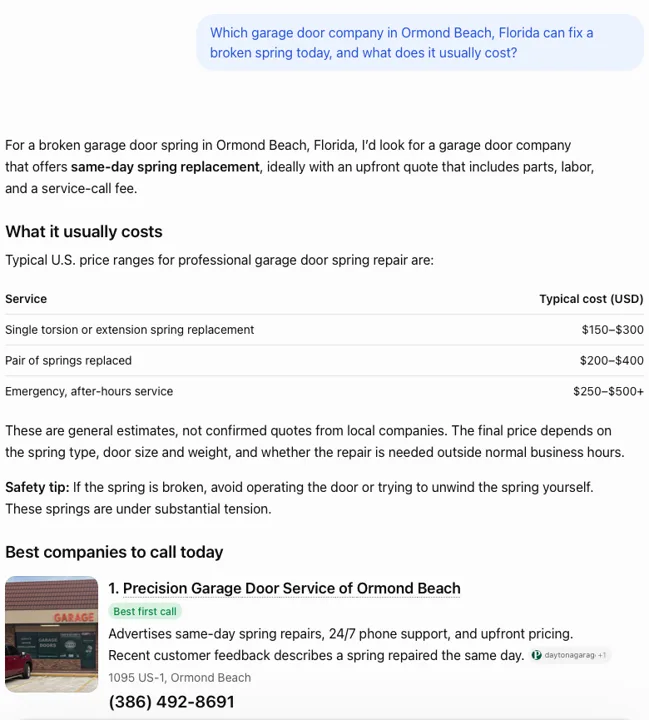
The real answer for the Ormond Beach broken spring question, cropped and untouched. It shows a price table and a safety tip, then names a franchise location first.
Spring $150 to $300, a pair $200 to $400, after hours $250 to $500 and up, before any company is named.
Precision Garage Door Service of Ormond Beach leads, "best first call," with same-day repairs and upfront pricing. Locals follow.
"Avoid operating the door or trying to unwind the spring yourself." Careful, specific advice comes from specific pages.
Companies named in each answer. Google's answers are cards, so the order is not a strict ranking. Logged-out ChatGPT and Google AI Mode through our own search data account, October 22, 2026, one run each.
What this means for you. Garage doors are a trade where brand locations show up: Precision Garage Door Service and Overhead Door Company of Daytona Beach appeared in 10 of 18 answers and led 3. They did not appear in DeLand at all. Local companies were named in every single answer, so a detailed local page still competes, and the new-door question is where a brand led most.
An earlier check agrees. On October 1 and 5, 2026 we asked ChatGPT, Google AI and Claude for a plumber and an AC company in Richmond, Virginia and DeLand, Florida. Local companies led, and the big chains appeared only in Google's paid ads beside them. Garage doors look more mixed.
What this does not prove. One run per question, one day, one state. AI answers change, so we re-check every month. It does not promise your result.
ChatGPT showed the sources next to some names: company sites, HomeAdvisor and Angi. Google's answers showed map-style listings with star ratings, review counts, phone numbers and any offers, and pulled details from company sites.
So being named is not one trick. The AI reads what others say about you and what you say about yourself, and it prefers a page that answers the exact question. A listing alone is not enough, and neither is a website with one services page.
The AI reads listings, reviews and your own pages. We write the pages that answer the exact question.
Google showed ratings such as 4.9 with a review count beside each company. Keep your profile accurate and consistent with your site.
HomeAdvisor and Angi appeared as sources in some answers. We do not buy leads there. We make sure your details match.
Same-day spring repair, 24/7 phone support and upfront pricing came from company sites. A page that fits the question gets used.
A page about a broken spring in Port Orange beats a general services page for that question.
You do not write or approve anything. Our AI agent, Ollie, does the research and the writing, our team checks it, and it goes live on your site.
You write nothing. We find the questions, write and publish the pages, then check every month.
We read your Search Console, your reviews and your competitors' pages, and list the jobs and towns where homeowners ask.
We ask ChatGPT and Google AI those questions, town by town, and save dated screenshots of who gets named.
One page per job and place: the price range, the process, the neighborhoods. Real facts about how you work, never filler.
Each page goes live with its FAQ and links to your related pages, then we load it to confirm.
We re-run the same questions and show you who is named now, next to last month.
Your name, logo and listings cleaned up so the AI reads one company.
Here is the shape of a page we would write for a garage door company. The details change for every job and town, but the parts do not.
The title is the question. Written the way a homeowner would type it, with the town in it. Not "Our Services" but "Broken Garage Door Spring in Port Orange: What It Costs and How Fast We Come."
The answer comes first. Price range, time and what changes the price, in two or three sentences, so the AI has a clean line to quote.
Then the proof. Facts a reader can check: your license, the equipment you use, the neighborhoods you work, a real job from last month with what it cost.
Then the questions that come next. A real FAQ: how long does it take, do you pull the permit, what does the warranty cover, is there an after-hours fee.
Then the paths. Links to the next page the homeowner needs: the opener page, the new door page, the town page.
If you run the business and do the jobs, you do not need a big website. You need the right pages: one for each job you really do and each town you really work. The AI cares about the answer on the page, not the size of the company behind it.
Ten honest job pages beat a long list of services.
Springs, openers, off-track doors, new doors, cables and rollers. Whatever pays your bills. One page each, with real price ranges.
Your name, your license, how long you have worked here, a real photo. The AI and the homeowner both look for a person.
A treatment you did last month in a real neighborhood, with what you found and what it cost. That is the page nobody else has.
Many home service companies have one shop and trucks that cover a wide area. The mistake is to copy one page twenty times with a different town name, or worse, to invent an office in each town. Google can suspend a listing for a fake address, and AI can tell a copy when it reads one.
A real town page says where your trucks start, how fast you get there, what you have done in that town and what is different about working there.
Real town pages for the towns you really serve. Never a fake address, never a copy.
"Serving Port Orange from our Daytona Beach shop, about 15 minutes away." True, specific and useful.
Real jobs in that town: the older doors with worn springs, the openers in hot garages.
Permit rules, the local climate, the age of the homes. Facts a copy cannot have.
One Google Business Profile can list many service areas. You do not need 15 profiles.
We check which towns the AI names you for and which it skips, and write the first three towns where you are missing.
About twenty pages at a time. We read Search Console between waves and stop to fix anything that is not working.
| Town | Homes Searching | AI Names You? | Order |
|---|---|---|---|
| Port Orange | High | No | Wave 1 |
| Ormond Beach | High | No | Wave 1 |
| Daytona Beach Shores | Medium | No | Wave 1 |
| Holly Hill | Medium | Sometimes | Wave 2 |
| South Daytona | Medium | Yes | Keep fresh |
When a company has twelve locations, the AI has to do two things: tell the branches apart and know they are one company. Most multi-location sites fail the first. Every branch page says the same thing, so the AI names none of them.
We write a page for each branch from that branch's own facts: its team, its jobs, its neighborhoods, its hours and its reviews. Brand rules live at the top. Local facts live at each location.
Same brand rules everywhere, different facts at every branch, rolled out in waves with one report for head office.
One company name, one logo, one set of rules, and a clear page for each location so the AI knows they belong together.
The team, the jobs, the neighborhoods and the hours of that branch. Copied pages are the trap, so none are made.
A Google profile and review story for each real location, kept consistent.
We start where the check shows the biggest gap, prove it, then scale to the rest.
Which towns the AI named this month, which it did not, with a dated screenshot per branch.
A single view for corporate or the franchisor: who is named where, and what changed since last month.
Good. Each manager can read their own pages and report. Nothing waits on them to write.
We work inside your brand rules and your approvals. Pages follow the rules you give.
Franchise rules and local facts both fit. We write per location, with the brand at the top.
Templates are why branch pages read the same. We keep your layout and replace the copy with real local facts.
| Branch | Named by ChatGPT | Named by Google AI | Since Last Month |
|---|---|---|---|
| Branch A | Yes | Yes | Same |
| Branch B | No | Yes | New in ChatGPT |
| Branch C | No | No | Pages live, watching |
| Branch D | Yes | No | Lost in Google, fixing |
You have probably been burned by marketing that takes a quarter to show anything. So here is the first week, and what you can see each day. You do not write or approve anything along the way.
Google usually takes a few weeks to show new pages, so the first week is about getting the right pages live and your starting answers saved. The monthly re-check is where you see whether the AI's answer has moved.
We do not promise a result, because AI answers change and no one controls them. What we can do is show you the math you will run in your head anyway. Put in what one job pays you.
Sample The starting numbers are an example. Type your own and watch it change.
If one extra job a month does not cover it, this is not for you, and we will say so on the call.
3 locations or towns x 1 extra job a month x $450 x 12 months.
Arithmetic only. We do not promise jobs. Use your own numbers.
In our check a brand location appeared in 10 of 18 answers and led 3, but none in DeLand. Local companies were named in every one. A detailed local page is how you get named beside them.
Ask any provider what it checks. We run the same questions every month in ChatGPT and Google AI and show dated screenshots of who was named.
Referrals ask AI too. When a neighbor says "call Mike," the next move is a search. Be the name that comes back.
The work is the same: real pages for real jobs and places. It scales from one truck to hundreds of locations.
You write nothing and approve nothing. Everything we publish is on your site and recorded in your account.
We cannot promise calls. The 90 day guarantee covers how often Google shows your site, and you keep every page either way.
These trade pages are being written next. Each one starts with its own check of what AI says in that trade.
Most home service companies already pay for something. Here is what each one does about AI answers, in plain terms.
| Option | What It Does | AI Answers |
|---|---|---|
| Lead sites (Angi, HomeAdvisor) | Sells you leads on their pages | Not your site, so not your name in the answer |
| Local Services Ads | Pays for a slot above the results | An ad beside the answer, not in it |
| A template website | Lists your services | Nothing specific for the AI to quote |
| An SEO agency | Reports, some posts, monthly calls | Sometimes, often not checked |
| RunOctopus | Writes, publishes and checks a page per job and place, every week | Checked monthly, screenshots shown |
Honest ranges, in plain words, near the top. For a broken spring, say what one spring and a pair usually cost and what an after-hours visit adds. For a new door, say what a single and a double door cost installed and what changes the price. ChatGPT led with a price table in its Ormond Beach spring answer, and an AI can only quote a page that gives ranges.
Yes, plainly and carefully. ChatGPT's own answer warned not to operate a door with a broken spring or try to unwind it, because the springs are under heavy tension. A page that says when to stop and call a pro earns trust. We never promise safety, and we write what is true for the job.
We found no independent complaints about lead sites in this trade, only listing pages where up to three pros are matched to a request. We can't speak for every owner. A page on your own site is yours, and an AI can name it without a fee for each call.
Many now ask ChatGPT or Google's AI who can fix a broken spring today, who installs a new door, or whether to repair or replace an opener, and what it should cost. Each answer names a few companies, and the ones named get the first call.
In our October 2026 check of three Florida towns, local companies were named in all 18 answers. A national or franchise-brand location showed up in 10 of 18, and was first in 3. In DeLand it showed up in none. AI tends to name the businesses that detailed pages and other sources vouch for.
Check your franchise agreement first, because some brands control the website. Where you are allowed your own pages, we write one for each town you serve from your own facts. Where you are not, we tell you plainly and do not touch it.
Yes. The work is one clear page per job and per town you really serve. One truck can be named as easily as a large company.
We write a different page for each branch, with its own team, jobs and neighborhoods, under one brand. We start with the two or three locations where the check shows the biggest gap, then roll out in waves.
No, and you should never invent one. A real page for each town you serve says where your trucks start and shows real jobs there. One Google profile can list many service areas.
No. We research the questions, write the pages in your voice, publish them and check them live. You can read everything, but nothing waits on you.
We cannot promise calls, because AI answers change week to week. We put the right pages on your site, check each month who the AI names and show you the dated screenshots, and refund you if your Google appearances are not up after 90 days.
Those sell you a slot on someone else's page. An AI answer names a few companies with reasons, and nobody sells that slot. Your pages stay on your own site whether or not you keep paying.
Access to your website and Google Search Console, the towns and branches you serve, and anything that makes you different. We look up the rest ourselves.
One honest note on size: on a Florida recruiting site we work on, a typical page earns well under one click a month at first, and half of all clicks came from 20 pages. The work is to build the pages that answer real questions well, and to check each month which ones the AI now trusts.
The pieces behind this page, in plain words.
How AI picks a local business, step by step.
What AI Search Visibility MeansThe idea behind being named in an answer.
Get Your Business on ChatGPTWhat to put on your site so ChatGPT can name you.
RunOctopus Compared with an SEO AgencySide by side, in plain terms.
A Case Study, Misses IncludedA recruiting site we write for, with every number and every miss.
RunOctopus for Home ServicesThe parent page: pest control, plumbing, HVAC and more.

We research the questions, write and publish the pages, check every one, and show you each month who the AI named. If your Google numbers are not up at 90 days, you get your money back and keep every page.
Click Here to Start with the Free Scan →How the 90-day promise works: we compare how often your site is shown in Google in the 90 days after your first page goes live against the 90 days before. It covers how often Google shows your site, not a particular ranking or a spot in a particular AI answer, because nobody can promise those. The price you start at is the price you keep, even when it goes up for new customers.
Type your website. The free scan shows what AI can and can't read, and which pages you're missing.
Run My Free Scan