Get your company, every branch and every town you serve named by ChatGPT and Google AI.
In 18 AI answers about roofers in three Florida towns, local roofers were named in every one. See the answers
When a homeowner asks AI who to call for a leaking roof, a new roof or storm damage, it names two or three companies, and often gives a price. RunOctopus writes and publishes the pages on your website that those answers are built from, one crew or fifty locations, and every month shows you with dated screenshots who the AI named.
Run my free scanNames as the AIs printed them. One run, one day. Every name here is a local roofer.
A leaking roof is urgent, and a new roof is one of the biggest bills a homeowner pays. They want one name and a price now, and they hand that question to an AI, which answers with a few companies and a price range.
If you are one of the few named, you get the call. If you are not, the homeowner never sees you, however good the work is. Roofing is also where homeowners worry most about who to trust, so a company with a clear page, a license number and honest ranges gets quoted.
People ask for one name and a price on a big, urgent job. AI gives a few. Being one of them is the job.
A leak or a failed roof does not wait for comparison shopping, and a replacement is a large bill. The first names the homeowner sees get the call.
ChatGPT gave a leak repair price table before naming companies. A roofer with honest ranges on a page gets quoted.
In the 18 answers we read, local roofers were named in every one. The only franchise brand was a restoration company, on storm answers.
People ask how to tell if a roofer is lying and how to check a license. A page with your license number and real jobs answers it.
Pages on your own site are yours. They can be named by AI without a fee for each call.
Home service companies are not all built the same, and what gets you named is different for each. Pick the one that sounds like you and jump to it. The rest of the page applies to all four.
You can be named at any size. A single crew needs real job pages. Many towns or many branches need a real page for each place, never a copy.
You run it and do the jobs. Start with the five problems that pay your bills.
One base, crews that cover 15 towns. A real page for each town, and no fake offices.
Several locations under one brand. A different page for each branch, rolled out in waves.
Many owners, one brand. Brand rules at the top, local facts at each location. Check your franchise agreement first.
A homeowner with water coming through the ceiling does not browse. They type one sentence, read one paragraph and call. Everything we do aims at one of the steps in between.
The AI does not know your company. It searches the way you would, reads the pages it finds (your site, reviews, local sites, forums, directories) and writes an answer from what those pages say. It leans hardest on pages that answer the exact question asked: "who fixes a leaking roof in Port Orange this week, and what does it cost?"
That is the opening. A national brand has a famous name, but it rarely has a page for your town. A local company can. In our check of three Florida towns, local companies were named in nearly every answer. The big names showed up mostly in the paid ads beside the answer.
Six things kept showing up in the companies that got named. None of them is "spend more on ads." All of them live on your own website.
One page per exact job and town, the answer in the first lines, and facts only you can give.
"Roof Leak Repair in Port Orange" beats "Our Services" every time.
Price ranges, how long it takes, what is included, in the first two sentences. The AI quotes that line.
Your license, your response time, the neighborhoods you work, the parts you stock. Specific beats polished.
Reviews, local press, directories and forum threads that name you. The AI trusts what others say about you.
The same name, address, phone and logo everywhere, so the AI is sure every mention is one company.
A price page from 2023 tells the AI you stopped paying attention. Dated, refreshed pages read as alive.
Homeowners ask AI about roofs in three ways, and each one needs a different page. A company that only writes "call us for a free estimate" is missing all three.
Sample These are real questions Google shows people about roofing (checked October 22, 2026), and the kinds we build pages for. On your account, every question comes from your own Search Console, your towns and what people in your market really ask, and you see the list before we check it.
People ask to hire, to price a job, and to decide what to do themselves. Write for all three.
"Which roofer in Ormond Beach can fix a leaking roof this week, and what does it usually cost?"
"Who is the best roofer in Port Orange for a full roof replacement?"
"How much does it cost to fix a roof that only leaks in heavy rain?"
"What time of year is cheapest to replace a roof in Florida?"
"My roof is leaking. What should I do until the roofer comes?"
"How long can you leave a leaking roof?"
"Can you stay in your house while the roof is being replaced?"
"How do I check that a roofer is licensed and insured?"
"How long does a roof last in Florida?"
"Is a metal roof or a shingle roof better in Florida?"
"How long can a tarp stay on a roof?"
"Can a roof be repaired in the rain?"
The most common roofing questions on Google are about money and trust: how much does a leak repair cost, is thirty thousand dollars too much for a roof, how can I tell if a roofer is lying. In our check, ChatGPT answered with a price table and several answers named the license number a roofer lists on its own site.
A roofer who hides prices and credentials gives the AI nothing to quote. A roofer who explains what drives the price, from roof type to after-hours work, and shows a license number and real jobs, gives the AI a clean answer and gives the homeowner a reason to trust the call.
Explain what drives your price and show who you are. The AI quotes it and the homeowner trusts it.
What a leak repair, a replacement or a tile repair usually costs here, and what changes it.
How old is too old, and when a repair makes sense. People ask this in every town.
A leak tonight. What to do, what a tarp is, who to call.
Your license number, your insurance, real jobs with photos. Answers "how do I check a roofer."
Metal, tile or shingle in Florida: cost, wind and how long each lasts.
What to photograph, what a tarp is, what a roofer can and cannot do. Informational only. Never claim solicitation or advice on coverage.
On October 22, 2026 we asked both AIs about roofers in DeLand, Ormond Beach and Port Orange: a leak fixed this week, a full replacement, and storm damage. That is 18 answers, with the misses left in.
Local roofers were named in every answer. The only franchise brand was a restoration company, in 2 of 18, on storm questions.
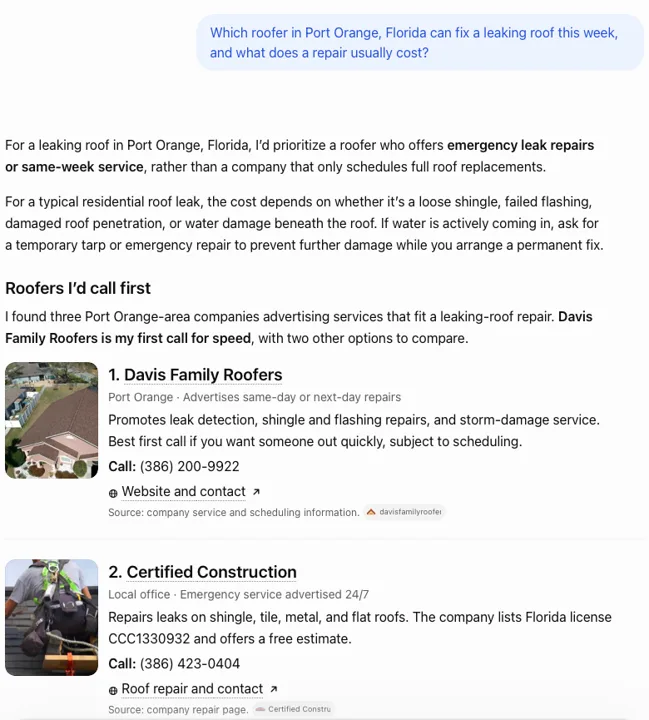
The real answer for the Port Orange leak question, cropped and untouched. It names Davis Family Roofers first and Certified Construction second, with a license number.
Davis Family Roofers is named first for "same-day or next-day repairs" with the exact jobs: leak detection, shingle and flashing repairs.
Certified Construction is second, and the AI repeats the Florida license number its own site lists. Facts only you can give get quoted.
The Ormond Beach leak answer opened with a price table: from about $150 to $400 for a small patch. Specific numbers come from specific pages.
Companies named in each answer, in the order each AI listed them. Logged-out ChatGPT and Google AI Mode through our own search data account, October 22, 2026, one run each.
What this means for you. Local roofers were named in every answer. The only franchise brand was SERVPRO, a restoration company, on two storm answers. No national roofing brand appeared. So a detailed local page still beats a famous name, and the storm question is where the AI also names companies that talk about insurance, which is the one place a roofer has to be careful about the rules.
An earlier check agrees. On October 1 and 5, 2026 we asked ChatGPT, Google AI and Claude for a plumber and an AC company in Richmond, Virginia and DeLand, Florida. Local companies led, and the big chains appeared only in Google's paid ads beside them.
What this does not prove. One run per question, one day, one state. AI answers change, so we re-check every month. It does not promise your result.
ChatGPT named companies from their own service pages and quoted their license numbers and emergency hours. Google's answers showed map-style listings with star ratings, and four of the nine also listed Angi or Yelp directories as sources.
So being named is not one trick. The AI reads what others say about you and what you say about yourself, and it prefers a page that answers the exact question. A listing alone is not enough, and neither is a website with one services page.
The AI reads listings, reviews and your own pages. We write the pages that answer the exact question.
Google showed ratings beside each roofer. Keep your profile accurate and consistent with your site.
Angi and Yelp appeared as sources. We do not buy leads there. We make sure your details match.
Emergency hours, free estimates and license numbers came from company sites. A page that fits the question gets used.
A page about a leak repair in Port Orange beats a general services page for that question.
You do not write or approve anything. Our AI agent, Ollie, does the research and the writing, our team checks it, and it goes live on your site.
You write nothing. We find the questions, write and publish the pages, then check every month.
We read your Search Console, your reviews and your competitors' pages, and list the jobs and towns where homeowners ask.
We ask ChatGPT and Google AI those questions, town by town, and save dated screenshots of who gets named.
One page per job and place: the price range, the process, the neighborhoods. Real facts about how you work, never filler.
Each page goes live with its FAQ and links to your related pages, then we load it to confirm.
We re-run the same questions and show you who is named now, next to last month.
Your name, logo and listings cleaned up so the AI reads one company.
Here is the shape of a page we would write for a roofing company. The details change for every job and town, but the parts do not.
The title is the question. Written the way a homeowner would type it, with the town in it. Not "Our Services" but "Roof Leak Repair in Port Orange: What It Costs and How Fast We Come."
The answer comes first. Price range, time and what changes the price, in two or three sentences, so the AI has a clean line to quote.
Then the proof. Facts a reader can check: your license, the equipment you use, the neighborhoods you work, a real job from last month with what it cost.
Then the questions that come next. A real FAQ: how long does it take, do you pull the permit, what does the warranty cover, is there an after-hours fee.
Then the paths. Links to the next page the homeowner needs: the replacement page, the town page, the emergency page.
If you run the business and do the jobs, you do not need a big website. You need the right pages: one for each job you really do and each town you really work. The AI cares about the answer on the page, not the size of the company behind it.
Ten honest job pages beat a long list of services.
Leak repair, replacement, tile, metal, inspections. Whatever pays your bills. One page each, with real price ranges.
Your name, your license, how long you have worked here, a real photo. The AI and the homeowner both look for a person.
A treatment you did last month in a real neighborhood, with what you found and what it cost. That is the page nobody else has.
Many roofing companies have one shop and crews that cover a wide area. The mistake is to copy one page twenty times with a different town name, or worse, to invent an office in each town. Google can suspend a listing for a fake address, and AI can tell a copy when it reads one.
A real town page says where your crews start, how fast you get there, what you have done in that town and what is different about working there.
Real town pages for the towns you really serve. Never a fake address, never a copy.
"Serving Port Orange from our Daytona Beach shop, about 15 minutes away." True, specific and useful.
Real jobs in that town: the older homes with aging shingles, the tile roofs near the coast.
Permit rules, the local climate, the age of the homes. Facts a copy cannot have.
One Google Business Profile can list many service areas. You do not need 15 profiles.
We check which towns the AI names you for and which it skips, and write the first three towns where you are missing.
About twenty pages at a time. We read Search Console between waves and stop to fix anything that is not working.
| Town | Homes Searching | AI Names You? | Order |
|---|---|---|---|
| Port Orange | High | No | Wave 1 |
| Ormond Beach | High | No | Wave 1 |
| Daytona Beach Shores | Medium | No | Wave 1 |
| Holly Hill | Medium | Sometimes | Wave 2 |
| South Daytona | Medium | Yes | Keep fresh |
When a company has twelve locations, the AI has to do two things: tell the branches apart and know they are one company. Most multi-location sites fail the first. Every branch page says the same thing, so the AI names none of them.
We write a page for each branch from that branch's own facts: its team, its jobs, its neighborhoods, its hours and its reviews. Brand rules live at the top. Local facts live at each location.
Same brand rules everywhere, different facts at every branch, rolled out in waves with one report for head office.
One company name, one logo, one set of rules, and a clear page for each location so the AI knows they belong together.
The team, the jobs, the neighborhoods and the hours of that branch. Copied pages are the trap, so none are made.
A Google profile and review story for each real location, kept consistent.
We start where the check shows the biggest gap, prove it, then scale to the rest.
Which towns the AI named this month, which it did not, with a dated screenshot per branch.
A single view for corporate or the franchisor: who is named where, and what changed since last month.
Good. Each manager can read their own pages and report. Nothing waits on them to write.
We work inside your brand rules and your approvals. Pages follow the rules you give.
Franchise rules and local facts both fit. We write per location, with the brand at the top.
Templates are why branch pages read the same. We keep your layout and replace the copy with real local facts.
| Branch | Named by ChatGPT | Named by Google AI | Since Last Month |
|---|---|---|---|
| Branch A | Yes | Yes | Same |
| Branch B | No | Yes | New in ChatGPT |
| Branch C | No | No | Pages live, watching |
| Branch D | Yes | No | Lost in Google, fixing |
You have probably been burned by marketing that takes a quarter to show anything. So here is the first week, and what you can see each day. You do not write or approve anything along the way.
Google usually takes a few weeks to show new pages, so the first week is about getting the right pages live and your starting answers saved. The monthly re-check is where you see whether the AI's answer has moved.
We do not promise a result, because AI answers change and no one controls them. What we can do is show you the math you will run in your head anyway. Put in what one job pays you.
Sample The starting numbers are an example. Type your own and watch it change.
If one extra job a month does not cover it, this is not for you, and we will say so on the call.
3 locations or towns x 1 extra job a month x $450 x 12 months.
Arithmetic only. We do not promise jobs. Use your own numbers.
In our check local roofers were named in every one of 18 answers. The only franchise brand was a restoration company on two storm answers. A detailed local page is how you get named beside it.
Ask any provider what it checks. We run the same questions every month in ChatGPT and Google AI and show dated screenshots of who was named.
Referrals ask AI too. When a neighbor says "call Mike," the next move is a search. Be the name that comes back.
The work is the same: real pages for real jobs and places. It scales from one truck to hundreds of locations.
You write nothing and approve nothing. Everything we publish is on your site and recorded in your account.
We cannot promise calls. The 90 day guarantee covers how often Google shows your site, and you keep every page either way.
These trade pages are being written next. Each one starts with its own check of what AI says in that trade.
Most home service companies already pay for something. Here is what each one does about AI answers, in plain terms.
| Option | What It Does | AI Answers |
|---|---|---|
| Lead sites (Angi, HomeAdvisor) | Sells you leads on their pages | Not your site, so not your name in the answer |
| Local Services Ads | Pays for a slot above the results | An ad beside the answer, not in it |
| A template website | Lists your services | Nothing specific for the AI to quote |
| An SEO agency | Reports, some posts, monthly calls | Sometimes, often not checked |
| RunOctopus | Writes, publishes and checks a page per job and place, every week | Checked monthly, screenshots shown |
Honest ranges, in plain words, near the top. For a leak repair, say what a small patch, a flashing repair and a larger repair usually cost and what changes the price, such as roof type, access and after-hours work. For a replacement, say what drives the total. ChatGPT gave ranges like these in the leak answers we read, and an AI can only quote a page that gives them.
We do not write claim solicitation, and we do not give insurance or legal advice. Florida limits how a roofer may advertise roof claims and what a roofer may say about coverage, so any page about storm damage stays informational: what to document, what a tarp is, and what a roofer can and cannot do. We suggest the client confirms current Florida rules with a licensed professional before anything goes live.
Experiences vary. Some contractors in public reports and blogs say shared leads are expensive and go to several companies at once. We can't speak for every roofer. A page on your own site is yours, and an AI can name it without a fee for each lead.
Many now ask ChatGPT or Google's AI who to call for a leak, a replacement or storm damage, and what it should cost. Each answer names a few companies, and the ones named get the first call.
In our October 22, 2026 check of three Florida towns, local roofers were named in all 18 answers. The only franchise brand that appeared was a restoration company in two of the storm answers. AI tends to name the businesses that detailed pages and other sources vouch for.
Yes. The work is one clear page per job and per town you really serve. One crew can be named as easily as a large company.
We write a different page for each branch, with its own team, jobs and neighborhoods, under one brand. Check your franchise agreement first, because some brands control the website. We start with the two or three locations where the check shows the biggest gap, then roll out in waves.
No, and you should never invent one. A real page for each town you serve says where your crews start and shows real jobs there. One Google profile can list many service areas.
No. We research the questions, write the pages in your voice, publish them and check them live. You can read everything, but nothing waits on you.
We cannot promise calls, because AI answers change week to week. We put the right pages on your site, check each month who the AI names and show you the dated screenshots, and refund you if your Google appearances are not up after 90 days.
Those sell you a slot on someone else's page. An AI answer names a few companies with reasons, and nobody sells that slot. Your pages stay on your own site whether or not you keep paying.
Access to your website and Google Search Console, the towns and branches you serve, your license number, and anything that makes you different. We look up the rest ourselves.
One honest note on size: on a Florida recruiting site we work on, a typical page earns well under one click a month at first, and half of all clicks came from 20 pages. The work is to build the pages that answer real questions well, and to check each month which ones the AI now trusts.
The pieces behind this page, in plain words.
How AI picks a local business, step by step.
What AI Search Visibility MeansThe idea behind being named in an answer.
Get Your Business on ChatGPTWhat to put on your site so ChatGPT can name you.
RunOctopus Compared with an SEO AgencySide by side, in plain terms.
A Case Study, Misses IncludedA recruiting site we write for, with every number and every miss.
RunOctopus for Home ServicesThe parent page: pest control, plumbing, HVAC, roofing and more.

We research the questions, write and publish the pages, check every one, and show you each month who the AI named. If your Google numbers are not up at 90 days, you get your money back and keep every page.
Click Here to Start with the Free Scan →How the 90-day promise works: we compare how often your site is shown in Google in the 90 days after your first page goes live against the 90 days before. It covers how often Google shows your site, not a particular ranking or a spot in a particular AI answer, because nobody can promise those. The price you start at is the price you keep, even when it goes up for new customers.
Type your website. The free scan shows what AI can and can't read, and which pages you're missing.
Run My Free Scan