Get your CRM named by ChatGPT and Google AI when small business owners ask which one to pick.
In 18 AI answers about CRM software, 17 put a price or a free plan on the tools they named, and the vendors' own pages were the sources. See the answers
Owners ask AI which CRM fits their business and what it costs for three people, and it names a short list with prices. RunOctopus writes and publishes the pages those answers draw from, then shows you each month who the AI named.
Run my free scanThe names ChatGPT and Google AI gave, in order. One run, one day. Both put Pipedrive first.
A business owner used to compare five CRMs in five tabs. Now many type one sentence: "what is the best CRM for a solo consultant that needs a free plan, email tracking and a simple sales pipeline?" The AI does not show ten results. It names a short list and prints a price and the free plan limits for each.
If you are on that list, the owner starts a trial. If you are not, they never hear about you. And the list is not only the biggest names: in our check Pipedrive, Zoho CRM, Bigin and local service tools were named beside HubSpot and Salesforce.
Owners get a short list, a price and the free plan caps. A clear page gets a smaller tool onto it.
Each answer named a handful of tools. The first few get the trial.
17 of 18 answers put a price or a free plan on the tools they named. A tool with no clear price page gets guessed at.
Owners ask what three people will cost. The AI does that sum from your per-seat price and free plan limits, so they have to be printed plainly.
What are some alternatives to Salesforce. Is there a free app like Jobber. What CRM is most like Follow Up Boss. People ask for an alternative by name.
Solo consultants ask about free plans. Sales teams ask about call logging and reminders. Local service businesses ask about texts and leads.
CRMs are not all built the same, and what gets you named is different for each. Pick the one that sounds like you. The rest of the page applies to all four.
You can be named at any size. A free CRM needs a clear limits page. A platform needs a page for each module and each kind of buyer.
Free for one to three users. The first questions are what the free plan caps and what it brands.
A small team on paid seats. The AI asks about call logging, reminders and the price for three.
Local service lead tracking with texts. The AI asks what texts and numbers cost.
Email, calls, texts and automation together. A longer decision, a bigger bill.
A owner who needs CRM software this week does not browse. They type one sentence, read one answer and try the first names. Everything we do aims at one step in between.
The AI does not know your product. It searches the way a owner would, reads the pages it finds (pricing pages, help pages, roundups, Reddit, reviews) and writes an answer from what those pages say. It leans on pages that answer the exact question: "what are good alternatives to Salesforce for a small sales team of three that wants a lower price per user and quick setup?"
That is the opening. A famous CRM has a famous name, but it may not have a page that answers a buyer's exact question about price for three seats. A smaller tool can. In our check ChatGPT named Bigin and Freshsales, each with a price or a limit from its own page.
Six things kept showing up in the tools that got named. None of them is "spend more on ads." All of them live on your own website.
One page per exact question, the price first, and the facts only you can give.
"Alternatives to Salesforce for a Small Sales Team" beats "Why Choose Us" every time.
Plans, the price for 1, 3 and 5 seats and what the free plan caps, in the first lines. The AI quotes that line, and works out the sum for your team.
Free plan limits, tier names, text message costs, pipelines and call logging by plan, in plain words.
Roundups, reviews and Reddit threads that name you. The AI trusts what others say about you.
The same tool name, plans and prices everywhere, so the AI is sure every mention is one product.
Prices change. A dated pricing page tells the AI and the owner you are paying attention.
Owners ask AI about CRM software in three ways, and each one needs a different page: which tool to shortlist, what it costs, and what to switch to. A site that only says "book a demo" is missing all three.
Sample These are real questions Google shows people about CRM software (checked October 25, 2026), and the kinds we build pages for. On your account, every question comes from your own Search Console, your sales calls and what owners in your market really ask, and you see the list before we check it.
People ask for a shortlist, a price and an alternative. Write for all three.
"What is the most user-friendly CRM?"
"What is the best CRM for solopreneurs?"
"What is the best CRM for a consultancy business?"
"What are the best CRM tools for sales?"
"What is the best job management software?"
"What are some alternatives to Salesforce?"
"What's a better CRM than Salesforce?"
"Is there a free app like Jobber?"
"What CRM is most like follow up boss?"
"Is Zoho CRM really free?"
"What is the cheapest CRM on the market?"
"Which Jobber subscription is best?"
Most CRM software sites have a home page, a features page and a blog. The questions above need a different set. In our check the AI quoted pricing and help pages and printed a price for almost every tool, so a page that states those plainly is a page it can use.
Each page below answers one question honestly, from public facts. None of them runs anyone down, and none of them invents a claim.
Pricing, comparison, alternatives, shop-type, switching and help pages. Each answers one exact question.
Every plan, the fee for each person, what texts and payments cost, what is extra. Worked out for 1, 3, 5 and 10 people.
You against the one tool owners weigh you against. Plans, limits and who each fits, from public facts.
"Alternatives to HubSpot for a Solo Consultant." The question people type when they are switching.
Solo consultants with a free plan, sales teams with call logging, local service businesses with texts. One page per kind of buyer.
How to move clients, services and card on file from the old tool, with what moves and what does not.
Seats, free plan caps, texts, pipelines. Plain, current and easy to quote.
Pick the kind of business, and for a sales team how many people need a seat. Every row works out the monthly price ChatGPT or Google AI printed for that tool. Free plans have user and contact caps, so a row that is free for two people can cost money for three.
Prices as printed on October 25, 2026, from the providers' own pages. They change. Not quotes, and not our prices.
The AI prints a bill for your seat count.
We asked both AIs about the same tools. In several cases they printed different prices for one product, and ChatGPT even gave two prices for one plan in two answers. A buyer who asks only one AI gets only one of those answers.
The AIs read the vendor's own pricing and help pages. When those pages leave a plan, a limit or a tier name unclear, the AI fills the gap on its own.
A page that states every plan, tier name and limit gives the AI nothing to guess.
One answer said $24 a user billed yearly. Another said $39 a user, or $117 monthly for three.
Called the Advanced tier $39 a user billed yearly. Essential is $14 to $24.
From $7 a user billed yearly. About $10 billed monthly.
A seat, frequently discounted to about $7 for new annual customers.
A month, for a local service business.
For the Grow plan with two-way texting, billed yearly.
A user billed yearly. $42 a month for three.
A user billed yearly, higher if paid monthly.
Up to 1,000 contacts, 3 email templates and 3 snippets.
One active pipeline, basic email tracking, HubSpot branding on emails.
Free forever, up to 5,000 records, exports limited to 10.
Free for up to 3 users with limited features.
One tool showed up in most answers, and 17 of 18 answers put a price or a free plan on the tools they named. Smaller and specialist tools were named in every answer, beside Salesforce.
One run per question, one day, three kinds of buyer. It is not a ranking and not permanent. A tool the question asked to replace is not counted.
Big names get repeated. A clear page on seats, free plans and texts gets a smaller tool named.
As a pick or a priced option: ChatGPT 6, Google AI 8. Pipedrive was named in 9, Zoho in 8, Jobber, Housecall Pro and GoHighLevel in 4 each.
ChatGPT in all 9 answers, Google AI in 8 of 9. Free plan limits were printed for HubSpot, Zoho CRM, Bigin, Freshsales and Capsule.
The sources were the vendors' own pages: hubspot.com, zoho.com, pipedrive.com, freshworks.com, bigin.com, gohighlevel.com and others. Reddit appeared four times.
Names ChatGPT and Google AI printed in these answers, as examples. Not a ranking, and not our clients.
The same cautions came up across all three kinds of buyer. A good pricing page answers these before the buyer has to ask.
Say what the free plan caps, what texts cost and what the tier is called.
Tick what your pricing page says today, in plain words a stranger can find. We show what the AIs did where a page was silent.
Sample A self-check, not a scan. Nothing you tick is sent anywhere. The free scan reads your real site.
Every silent line is a number the AI has to guess.
On October 25, 2026 we asked both AIs about CRM software for three kinds of buyer: a solo consultant who needs a free plan and email tracking, a three person sales team that needs call logging and reminders, and a local service business that needs lead tracking and text follow-ups. Each kind got three questions: the best one, alternatives to a big name, and what it costs. That is 18 answers, with the misses left in.
17 of 18 answers priced the tools. HubSpot was named in 14. Smaller and specialist tools were named too.
Tools named in each answer, in the order each AI listed them. The tool a question asked to replace is not counted. Logged-out ChatGPT and Google AI Mode through our own search data account, October 25, 2026, one run each.
What this means for you. The AI did not simply name one winner. It named tools by fit: a free plan tool for the solo consultant, a per-seat CRM for the sales team, a lead and text tool for the local service business, and it printed the free plan caps. A page that says clearly who you fit, what it costs for their seat count and what is capped is how a smaller tool gets named.
What this does not prove. One run per question, one day, three kinds of buyer out of many. AI answers change, so we re-check every month. It does not promise your result, and we have not yet run this for a CRM software client of our own.
The price question for each kind of owner, as ChatGPT answered it when logged out on October 25, 2026. Swipe on a phone, or use the arrows on a computer. Each answer opens with a price table before any advice.
Price first. Then the tools.
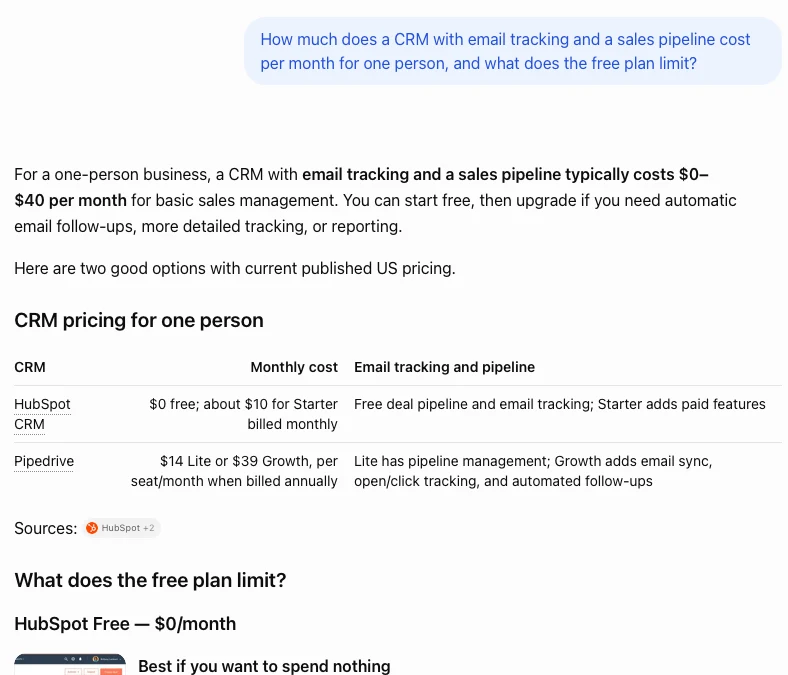
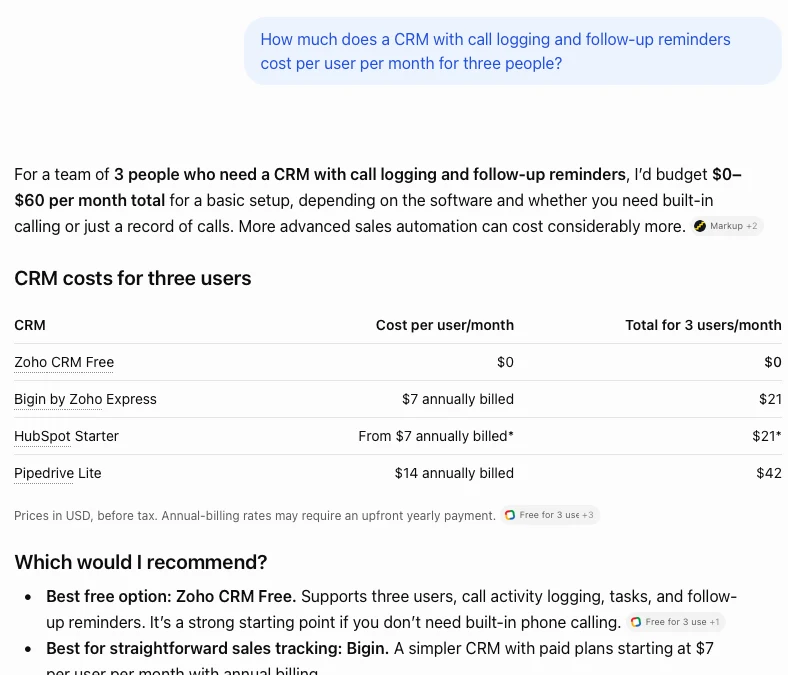
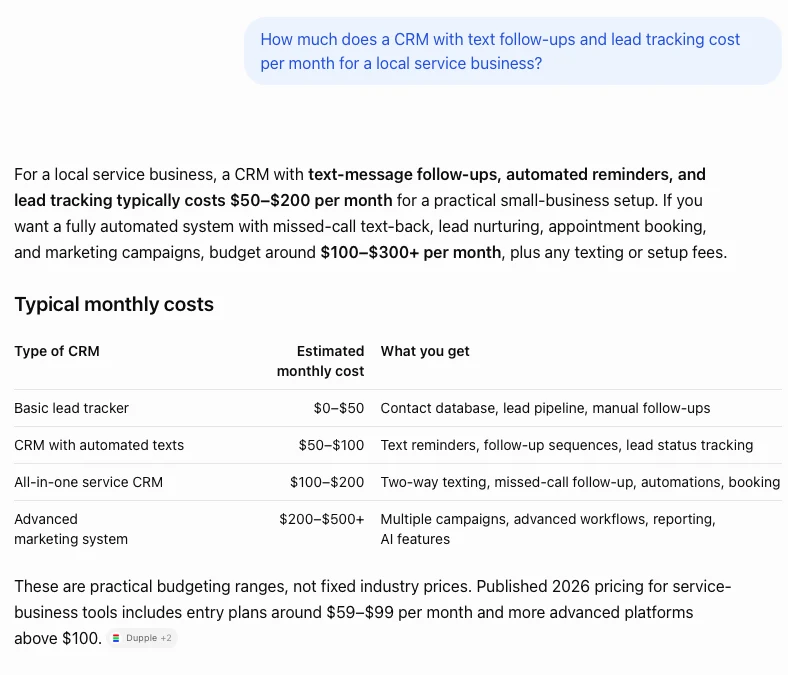
Real screenshots, cropped to the question and answer, nothing drawn on them. One run, one day.
ChatGPT linked the vendors' own sites in nearly every answer: hubspot.com four times, zoho.com four, pipedrive.com three, freshworks.com, bigin.com, gohighlevel.com, getjobber.com and housecallpro.com two each. Google's reference lists were mostly vendor sites (hubspot.com seven times, streak.com three) with Reddit four times. Neither engine named G2 or Capterra.
So the AI reads what the tool says about itself first. A listing alone is not enough, and neither is a site with one features page.
The AI reads your own pricing and help pages. We write the pages that answer the exact question.
ChatGPT linked vendor pricing and feature pages in nearly every answer. A page that fits the question gets used.
A few answers cited roundup and comparison sites. We do not write or buy them. We make sure your details match.
Google listed Reddit four times. We do not post for you. We write pages that answer the same questions clearly.
Small tool sites and YouTube walkthroughs were also cited. Clear, current help pages get quoted.
You do not write or approve anything. Our AI agent, Ollie, does the research and the writing, our team checks it, and it goes live on your site.
You write nothing. We find the questions, write and publish the pages, then check every month.
We read your Search Console, your plans and pricing, your competitors' pages and what owners ask, and list the questions where you should be named.
We ask ChatGPT and Google AI those questions and save dated screenshots of who gets named, and what price they print for you.
One page per question: the fit, the price, the limits. Real facts about your product, never filler.
Each page goes live with its FAQ and links to your related pages, then we load it to confirm.
We re-run the same questions and show you who is named now, next to last month.
Your product name, plans and prices made consistent so the AI reads one product, and prints one price.
Here is the shape of a pricing page we would write for a CRM. The details change for every question, but the parts do not.
The title is the question. Written the way a owner would type it. Not "Pricing" but "What a CRM Costs for a Sales Team of Three: Seats, Free Plan Caps and What Is Extra"
The answer comes first. The price, who it fits and what you give up, in two or three sentences, so the AI has a clean line to quote.
Then the proof. Facts a reader can check: plans, limits, fees, payment rates, and a real customer if they agree.
Then the questions that come next. A real FAQ: what does the free plan cap, are texts included, what does a third seat cost.
Then the paths. Links to the next page the owner needs: the comparison, the switching guide, the help page.
You have probably been burned by marketing that takes a quarter to show anything. So here is the first week, and what you can see each day. You do not write or approve anything along the way.
Google usually takes a few weeks to show new pages, so the first week is about getting the right pages live and your starting answers saved. The monthly re-check is where you see whether the AI's answer has moved.
Keep it. It is the foundation. The AI answer is built from pricing, comparison, alternatives and shop-type pages that answer one exact question. We write those and check each month who the AI names.
In our check HubSpot was named in 14 of 18 answers. Pipedrive was named in 9 and Zoho in 8, and Bigin, Freshsales and local service tools were named too, each with a price or a limit from its own page.
The AI cares whether a page answers the question and whether others vouch for you. A clear pricing page and three honest comparisons are a start.
Neither do we. Comparison pages use public facts only: plans, limits, fees. If we cannot source it, it stays out.
Many now do, before they open a pricing page. We check your category first and tell you plainly if the AI is not where your owners look.
We cannot promise signups. The 90 day guarantee covers how often Google shows your site, and you keep every page either way.
Each page starts with its own check of what AI says in that field.
Most CRM software companies already pay for something. Here is what each one does about AI answers, in plain terms.
| Option | What It Does | AI Answers |
|---|---|---|
| Review sites (G2, Capterra) | Collect reviews and sell placement on their pages | Neither was named in our 18 answers |
| Paid search and social | Pays for a slot beside the results | An ad beside the answer, not in it |
| A content and SEO team | Blog posts, rankings, reports | Helps, often not built for the AI's exact question |
| A GEO or AEO audit | A report on where you stand | A report, not pages |
| RunOctopus | Writes, publishes and checks a page per owner question, every week | Checked monthly, screenshots shown |
Many now ask ChatGPT or Google's AI which CRM fits their business and what it costs. In our check of 18 answers, 17 put a price or a free plan on the tools they named.
HubSpot was named in 14 of 18 answers and Salesforce in 1. Pipedrive, Zoho CRM, Bigin, Freshsales and local service tools such as GoHighLevel, Jobber and Housecall Pro were named too. A clear page for the exact question is how a smaller tool gets named.
Yes, and it is the point. ChatGPT gave Pipedrive Growth at $24 in one answer and $39 in another, and Jobber at $70 to $105 while Google AI said $149 and up. A page that states every tier name, price and limit, with a date, keeps the AI from guessing.
They matter to buyers. In our 18 answers the AI named neither. It leaned on the tools' own pricing and help pages. We do not buy placements on review sites or write reviews.
We write honest comparison and alternatives pages from public facts: plans, limits, seat and text rules. We do not run anyone down and we never invent a claim. If we cannot source it, it stays out.
Yes. The AI picks tools by fit. A local service CRM can answer lead tracking, text follow-ups and missed-call text-back. We write a page set per kind of buyer.
Free plans were named in every kind of answer, with their limits. A page that states the user and contact caps plainly is a page the AI can quote.
No. We research the questions, write the pages, publish them and check them live. You can read everything, but nothing waits on you.
We cannot promise signups, because AI answers change week to week. We put the right pages on your site, check each month who the AI names and show you dated screenshots, and refund you if your Google appearances are not up after 90 days.
Many sell an audit and a monthly report. We write and publish the pages and re-check every month. Ask any provider to show you what it actually shipped and the dated answers before and after.
Access to your website or CMS and Search Console, your plans and pricing, the kinds of buyers you serve, and anything that makes you different. We look up the rest ourselves.
One honest note: we have not yet worked with a CRM software company, so the proof on this page is the check of 18 answers, not a client result. On a Florida recruiting site we do work on, a typical page earns well under one click a month at first, and half of all clicks came from 20 pages. The work is to build the pages that answer real questions well, and to check each month which ones the AI now trusts.
The pieces behind this page, in plain words.
The wider check, with a price picker for invoicing, booking and help desk.
What AI Search Visibility MeansThe idea behind being named in an answer.
Get Your Business on ChatGPTWhat to put on your site so ChatGPT can name you.
RunOctopus Compared with an SEO AgencySide by side, in plain terms.
A Case Study, Misses IncludedA recruiting site we write for, with every number and every miss.
RunOctopus for Home ServicesThe same check for the trades, with its own numbers.

We research the questions, write and publish the pages, check every one, and show you each month who the AI named. If your Google numbers are not up at 90 days, you get your money back and keep every page.
Click Here to Start with the Free Scan →How the 90-day promise works: we compare how often your site is shown in Google in the 90 days after your first page goes live against the 90 days before. It covers how often Google shows your site, not a particular ranking or a spot in a particular AI answer, because nobody can promise those. The price you start at is the price you keep, even when it goes up for new customers.
Type your website. The free scan shows what AI can and can't read, and which pages you're missing.
Run My Free Scan